
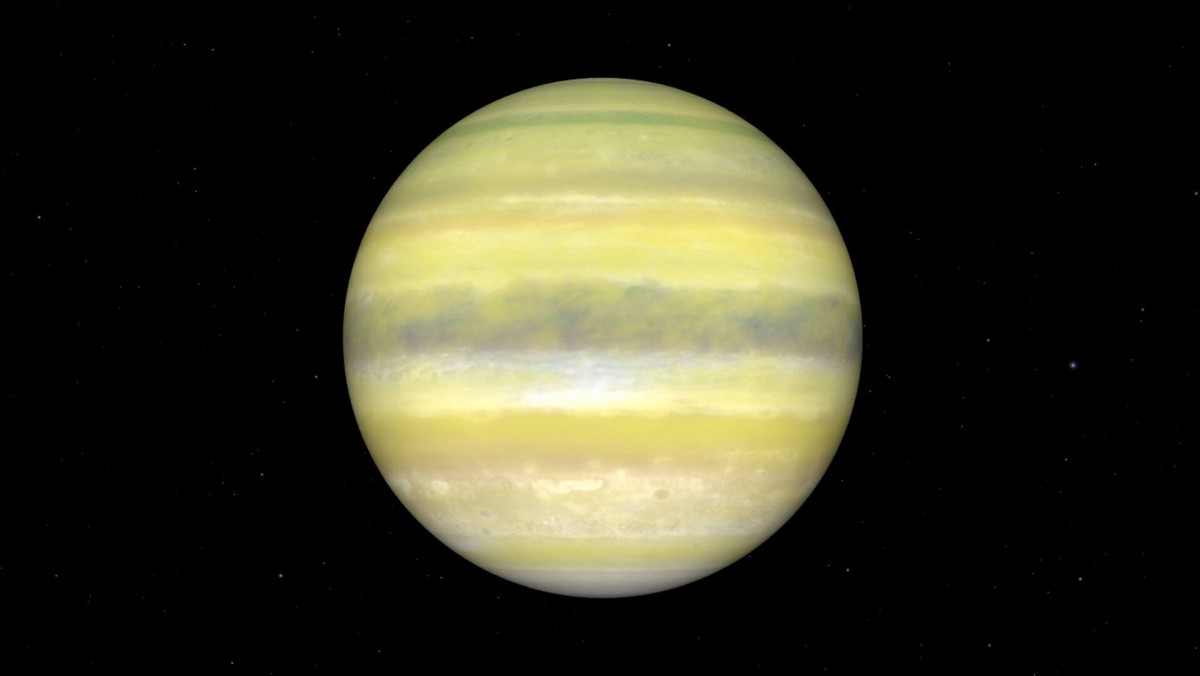
The haze veiling LP 791-18 c is likely created through photochemistry, where ultraviolet radiation from the planet’s active red-dwarf star breaks apart methane molecules high in the planet’s atmosphere. The fragments recombine into heavier hydrocarbons. This same process gives Saturn’s moon Titan its orange smog.
This photochemical haze can block or mute the molecular “fingerprints” that astronomers rely on to decode a planet’s atmosphere. Yet even with this veil, JWST was able to identify methane clearly and place constraints on what is missing.
Another important result: the team demonstrated that the spectrum remains consistent regardless of whether stellar activity is included in the analysis or not. That means the unusual atmospheric chemistry is not an illusion caused by star spots or flares — a rampant issue in recent exoplanet atmosphere studies — but is intrinsic to the planet.
“Webb gives us a clean, direct look,” explains Prof. Björn Benneke (UCLA/UdeM), co-author and Pierre-Alexis Roy’s Ph.D. supervisor. “Even when we account for all the ways the star might influence the signal, the atmospheric picture stays the same. LP 791-18 c genuinely shows these abundant hazes and that strong methane absorption band.”
A clue to where the planet was born
If planets with the same size and temperature can have radically different atmospheres, the obvious question is why? The answer may lie billions of years in the past.
The chemical fingerprint of LP 791-18 c, rich in methane yet depleted in oxygen-bearing molecules, suggests it formed inside the protoplanetary disk’s water-ice line, the region close to the star where temperatures are too warm for icy grains to survive. Planets forming farther out tend to incorporate more water and volatile ices, leading to CO₂- and H₂O-rich atmospheres like those found on K2-18 b and TOI-270 d.
By contrast, LP 791-18 c appears to have been built from drier, carbon-rich material. Such a fundamental difference can leave a lasting imprint on the planet’s composition.
“This is the strongest evidence yet that formation history and evolution, not just temperature or size, shape the atmospheres of sub-Neptunes,” says Roy. “Two planets can look identical from afar, but their chemistry can reveal completely different origins.”
The study highlights how JWST is enabling “comparative planetology” at a level that was impossible before: identical-looking planets can now be distinguished by their deepest atmospheric traits.
“We know that the atmospheres of small terrestrial planets show an intrinsic diversity,” states Roy. “One simply has to consider Earth and Venus, which despite forming together in the habitable zone of the Sun, host drastically different atmospheres. But here, we are starting to observe such a diversity for gaseous sub-Neptunes as well.”
A miniature planetary system full of surprises
LP 791-18 c orbits within a compact, dynamic planetary system that has already captivated astronomers. In 2023, another UdeM-led team revealed that the system’s inner terrestrial planet LP 791-18 d likely experiences intense volcanic activity triggered by gravitational interactions, making it one of the best candidates for a volcano world outside the Solar System.
Now, with LP 791-18 c showing an entirely different form of atmospheric complexity, the system has become a showcase for the diversity of planets orbiting small stars.
“You’ve got a volcanic Earth-sized planet and a hazy methane-rich sub-Neptune in the same system,” notes Benneke. “It really underscores how wildly diverse planets can be, even when they form around the same star.”