
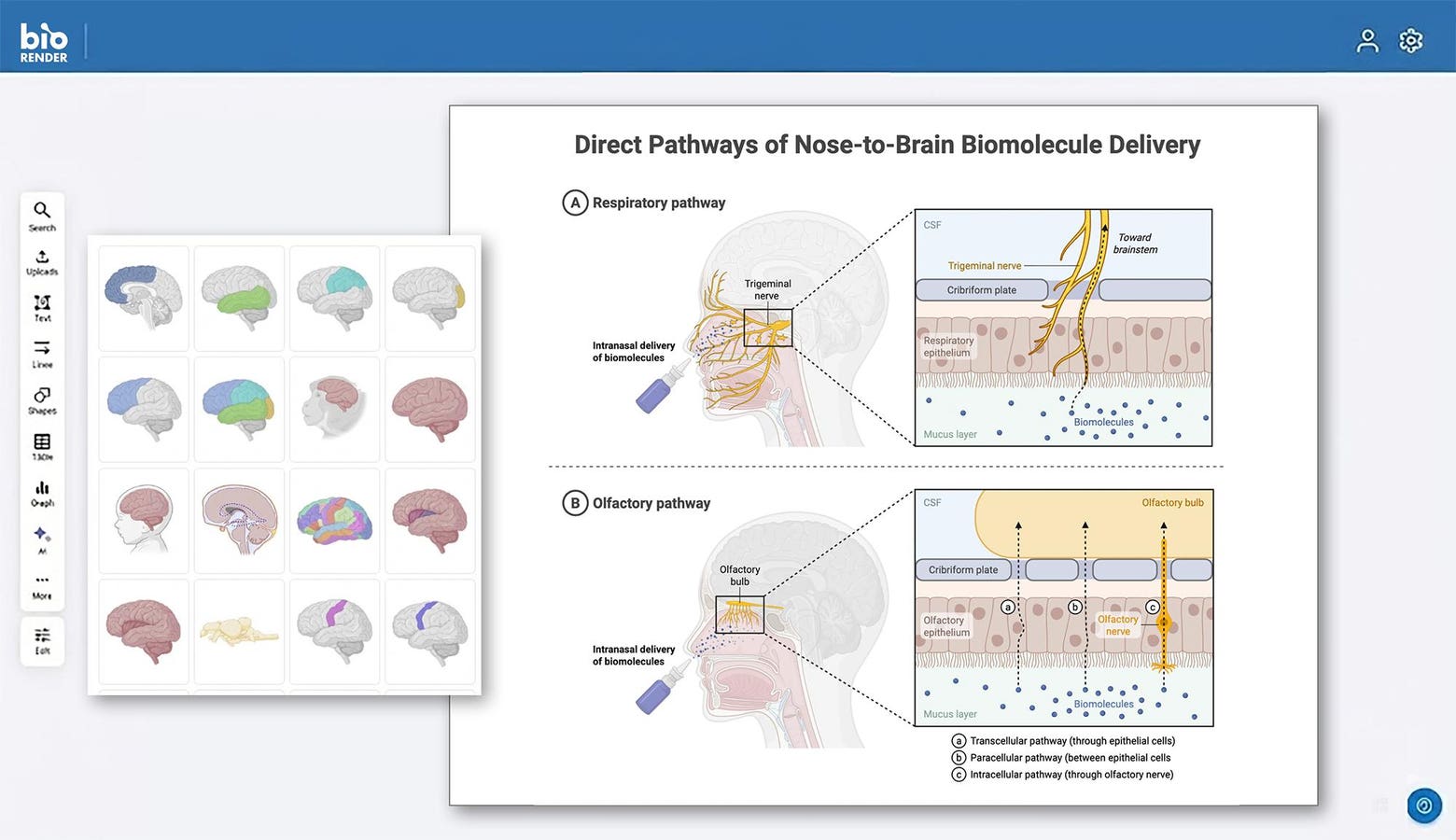
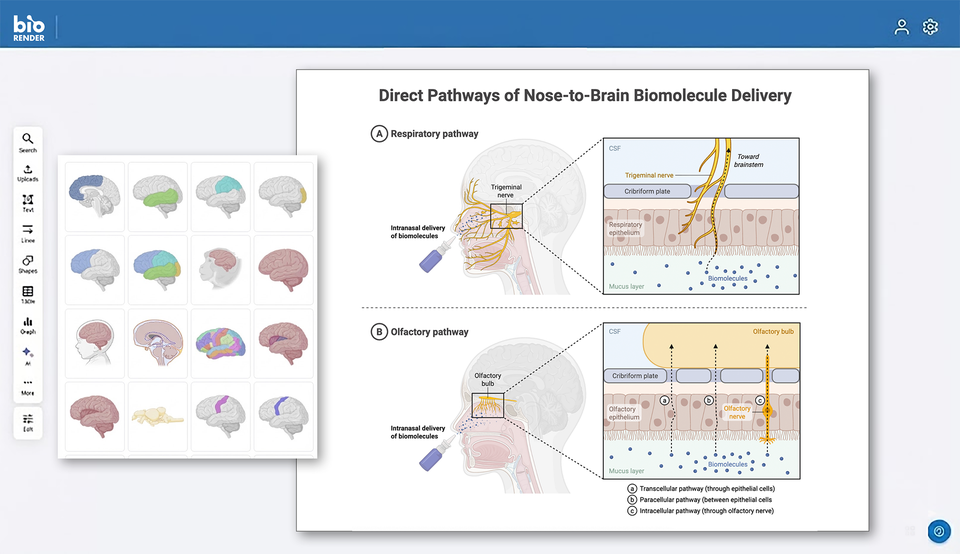
BioRender provides a rich set of tools for creating highly accurate images from biology. The tools provide a visual language to support AI in the biological domain.
BioRender
Notation and diagrams are essential elements of scientific communication. And while much of modern mathematical science has benefited from the development of standard tools for typesetting and image generation, when it comes to biology, even Nobel laureates still give talks with visuals that have bits and pieces grabbed from tools like MS Paint, scaled badly, misaligned, and often scientifically ambiguous. BioRender, led by CEO and cofounder Shiz Aoki, endeavors to remedy this situation.
Initially envisioned as a kind of “Canva for science,” with a library of professionally drawn biology icons and templates, the company has found itself creating a standard visual language for biology, with standards for how different elements should be displayed. Aoki has described this as building both the “Word processor” and the “Times New Roman font” of biology simultaneously. Aside from being crucially useful for practicing scientists, this approach also turns out to be exactly the sort of foundation AI needs.
BioRender: Millions Of Diagrams, Millions Of Corrections
Almost four million scientists have registered accounts on BioRender, with several hundred thousand using it regularly. They come from universities, pharma companies, biotech startups, hospitals and classrooms. Many publish their BioRender diagrams openly for others to reuse and adapt. Some of those contributors are leading virologists, immunologists, and other specialists whose lecture slides and explanatory figures have been rebuilt entirely in BioRender and shared back to the community.
This has made BioRender look less like a static design app and more like a GitHub-style ecosystem for science visuals. Diagrams are copied, remixed, improved, and crucially, corrected. If a protein is drawn in the wrong place or a minor anatomical feature is off, someone in that four-million-strong community is likely to notice and flag it. BioRender has quietly accumulated a curated, constantly updated, expert-reviewed dataset of how biology should be drawn. For any AI system seeking to move beyond generic clip art toward true scientific communication, that dataset is essential.
BioRender: Ensuring Accuracy And Semantic Coherence
Anyone who has experimented with image generators will have seen both their magic and their blind spots. Ask a system for “cells attacking a virus” and the result will likely be dramatic and colorful. Ask for a specific signaling pathway or surgical procedure and the cracks appear. Arrows point the wrong way. Molecules that should bind drift apart. Components that should be distinct blur into one another.
BioRender’s team tests these models regularly. Even with the latest “nano-banana”-scale tools, subtle but important errors still creep into diagrams. These are aspects that a non-expert might miss but a scientist notices immediately. While one would never accept “almost right” equations in a math textbook, “almost right” diagrams still appear routinely in biology papers, presentations and educational resources.
BioRendr provides accuracy, uniformity, and structural coherence to diagrams that otherwise are at best an artist’s conception.
BioRender
The stakes are not merely academic. In patient-facing materials, a slightly misleading syringe graphic can nudge a nurse toward misreading a dose. In research journals, manipulated or recycled images have become a major source of retractions. In classrooms, a muddled diagram can cement misconceptions that take years to unwind.
BioRender And The Classroom Flywheel
Education use cases are already driving visible behavior on the platform. BioRender periodically sees bursts of 300–400 new sign-ups within hours. Internal data and teacher feedback often trace those spikes to a simple assignment pattern: an instructor shows a diagram, removes the labels, and asks students to log in, fill in the blanks, and submit the completed figure. This conversion of passive assets into active learning tools aligns with patterns observed in other AI-enabled educational tools.
With AI in the mix, the evolution steps become straightforward: automatically generate quizzes from any diagram, analyze where students mislabel or mis-sequence steps, and generate targeted remedial visuals that address those misconceptions directly. Technically, this is an integration challenge more than a conceptual one; the underlying visual assets and usage patterns already exist, it is just an operational matter to make these easy to deploy in the intended use case.
BioRender: From Static Figures To Dynamic Science Stories
As BioRender incorporates AI capabilities, the types of diagrams and visuals that can be produced has been evolving. Some examples are given by AI-assisted protocols and timeline generators. A scientist can type “draw an ELISA protocol in five steps,” and BioRender assembles a clean sequence using vetted icons, with numbered callouts and consistent styling. Another feature allows users to describe a custom object, such as a particular piece of lab equipment, and have the system draft an icon in the BioRender house style.
Aoki compares scientific presentations to narratives with a kind of “Disney story arc.” You might begin with normal anatomy; introduce a mutation or insult; watch disease emerge; show the intervention; and end with restored health, perhaps accompanied by a photograph of a smiling patient or elderly couple.
Once that pattern is recognized, much of it can be templated and made readily available for future use. BioRender’s longer-term ambition is to accept inputs such as audience, time available and key findings, then generate not just a single figure but an entire visual narrative: a sequence of diagrams, each accurate, visually consistent and pitched at the right level for its viewers.
Looking ahead, the same components could power event richer formats:
A single slide that allows zooming from organ to tissue to cell to molecular pathway.Diagrams that expand into short animations with a click.Explanatory videos spun up from the same underlying assets, tuned separately for patients, regulators, specialists and students.
BioRender’s roadmap fits squarely into a world where accurate scientific visuals can be instantly reconfigured as slides, handouts, interactive modules or videos without redrawing everything from scratch.
BioRender Is The Visual Layer For Biological Science
Across the AI ecosystem, teams are racing to build models that can “do biology,” such as suggesting experiments, summarizing papers, and even designing molecules. But at some point, those models must communicate what they “think” in a form humans can understand and trust. And this almost always involves pictures.
Today, most of those images are either produced by overworked scientists using generic tools or generated by models with limited understanding of the underlying science. Neither approach scales well.
With a vast, standardized library of biological components, a large, active base of domain experts who continuously correct and improve visuals, and a growing set of AI features that treat diagrams as structured, interpretable objects rather than flat images, BioRender can offer a better path forward.
When looking at emerging AI tools a consistent pattern emerges: the most transformative AI products tend to become infrastructure that other systems quietly depend on, rather than flashy standalone apps. Beneath its clean icons and polished diagrams, BioRender has the potential to emerge as a consistent visual language for science. If this happens, BioRender may find that is has become the visual layer that other AI systems call when they need to “show their work.”