
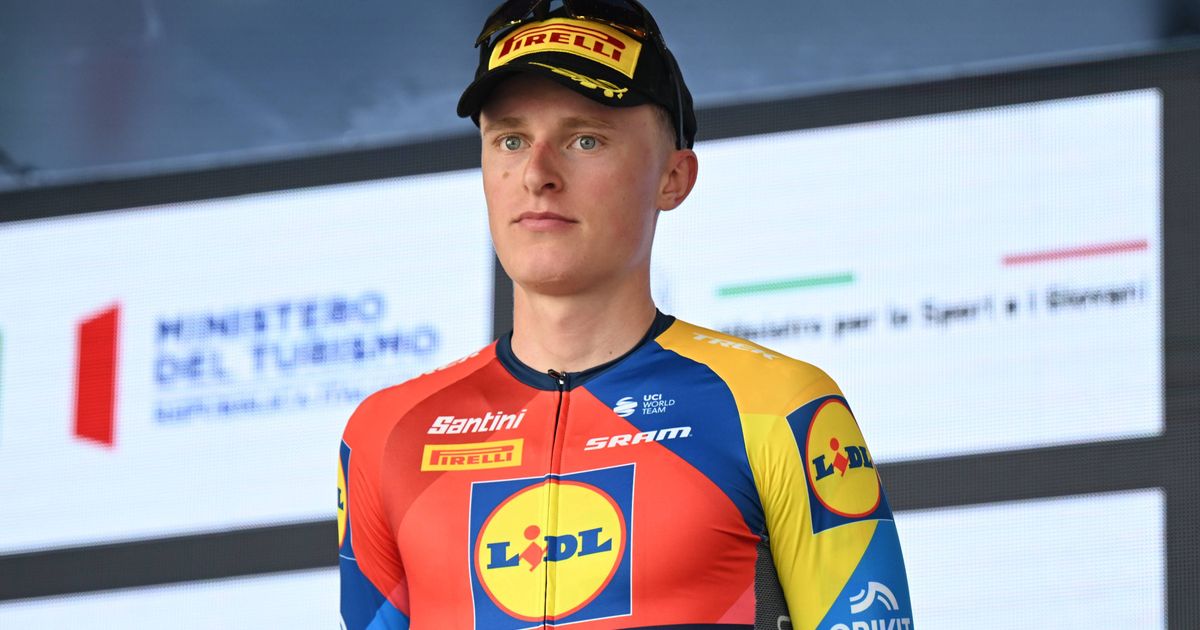
There is a lot the team can expect of the Dane, yet another who fills its ranks with tons of talent. However managing such a talented rider is no easy task, specially when tough decisions have to be made to forego some goals or big races.
You turned pro in 2025 with a lot of great rersults but a lot of results in different kind of terrains. What kind of rider are you?
I don’t think I want to specify what kind of rider I am so far. I really enjoy being able to do a bit of everything, a bit of the classics, climbing races, cobbled races, gravel races, a little bit of everything. I think it’s quite interesting and good for my development. So far I’m riding all these different kinds of races, so far I like which kind of rider I am as an all-rounder and in the future I can specify a bit more.
It was only my first year and hopefully I have a long career ahead of me, so I see no reason to rush anything or try to make any fast decisions. I’ll just take it how it comes.
Which one was the most fun at this point of your career? What do you like the most?
I would say the hard one, the race. It’s something like Strade, I really, really enjoyed it. I think that’s what I enjoy the most when I’m riding.
But it could be like, for example, in a few years, stage racing would suit you better than you could eventually be a stage racer, for example?
Yeah, for sure. Maybe I develop that direction in a few years, we’ll see. And maybe I’ll come back to the classics and only want to do the hard races.
What are your plans for the coming season? Which types of races are you looking to race?
I’ll definitely get a bit more experience with the spring classics. So I think I’ll be in the group for the cobbled classics in the start of the year mainly to help and to gain the experience. And for the rest of the season, I’ll do a bit like I did this year with some different kind of terrains and races.
So no Flanders or Roubaix in mind?
Still a bit uncertain. There is an opening that maybe it’s possible to do the Vuelta, but there’s no decision made right now. It’s something me and the team have to think about when we get a bit further into the year and see if I’m ready for it.
I presume you’re going to help Mads in the classics. What can you learn from him? Because he’s one of the best classics riders in the world.
I think there’s so much to learn from Mads. As you said, he’s one of the best classics riders in the peloton. He has such a presence and so much experience. So I think it’s unlimited how many things I can learn from him.
People have been talking about you since you were 16. How did you get used to that so young? Because most people don’t become inspired until they’re 21 or 22. But you had to deal with that when you were still at school. How was that, just to learn that people knew you and expected you to win?
Of course it was a different world of cycling that I didn’t experience before but I think from quite a young age I’ve been putting a lot of pressure on myself already. So having the pressure from the outside was not a big surprise to me. So I think I quite quickly got used to handling it.
How was that when you were in school and you were just Albert to all your friends? But then there’s 10,000 people who know you.
It’s a bit weird in some way. But we’re all still humans and I’m still the same person that I was before. Nobody knew my name.
Is there one rider on the team who you sleep with most? Or who you look to for advice?
I would definitely say Mads is the one I was looking to if I needed advice on anything. He’s such a good leader and he has a really good balance with how he deals with the cycling world. So I think he’s a good example of what could be nice to be in the future.
Sometimes you interview these super devils like yourself at your age. I want to be world champion, I want to win one day, one time. You seem more modest. Is that something that’s in your characteristics or you don’t like to talk big?
I think I would prefer to show in the races than to speak about it in interviews. And I don’t really have a rush with anything. So maybe I do a big result next year, maybe it takes three more years. But I think if I carry on with my development, the results will come in the future.
What do you guys in Denmark eat nowadays? Because you have big stars from Denmark. Normally when they were good in the under-19’s and 23’s, that was the limit. But it seems like in the last ten years, there’s something in the ground in Denmark that produces stock now.
I think it’s mainly because there are so many fast riders in Denmark that we kind of develop each other. The level is so high from such a young age. And the competition is pretty crazy. So I think this pushes everybody to get better. And then you’ll always be a little bit in front of everybody else.
You also have this multi-discipline approach. Do you think that in the future, like you said in the beginning with all the terrains and road cycling, do you think that, for example, like what Pidcock does, that it’s also a possibility for you to combine all those disciplines?
Yeah, for sure. I would say, at least in the coming years, I would like to do road cycling and mountain biking. Now I don’t do any more cyclocross, but those two disciplines I would like to combine. I have a bit of a dream of going to the Olympics on a mountain bike in 2028. So I think with the team, we’re trying to make a timeline that goes until then between two disciplines. And then we can reevaluate after that. So far, I just enjoy doing both disciplines. But if it comes to a point where there’s no enjoyment in it anymore, then I will stop on the mountain bike and only do road.
Because the road is the future.
For sure, the road is the main discipline for me. It’s where I want to be the best rider in the future.
How did you start having an interest in cycling? How did it all come about?
I think I started riding on the mountain bike when I was five, because my brother started. And then I did mountain biking from then until I was 14, 15 and got my first road bike there. And then I didn’t think I was going to do so much on the road. I was just doing it for training. And then when I was 17, I did a few races on the road, but didn’t really think about it. It was actually first when I won the world championships in junior that I decided, okay, now I start to focus more on the road.
Did it come from a traditional cycling family or something like that?
My dad was cycling a bit both mountain bike and road. But it’s not like a professional level or anything. But I would say we were probably a cycling family, because most of us was riding a bike.
You talked about the pressure before, that you’re such a young guy, and then you suddenly stand on the podium with Pogacar (Tre Valli Varesine, ed.). Has that experience made you feel more pressure that you suddenly make these big results among the greatest riders in the world?
No, I don’t think so. I think it doesn’t change so much. Maybe there’s a bit more expectations from the outside, but it’s not really because I put more pressure on myself, just because I achieved some of these results in the end of the season. I think it was a super nice confidence boost and definitely something I can carry into next year. I think it will be super good for my racing to have achieved these goals and have ridden these finals, but it’s not because I feel like it makes a huge difference in the pressure.
What do you think of the cycling world calls a rider like you a super-talent when you’re only 19 years old?
I don’t think so. I think it’s not because I don’t read every interview that comes out about me. I just try to be myself and not think so much about what everyone else wants me to be, but more what I want to be myself.
We spoke recently with Paul Seixas. He says, I really enjoyed these battles with Albert during the previous [age] categories and I really see him as a possible competitor in the Grand Tours later on. How do you comment on that, that he sees you like that?
Yeah, me and Paul had some super nice battles in junior. He was really, really strong and a nice competitor. I think we maybe went into two different directions a bit this year. He developed more into a GC rider and I developed more into a one-day racer, but I think for sure we will meet a couple of times in the coming years and it’s going to be a good battle.
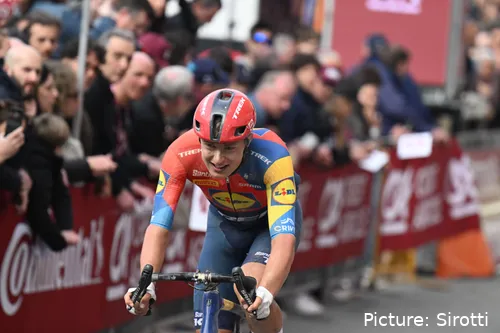
Philipsen rode Strade Bianche in his first year as a pro. @Sirotti
You smile when you talk about it, so some good memories.
It was a super nice competitor to have. I think all battles were really fair and I like him as a person. I think he’s a nice guy. He was just the strongest guy who was winning and I like that.
When we have in cycling now the established order with Pogacar, Van der Poel, even the big names, what does it take for you to try to reach that level? What do you need in the coming years to develop? Perhaps because everybody thinks you can do that. What do you think you need to become the main guy in time?
I definitely hope to be one of these names in the future. Maybe it’s in two years, maybe it’s in five. I think I need to have a bit of patience and not rush anything. Just see how my development goes and take it from there.
All those guys performed also for the fans great battles the last few years. Cycling is very fun to watch. Is that something you also want to achieve as a pro athlete? Or do you want to give a show to all the fans to keep the cycling community having fun watching the race?
Of course I think it makes cycling a lot more enjoyable to watch when you have these big rivalries. It’s for sure something I would like to in the future be able to give back to the sport. Also watching cycling as a kid, it was super nice to see some of these battles. It would be really cool to be able to create them.
Which battle do you specifically remember?
I knew this would come, but I don’t remember specifically.
Is there a race that was… If you ask me, the Amstel Gold Race 2019, was that a complete outcome nobody expected?
To be honest, it was not because I was watching a lot of road cycling when I was younger. I was more watching mountain biking. It’s not because I can pinpoint a lot of crazy races I’ve watched. It was more in the last few years that I’ve really been looking more into the road cycling.
Did you have any idols in mountain biking or on the road?
I think Nino Schurter was the idol in mountain biking. He was the biggest and best rider probably there’s ever been, in my opinion. Of course, some current riders I still go to, like Mathieu [van der Poel], Pogi (Tadej Pogacar, ed.) or someone like this. It’s definitely something I strive to be in the future.
Mathieu has a lot of difficulties nowadays when it comes to mountain biking. He doesn’t perform like he wants to be. Do you think it’s still possible to combine these two disciplines in the future? Do you want to do that?
I think it’s possible, but I think it takes more energy than it did five years ago. I think it’s more difficult. Everything is also getting optimized now in mountain biking. Everybody is at such a high level that it’s a bit naive to think that you can just jump on the bike and really perform. I think this is also a mistake I made myself this year: Not putting in enough effort to really perform. This resulted in just getting injured or crashing or doing something else stupid. I think it’s still possible, but you need some more specific work. You need to really make a smart plan on how to do it.
For example, the World Championships next year. Mountain biking, do you want to ride it? Do you have an ambition for that?
I don’t know what, actually. I don’t think so.
When you want to do that, you have to make time, like a month or something, to only focus on mountain biking.
That would definitely make the chances of getting a good result better. I think next year I will probably only do some World Cups, maybe some national races if I have time. And just do it to keep the feeling of the sport and of the bike. And then in 2027 maybe I can go to the World Championships if it fits in my program. 28 now, let’s see if it’s possible to go to the Olympic Games.
Mathieu always says that the adjustment from road bike to mountain bike is the most difficult for him. Can you perhaps explain why?
I think there is so much technique involved in mountain biking. Everybody is also riding so fast now that it’s not because you can just be the strongest and then expect to win. You can really lose the race by not being technically good enough. So I would agree with that, that it’s quite a hard change from the road to mountain biking. Also the way of the racing is quite different. It’s one and a half hours full gas, but it’s also quite anaerobic. It’s like doing one minute full gas and then trying to recover while going down a super technical descent. So if you cannot combine these things, it’s impossible to improve yourself.
Last year you started in Tour Down Under, what will your program be like? We know that you are going to do more classics like street classics. What’s your program for the first month?
It’s still not 100% confirmed, but I definitely don’t go to Australia this year or next year. But I think I will start my season quite early, maybe at the end of January or at the start of February. Which is Mallorca.
And opening weekend also?
Yes.
In the summer it seemed like you made some adjustments to improve so much to the autumn. What did you do during the summer that made you take one more step?
It’s hard to say specifically what made a big difference. To be honest I think the biggest change was finally having a bit more time. Just to relax and to train and get a bit more consistency in what I was doing. I think jumping from juniors to world tour is a really big step and it creates a lot of stress. Also with all the travelling and more races and stuff like this. So I was getting sick quite a lot after the big races. I think at the end of the season I was finally feeling a bit more comfortable in this new environment. And also feeling more confident than before. And I think this was probably the biggest change from the first part of the year to the end.