
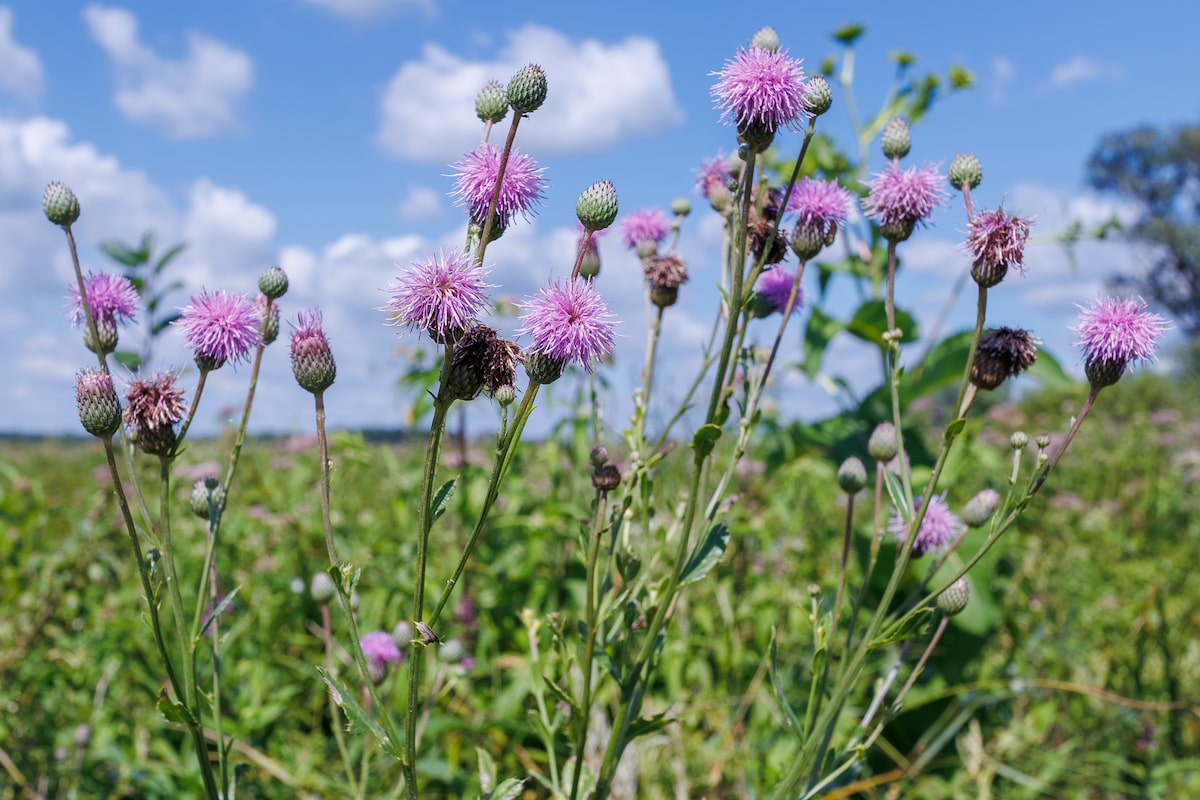
One of the earliest invasive species identified in North America is creeping thistle. Native to Europe, Africa and Asia, the plant is also known by the misleading name ‘Canada thistle’.Getty Images
Caitlin Stall-Paquet is a Montreal-based writer and editor.
Mount Royal Park – the Mountain by its local name – is more of a glorified knoll, but it remains Montreal’s crown jewel, its lungs and heart.
It bears the pressure of greeting some five million annual visitors, but another source of ecological stress are invasives. These non-native species (plants, animals, fungi, microbes and humans, depending on who you ask) bend ecosystems to their will, much like the colonizers who introduced plenty of them. European views of superiority in the 17th and 18th centuries came with a slew of imported plants, altering landscapes in a way that reflected anxieties about dominating new spaces and the people in them.
On an unseasonably hot day in September, 2024, I volunteered with Les Amis de La Montagne for the first time, a non-profit that hosts invasive species management activities in the 10-square-kilometre park.
The environmental stewardship program and volunteer activities lead at Les Amis de la Montagne, Benjamin Pilon, gave us a quick run-through on using an extractigator – a tool designed for yanking out small trees via a lever mechanism that hooks around thin trunks, pulling them out, roots and all, when you push down on the handle. Alongside a dozen or so volunteers, I walked into a targeted patch of shady forest to rip up and cut down common buckthorn. This shrub grows up to four metres, growing glossy leaves with serrated edges, like the teeth of saw blades. The extractigator’s metal covered in orange lacquer was heavy and smooth, cooling my hands as my ponytail’s rogue strands stuck to the sweat on the back of my neck. I wielded the tool like a weapon, as I walked through the forest looking for the next buckthorn, a wannabe Ripley from Alien armed with a tree-puller instead of a flame-thrower.
Other volunteers sweated alongside me, our grunts mixing with the sound of cracking branches. Felled trees began to pile up along a footpath. A few hours later, the piles were taller than me, leaving plenty of open spots in the woods where native species can grow back more easily, a small but measurable effort in supporting our city’s remaining wild patches.
People walk through Mount Royal Park, on Saturday, Dec., 6, 2025.Christopher Katsarov/The Canadian Press
Activities like these play roles on many fronts: Mitigating the spread of invasive species and supporting our communities’ biodiversity contributes to ensuring their resilience, as well as our lives within them. Though extreme weather events keep piling up like those buckthorn trunks, biodiversity and climate issues have been nearly absent from government action since Prime Minister Mark Carney came to power, in favour of economic development – true to the last federal election’s campaign discourse.
We also have plenty to gain individually from these actions, as studies show that spending time outdoors lowers stress levels and restores energy. However, a 2024 report published in the journal Nature highlights that an active connection with these spaces is what fosters benefits. This means getting our hands dirty acquaints us with the outdoors, potentially providing elation akin to meeting a new friend. Along with feeling more rooted in our communities, participating in volunteer biodiversity activities and data-gathering citizen science contributes to filling scientific knowledge gaps, mapping our rapidly changing surroundings, as professionals don’t have the resources or human power to keep up. And combatting fast-proliferating invasive species is a seriously underfunded realm. According to the Canadian Food Inspection Agency, nearly 500 invasive plants are spreading across the country. Containing these species is a David versus Goliath endeavour, with province-by-province funding hovering around the few-million-dollar mark annually – no match for species often getting a boost from warming climes.
While learning about our environments, we also need to unravel preconceived notions of how they ended up in this state. In her book Medicine Wheel for the Planet: A Journey Toward Personal and Ecological Healing, Indigenous invasive species specialist Dr. Jennifer Grenz digs into her experience of being educated in Western science traditions, while keeping her Indigenous identity separate from her work. Only after 20 years of field work did she shift toward on-the-ground learning with First Nation communities and elders, integrating Indigenous needs and knowledge into her scientific work on invasive species.
Dr. Grenz highlights a persistent idea surrounding the management of these plants: People create a narrative of “before” and “after” colonization, in which removing invasives and planting natives is seen as restoring a space to its natural state. This is what she calls Eden Ecology: misconceptions that pre-colonial lands were pristine, untouched ecosystems. In reality, those places never existed, since Indigenous people had been stewarding lands for millennia when settlers arrived. Stewardship through learning and participation is what she promotes, too. “I hope that as you read, you understand what is behind this quest to decolonize and Indigenize ecological restoration so that we can heal the land together,” Dr. Grenz writes.
Editorial: How cities can give nature a helping hand
Les Amis de la Montagne also aims to educate the people who walk, run, bike, ski, and snowshoe along the mountain’s paths, namely about the 20 or so invasives that took root in its clay-rich soils, including the buckthorn I gleefully yanked. Biologists think the tree was first introduced in New England in the 18th century for its purgative properties. Though beloved by rodents and the birds that spread their seeds, its berries the colour of onyx with a purple sheen become a powerful laxative in human digestive tracts. They were given to sick people to allegedly purge them of toxins, an early omen that this bush had the power to make things go down the toilet.
This type of buckthorn is present throughout urban parks in northeastern Canada and the United States, growing into dense shrubbery beneath taller trees, bending undergrowth to its will. It prevents other plants from germinating and its fallen leaves produce emodin as they decompose – a molecule poisonous to some amphibians. Below the surface, its roots alter soil, raising pH and nitrogen levels, making grounds more humid. These tweaks affect native plants not equipped with quick adaptation, creating forests less hospitable to butterflies and beetles, while the shrub’s low, thin branches force nesting birds closer to grounds where predators roam.
Volunteers remove buckthorn at Wilket Creek Park in Toronto.Paige Taylor White/The Canadian Press
Montreal’s mountain has seen its fair share of overhauls over the centuries. Designed by Frederick Olmsted, the landscape architect who carved out a chunk of Manhattan to create Central Park, Mount Royal Park was established in 1876 as a place of refuge where locals could breathe easier in an increasingly industrialized city. In the 1950s, then-mayor Jean Drapeau ordered that hundreds of trees be cut and brush cleared in the name of so-called morality. (The park was popular with gay men.)
Once again, human anxieties were reflected in ecological control, but what became dubbed the “morality cuts” had considerable impacts, beyond homophobia. Damaged roots led to erosion, which destroyed all but one of the mountain’s wetlands, taking amphibians, birds and insects with them, and making the woods a whole lot quieter. The disrupted ground, exposed to the sun and prying eyes alike, was an open-house party for plants, like the resilient buckthorn that luxuriates where the light gets in.
The second time I volunteered with Les Amis de la Montagne, we were planting rather than yanking. I paired up with Eric Kwasi Nkansah, a young graduate from Kwame Nkrumah University of Science and Technology in Kumasi, Ghana. Together we dug holes, alternating planting a dozen or so species, spacing out red oak, silver maple and black cherry trees, before watering them and covering the freshly packed earth with leaves for protection against approaching winter. Though we planted indigenous species, Les Amis de la Montagne contends with current realities – Montreal’s evolution into an urban environment, climate change, and considerable changes to forests over the years, due to people and diseases alike. “We couldn’t go back in time even if we wanted to. Instead, our approach emphasizes helping the forest to regenerate and stay healthy in the future by focusing on diversity and species that are able to adapt,” says Benjamin Pilon.
The third time I volunteered was a sunny May morning earlier this year. There were no extractigators in sight, though. Instead, we were there to remove more delicate invasives, an inaugural activity to kick off their season of stewardship. We gathered at the Mountain’s lookout facing the downtown’s high-rises, sharing coffee and granola bars before heading toward a weedy zone. I walked alongside Thérèse Nadeau, who has been signing up for these activities for decades.
“We feel like we’re participating in something that’s bigger than ourselves. We learn the importance of living with nature rather than possessing it,” she said of her open-air classroom.
Ms. Nadeau started volunteering at the Mountain after the 1998 storm, removing trees broken under the weight of 30 millimetres of ice. The wood was piled high for pick up, reminiscent of mayor Drapeau’s moralizing chop. The storm led the city to cut 5,200 trees on the Mountain and pruning another 45,000, which made more space for plants like the common buckthorn.
Norway maple trees were planted in Montreal’s Mount Royal Park in the 1960s and ’70s, and their fruitful seeds have continued blowing onto the mountain from other parts of the city.Andrej Ivanov/The Globe and Mail
May is prime time to target certain species that sprout early, before they’ve spread their seeds through flowers, like the ground elder, a ground cover whose leaves form thick green carpets. Unlike the buckthorn, this lacy growth needs to be broken off gently at the stem, leaving roots in place so that they get stressed when producing new shoots rather than being stimulated when a chunk remains buried out of sight. I pulled on gloves and pads before getting down on my knees. The scent of chlorophyll wafted up as I gently snapped stems between my index and thumb. I removed my gloves, finding the delicate work easier with the skin of my fingers uncovered.
The pile of leaves grew as I cleared space, revealing dirt where surrounding native plants would have more room to grow, and eventually young students would deploy native-plant seed bombs. Adding a handful to the pile, a woman in athletic gear walking with her husband watched me, worried. She asked me what I was doing, concerned for the stalks I was snapping. I explained that I was volunteering to contain an invasive species. It took me a second to remember its tongue-twistery French name: égopode podagraire. I went back to carefully plucking, down on the ground elder’s level. After an hour, we placed the removed plants in sacks and weighed them: six kilograms of ground elder and 18 kg of garlic mustard. A small dent, but a start toward something new. Sweaty and satisfied at the sight of a measurable difference, for the time being, it was enough.