
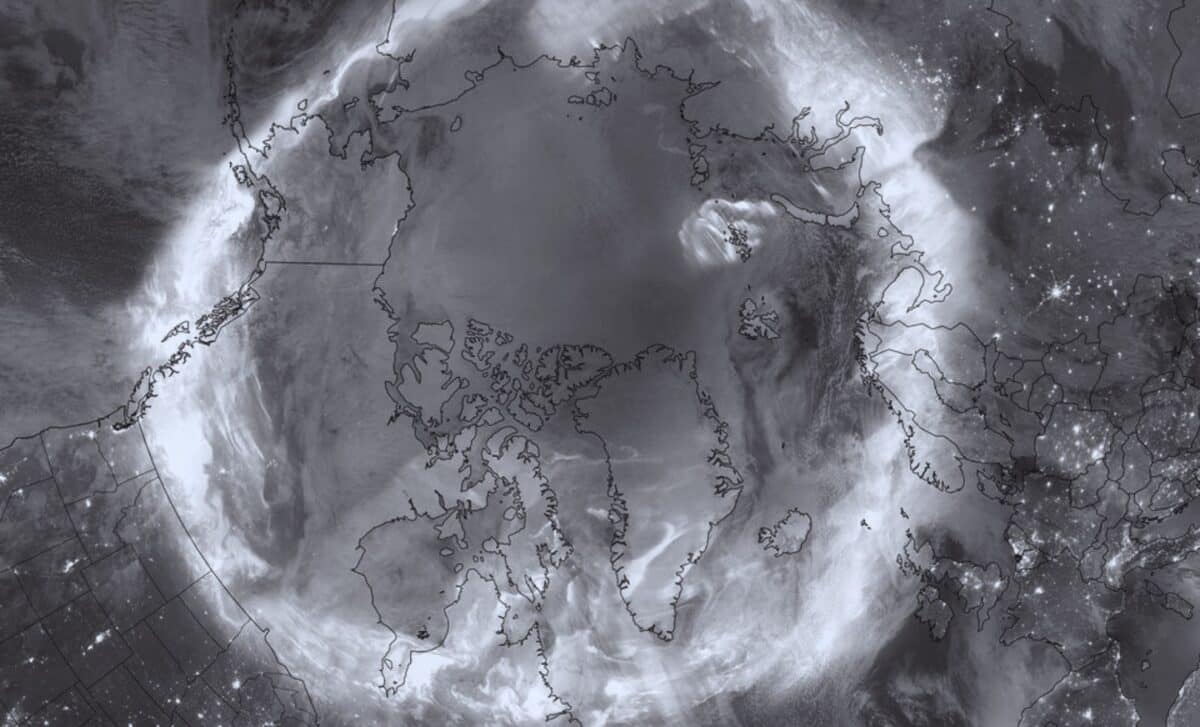
The European Space Agency’s Swarm mission detected an unexpected spike in high-energy protons over Earth’s poles during a geomagnetic storm in November. This temporary surge in proton levels, though brief, is a rare phenomenon that provides new insights into the complex interactions between the solar wind and Earth’s magnetic field.
Swarm, launched by the ESA in 2013, consists of three satellites designed to study Earth’s magnetic field in unprecedented detail. These satellites are constantly collecting data on the forces that shape our planet’s magnetic environment. This recent event, a sudden surge in high-energy protons during a solar storm, marks a notable moment in space weather research.
High-Energy Protons Detected by Swarm Satellites
According to the European Space Agency, the Swarm satellites were the first to observe this unusual spike in high-energy protons. These particles, which originated from the Sun, were temporarily accelerated as they interacted with Earth’s magnetic field during the geomagnetic storm. This event, though short-lived, was significant enough to register on Swarm’s highly sensitive instruments. It’s not every day that something like this is observed, and it provides researchers with a unique opportunity to study these bursts of solar activity up close. Scientists have long been curious about how these proton spikes occur and what they reveal about the solar wind’s behavior.
While these kinds of events are rare, they play a crucial role in the ongoing effort to better understand space weather. Swarm’s detection has provided valuable data, which will likely influence future models of how solar wind impacts our planet, especially during times of heightened solar activity.
🌟 Stunning use of Swarm’s star trackers detects rare proton spike 🌟
Swarm’s star trackers are normally used to correctly orient our magnetic field monitoring trio in space, but thanks to some clever tweaks they have become a surprising source of high-energy proton data 🤩 pic.twitter.com/Sp1UcL9jCu
— ESA’s Swarm mission (@esa_swarm) December 11, 2025
The Sun-Earth Interaction: The Case of Geomagnetic Storms
Geomagnetic storms themselves are nothing new. These storms happen when disturbances in Earth’s magnetic field are caused by energetic particles from the Sun, which can include high-energy protons like the ones recently detected.
According to experts, solar flares or coronal mass ejections are typically behind these storms, but it’s the resulting interaction with Earth’s magnetosphere that creates the spectacular phenomena we associate with solar weather. While most geomagnetic storms are relatively mild, this particular event was enough to set off a temporary surge in proton levels. The cause of this particular spike is still being studied, but its capture by Swarm will help scientists understand just how these events unfold.
The effects of geomagnetic storms on Earth can be quite varied. On the one hand, they can create beautiful auroras at the poles. On the other, more extreme storms have been known to interfere with satellites, disrupt communication systems, and even affect power grids.
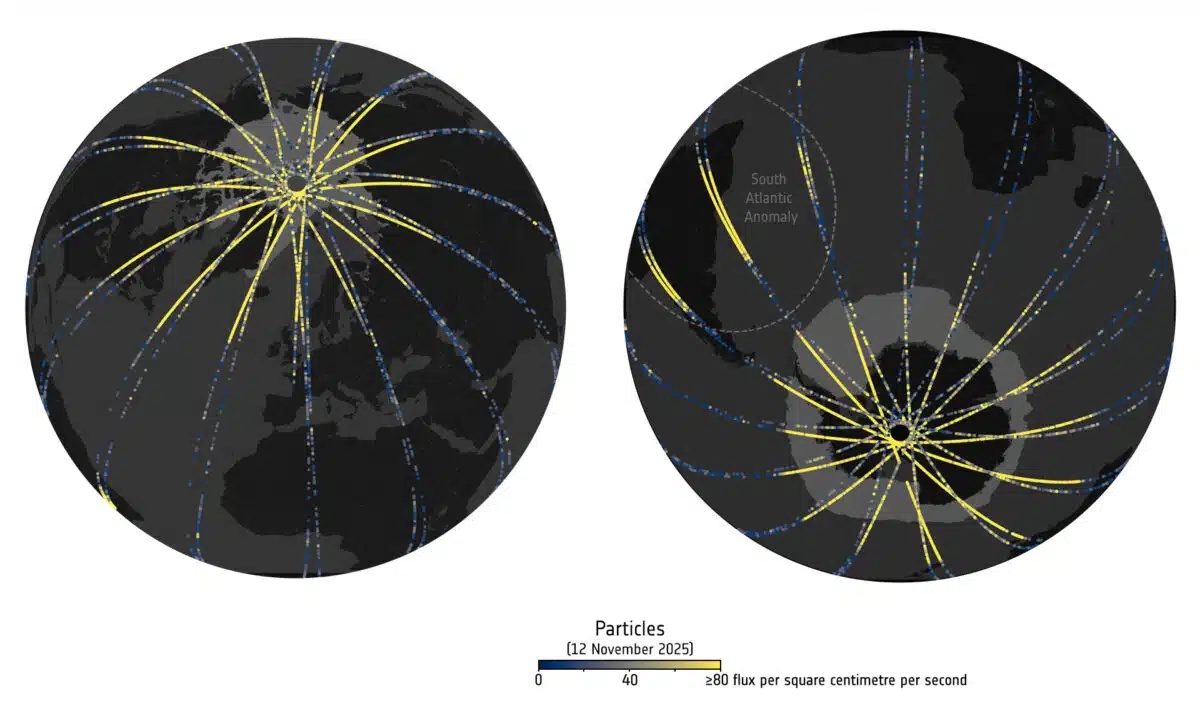 Proton flux at high energies across the polar regions. Credit: ESA
Impact of Solar Activity on Earth’s Environment
As the Swarm mission continues to study the magnetic field, scientists are learning more about how solar events can impact everything from satellite electronics to GPS signals. Even small disturbances in the magnetosphere, like the one observed in November, can have cascading effects on our increasingly technology-dependent world.
“Under normal conditions, Earth’s magnetic field deflects most solar wind particles; however, during a geomagnetic storm, the magnetosphere can become overloaded, allowing a substantial number of high energy protons to penetrate and give rise to several geophysical phenomena,” explained Enkelejda Qamili, a Swarm data quality analyst at ESA. “While these events are of great scientific interest, it is important to acknowledge the potential risks they pose to astronauts, spacecraft and communication.”
Solar events can have real-world consequences. While we haven’t yet experienced a truly catastrophic solar storm, ongoing research into space weather is essential.