
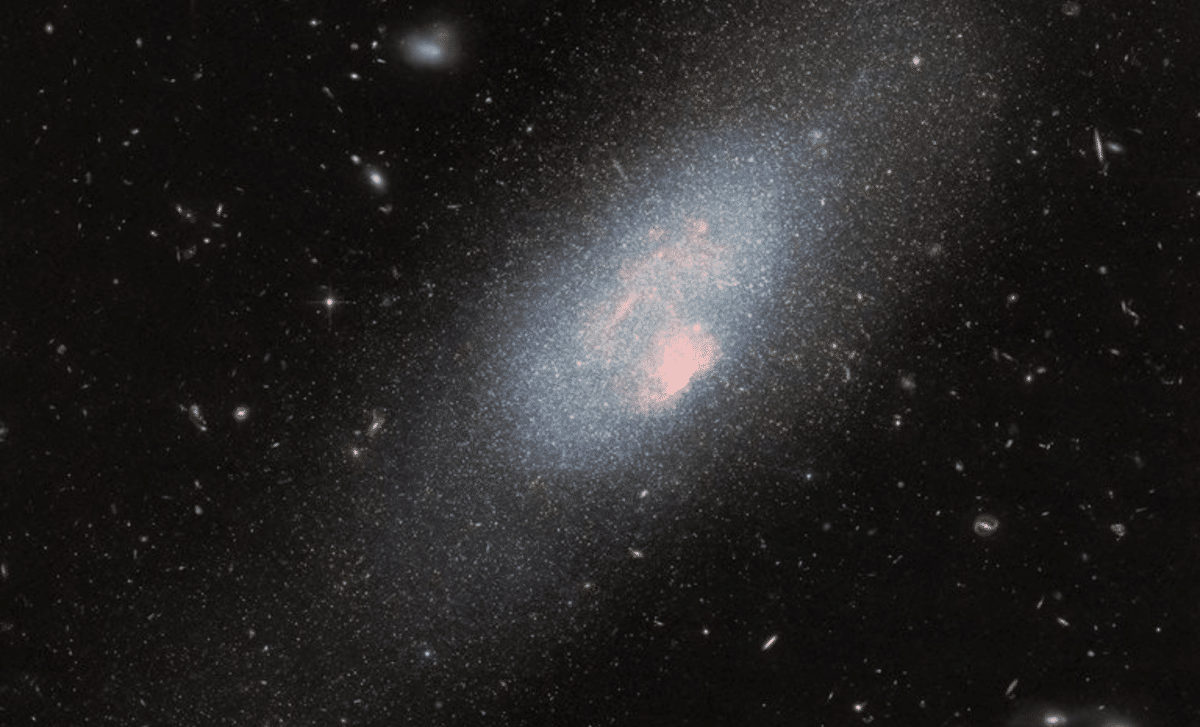
A captivating new image captured by the Hubble Space Telescope reveals fascinating details about a rare galaxy, Markarian 178 (Mrk 178), located 13 million light-years away in the constellation Ursa Major. This study, highlighted by NASA, explores the significant role of massive stars, including the rare and powerful Wolf–Rayet stars, which shape the galaxy’s distinct appearance. With star formation at its heart, this galaxy’s mysteries are only just beginning to unfold.
The Stunning Visuals of Markarian 178
The galaxy Markarian 178 (Mrk 178) stands out as a blue dwarf galaxy, glowing brightly due to its young and hot stars. Unlike larger galaxies like our Milky Way, Mrk 178 is relatively small, measuring only a fraction of the Milky Way’s size. The Hubble Space Telescope’s image brings into focus the unique stellar environment of this distant galaxy. As the telescope peered through the cosmos, it revealed not only the galaxy’s vibrant blue core but also intriguing features on its outer edges, where rare Wolf–Rayet stars reside. These stars are known for their incredible power and energy, which significantly influence the galaxy’s color and structure.
The galaxy’s most striking feature is the sharp contrast between its blue, star-filled center and the reddish glow at its edges. The latter is the result of the presence of Wolf–Rayet stars, massive stars nearing the end of their life cycle. These stars undergo rapid and violent processes, expelling their outer layers through intense solar winds. This shedding of material is what gives Mrk 178 its signature red hue, a stark contrast to the surrounding young, blue stars.
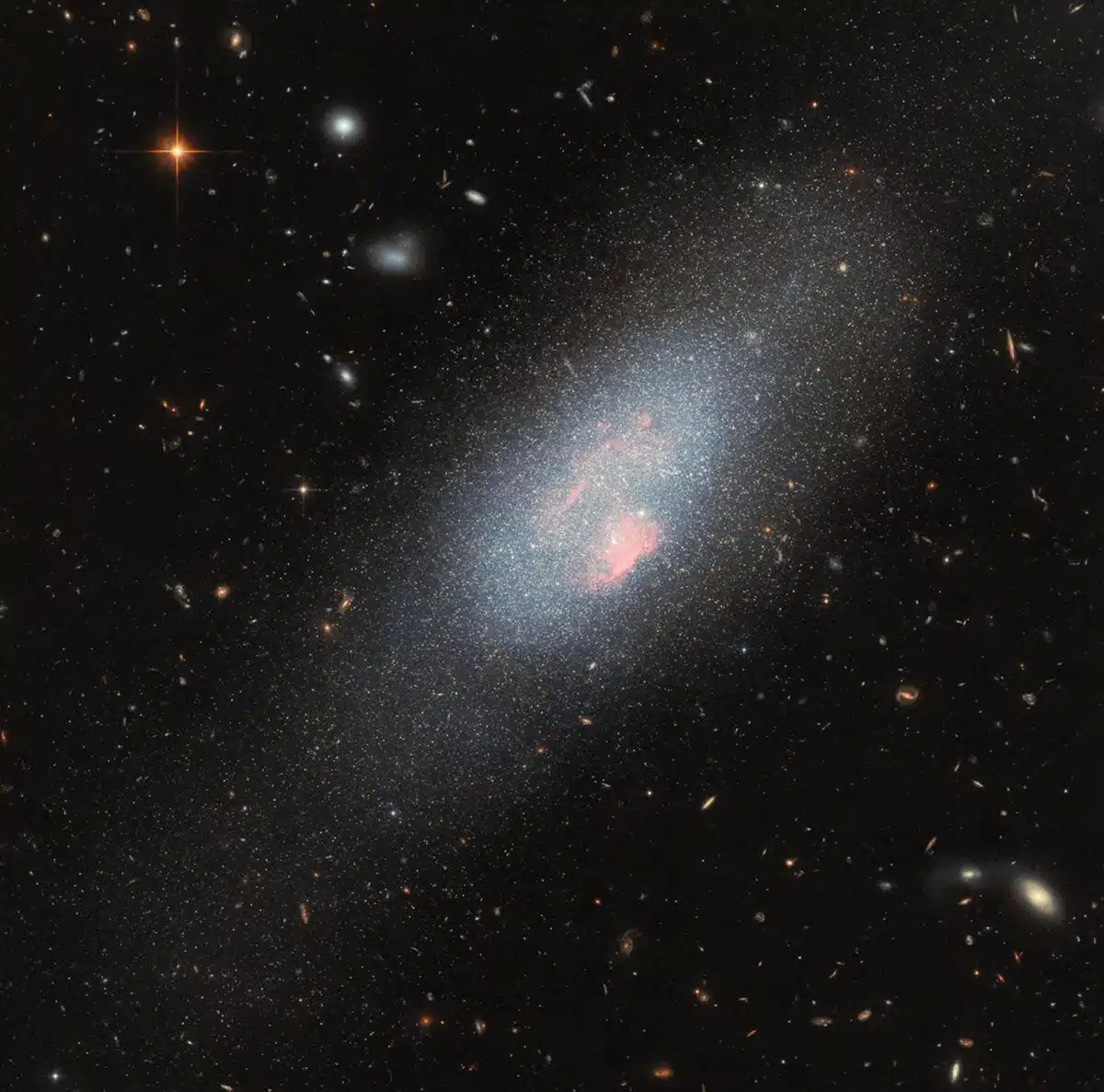 This NASA/ESA Hubble Space Telescope image features the blue dwarf galaxy Markarian 178 (Mrk 178) against a backdrop of distant galaxies in all shapes and sizes. Some of these distant galaxies even shine through the diffuse edges of Mrk 178.
ESA/Hubble & NASA, F. Annibali, S. Hong
The Role of Wolf–Rayet Stars in Galaxy Evolution
The discovery of Wolf–Rayet stars within Mrk 178 has sparked further interest in their role in galaxy formation and evolution. These stars are extremely hot and massive, and they are believed to be in the final stages of their life cycle before collapsing into black holes or neutron stars. The intense solar winds and the emission lines they produce leave an imprint on the light coming from the galaxy, making their presence unmistakable.
According to NASA, The Wolf–Rayet stars in Mrk 178 play a pivotal role in shaping the galaxy’s chemical composition and structure. As they expel matter, they enrich the surrounding space with heavy elements like oxygen and nitrogen, which will eventually contribute to the formation of new stars and planetary systems. The discovery of these stars also points to a crucial phase in the evolution of galaxies, especially those like Mrk 178, where star formation is actively occurring despite the galaxy’s small size. This highlights the idea that massive stars, though short-lived, are instrumental in driving the changes in their host galaxies.
What Triggered Star Formation in Mrk 178?
One of the central mysteries surrounding Mrk 178 is what triggered the recent burst of star formation in the galaxy. Despite its relatively isolated position in space, far from any major galactic neighbors, Mrk 178 has experienced an unusual spike in star activity. This burst is believed to have been triggered by external factors, such as a collision with a gas cloud or the disruption caused by the intergalactic medium as the galaxy moves through space.
This discovery challenges the traditional understanding that galaxy collisions are the primary catalysts for star formation. Instead, researchers are now considering other possibilities that might explain the sudden emergence of new stars in an otherwise quiet galaxy. The interaction with a gas cloud or even the effects of cosmic radiation could have provided the necessary conditions to ignite a new generation of stars. As more observations are made, scientists will continue to investigate the exact cause of this star-forming phenomenon.