
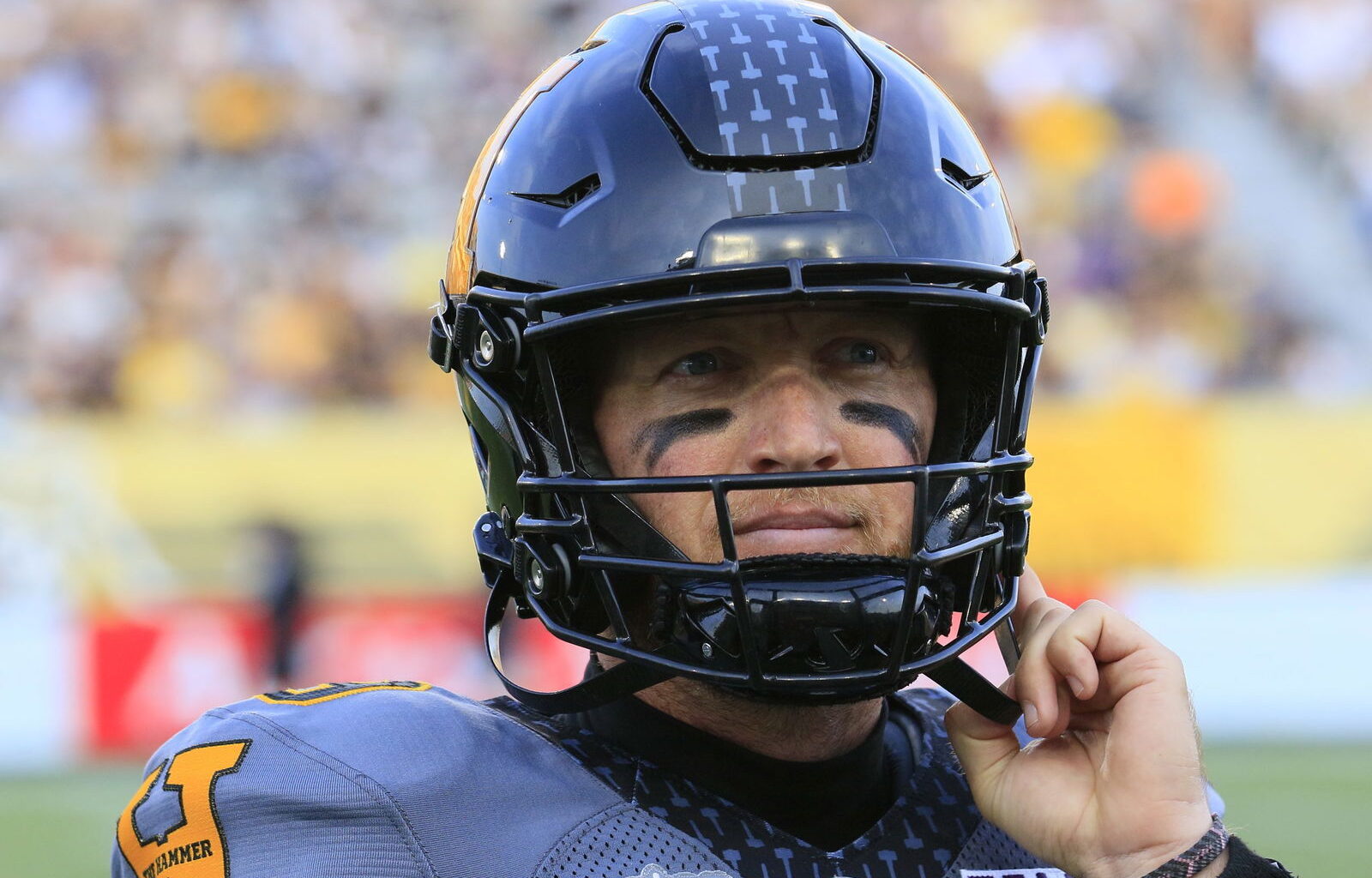
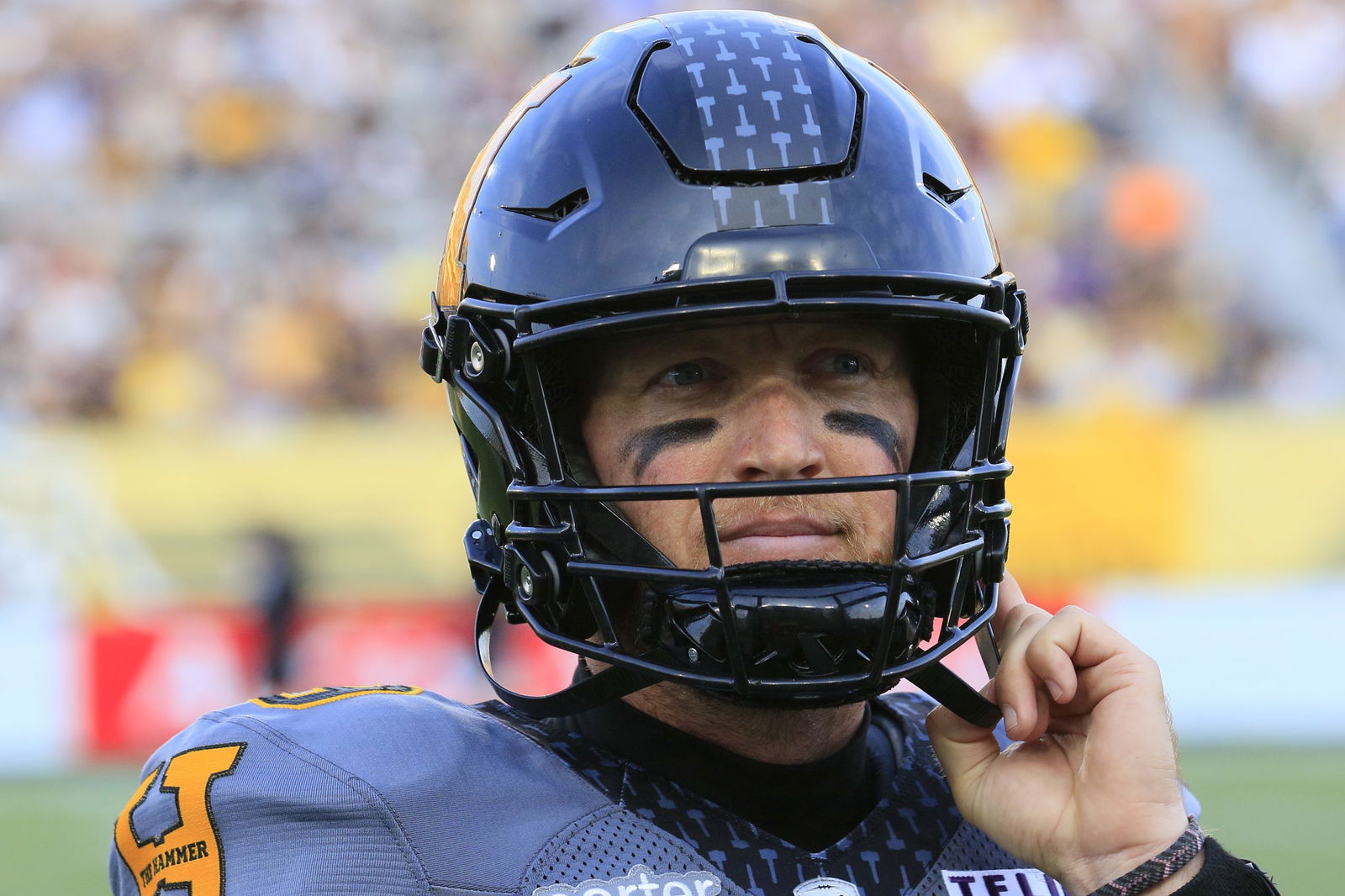
 Photo courtesy: Bob Butrym/RFB Sport Photography
Bo Levi Mitchell may have signed a two-year contract extension with the Hamilton Tiger-Cats, but the veteran quarterback isn’t committing himself to anything beyond next season.
“I think I’d be lying if I didn’t say it’s probably going to be a year-to-year thought process,” the 35-year-old acknowledged on Friday. “I’ve talked with (Brandon Revenberg) about this. I’ve talked to guys on other teams. I’ve talked with Milt (Stegall) about it during some of those Grey Cup weeks, just kind of how he knew. I think mentally, at the end of the year, you kind of have a feeling of, ‘Do I want to get hit anymore?’”
“How you end your year has a lot to do with how you want to play the next year. I ended the year very healthy, mentally very strong. It just felt like I could have went out and played the next week, whereas a lot of times you’re kind of dragging at the end of the year, and you’re on that race of recovery.”
Mitchell has been frank about contemplating retirement for the past several offseasons, going so far as to suggest that he regularly contemplates riding off into the sunset if the Ticats were to break their quarter-century Grey Cup drought. However, the 13-year CFL veteran remains at the top of his game, leading the CFL in passing the last two years and being named a finalist for Most Outstanding Player both times.
The past two seasons were the first and third most productive years of Mitchell’s career. That, along with support from key voices in both his personal and professional life, made the decision-making process easy this time around.
“I knew pretty quick when I got done with the year. Talked to (my wife) Madison; she could see it. I talked to my oldest brother, Pat; he could see it. My mom, everybody,” Mitchell said. “(Ticats’ CEO) Scott Mitchell walked by, Kenny Lawler’s family all walked by, and they’re like, ‘Don’t let this MFer (sic) retire.’ They used some choice words to make sure I understood how much they valued me. It was awesome to hear that, obviously, from one of your best players, and the guy that signs the cheques.”
The two Mitchells negotiated the new deal primarily amongst themselves, a process that the quarterback said only took between four to six text messages to complete once it got underway.
After injuries marred his first season with Hamilton, the Katy, Tex., native has played the past two seasons at a discount. Even after a contract renegotiation last offseason, he topped out at $374,800 in 2025 — sixth most among CFL quarterbacks. As the league’s top available pending free agent, he had the leverage to claw back every dollar he’d lost out on if he tested the open market, but didn’t even consider it.
“Oh no, that was never a possibility. It was Hamilton or nothing,” Mitchell insisted. “The decision was not whether or not I want to be here — I want to be in Hamilton. I’ve grown to love this place very fondly over the last three years.”
That’s not to say that Mitchell didn’t receive a tidy raise, however. While he declined to reveal exact numbers, the five-time all-star compared his contract to that of Saskatchewan Roughriders’ QB Trevor Harris, whose recent one-year extension will pay him $455,300 in hard money next season and a maximum $509,300 if all playtime incentives are reached.
Not only are the two passers close in monetary value, but they also shared a similar philosophy when it came to what they wanted from the deal.
“Trevor and I are in a position that we’ve played in the league for a very long time. If you do that, and you’re halfway decent with money, you can make a good living. I think we have the ability to maybe not try to ask for top dollar every single time,” Mitchell explained.
“That’s why, the last two years, when the performance fell in ’23 and the injuries, I was totally okay with taking a lower contract to stay here, to have that ability to play with this organization, and last year as well. Obviously, Scott Mitchell and (president of football operations Orlondo Steinauer) felt like they got value those last two years, so they reciprocated that to myself this year a little bit, but just back up into the normal aspect of starting quarterback money.”
Unlike Harris, who reflected his year-to-year decision-making process in the length of his contract, Mitchell felt that it was important to lock himself in with the Ticats for multiple seasons.
Even though either side could elect to make 2026 the end of an era depending on the result, the structure sends a message to both pending free agents and season-ticket holders looking to re-up.
“I think a one-year deal doesn’t show to the fans, to other players, a lot of continuity,” Mitchell said. “But the reality is, they’re always one-year deals for the most part. Just now, they have my rights for that next year, the contract’s in place. That gives security on both sides.”
Both the team and Mitchell understand that security is merely an illusion in professional sports, where nothing is guaranteed. At least for now, that illusion will serve both of their goals.