
The UCI’s controversial plans to introduce gear restrictions in the professional peloton, in a bid to reduce speeds and increase safety, has been branded “an absolute no-brainer” by 2007 Paris-Roubaix winner Stuart O’Grady.
The 52-year-old former GAN, CSC, and GreenEdge pro, who now organises the Santos Tour Down Under, the road season’s annual curtain raiser, back home in Australia, also called for cycling’s ongoing technological revolution to be “reined in a bit”, describing the use of wider handlebars and restricted gears as “common sense stuff”.
.jpg "Stuart O'Grady signs on at the 2012 Tour Down Under") Stuart O’Grady signs on at the 2012 Tour Down Under (credit: Santos Tour Down Under:Regallo)
Stuart O’Grady signs on at the 2012 Tour Down Under (credit: Santos Tour Down Under:Regallo)
O’Grady’s fellow retired Aussie pro, 2011 Tour de France winner Cadel Evans, while acknowledging that the sport has to “evolve”, also criticised cycling’s modern fixation with increasingly narrow handlebars and extreme positions, arguing that some riders are now using “brake levers that you can’t reach to avoid a crash”, a situation the former world champion said was “ludicrous”.
Evans and O’Grady made the claims during a recent appearance on the road.cc Podcast, where they also discussed their shifting perspectives on pro cycling since retiring over a decade ago, how the sport has changed during that period, the impact of this year’s anti-Israel protests on organisers, teams, and riders, the future of Australian racing, and why fans should just sit back and enjoy the greatness of the “freak” that is Tadej Pogačar – even when he kills off a race with 100km to go.
“Innovation has just exploded”
The duo – two of the pioneers of the Aussie invasion of European road racing in the 1990s and 2000s – may have both moved back home after spending the best part of three decades making a living racing their bikes on the other side of the world.
But they still manage to keep up to speed with cycling’s current so-called golden era, through O’Grady’s organising role at the Tour Down Under, a position he’s held since 2019, and their stints as tour guides at the classics and grand tours with cycling tourism company Mummu Cycling.
.jpg "Tour Down Under 2015, Cadel Evans signs on") Tour Down Under 2015, Cadel Evans signs on (credit: Regallo)
Tour Down Under 2015, Cadel Evans signs on (credit: Regallo)
Asked if they’ve noticed a discernible shift within cycling since they left the sport, Evans, one of the most consistent grand tour riders of his era (and the subject of a recent sold-out show at the Edinburgh Fringe), told the podcast: “There’s been a massive increase in professionalism. Sky was the real instigator. I was really dedicated to my job and did everything I could, altitude training and specific training.
“Most of my BMC team in 2011 went to altitude before the Tour. Then Sky started doing it where there weren’t just the nine riders going to altitude, it was 11. So every team had to do that, just to be competitive.
“In the early 2010s, what maybe in the past just the leader, and one or two helpers, did in terms of professionalism and dedication, now numbers eight and nine in the team were doing. And that pushes the whole level of the group to go faster.
“And it’s not just the preparation, it’s the technology, the tyres, everything together is impacting the average speeds. And then you have two guys who seem to be not just head and shoulders above everyone else, but with reserves too.”
O’Grady’s powerful CSC team were one of the early adopters of what came to be, rather nauseatingly, referred to as ‘marginal gains’, though the two-time Tour de France stage winner reckons even they were merely “tinkering with things” in the late 2000s, compared to the data-driven methods that would come later.
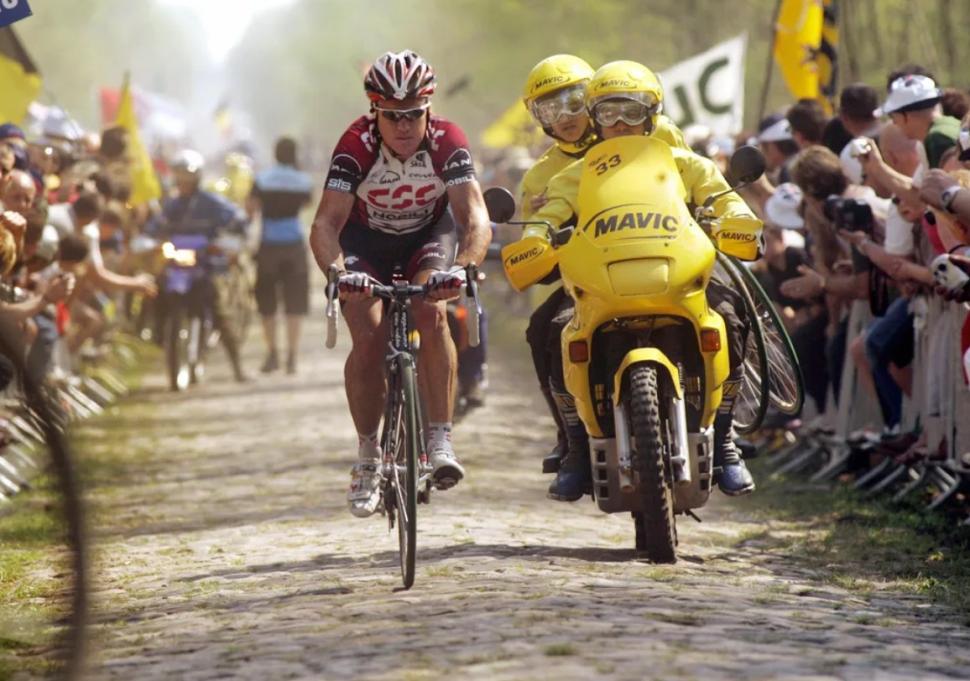 Stuart O’Grady wins the 2007 Paris-Roubaix (credit: Getty)
“For me, it’s the professionalisation of the entire team,” O’Grady, who became the first Australian since Phil Anderson to lead the Tour de France when he donned the yellow jersey for three days at the 1998 race, said.
“Back in our day, you had a mechanic, the directeur sportif, maybe a couple of riders had a coach, but you didn’t have a personal coach. Now, it’s the data-backed science, nutrition.
“CSC with Bjarne Riis, we were one of the first teams to have a full-time chef, and it was all the different seeds and all the three different types of oats. And we were going, ‘what are you talking about? What are we doing?’ We didn’t really understand it. We were tinkering with things, but now it’s all science-based data.
“And with that data, they’re getting feedback and recovery is more important. Personally, I think we were all overtrained. I definitely was. We felt bad so we had to go and smash ourselves for another seven hours the next day because you thought you weren’t fit enough. Whereas you probably just needed to have a day off your bike, which was just not a thing back then.
“The bikes, the aerodynamics, the changing positions, the equipment – things didn’t seem to happen very much up until I retired. But since then, it’s like everything’s just been snowballed into one, the innovation has just exploded.
“And a lot of the speed is down to aerodynamics. [Fabian] Cancellara would have had access to a wind tunnel at CSC, but certainly not all of us. Now, everyone’s doing the aerodynamics and wind testing, and everyone’s got the nutrition just dialled in.”
“All I see is people crashing coming down a hill at 80kph”
However, O’Grady believes that the whirlwind of technological innovation that has gripped the sport over the past decade has had a serious knock-on effect for its safety.
“I personally think it’s all too much at once, especially the aero positions and all that,” the 52-year-old, a gold medallist in the Madison with Graeme Brown at the 2004 Athens Olympics, says.
“I think that needs to be reined in a bit, because as an organiser now, all I see is people crashing coming down a hill at 80kph.
“And we used to go 100kph as well, but we weren’t pedalling when we were doing it. We were in the tuck and we had good skill levels because our handlebars were the same width as our shoulders, which gives you control of your bike. It was common sense stuff.
“But now they’re tucked in like this and they get a bump and you crash, right? So as an organiser, it’s hard to watch a few of these things, but the UCI are doing their best. At the end of the day, you want to see riders riding their bike and not crashing. There seems to be a phenomenal amount of crashes happening, so hopefully we can see some improvements in that area.”
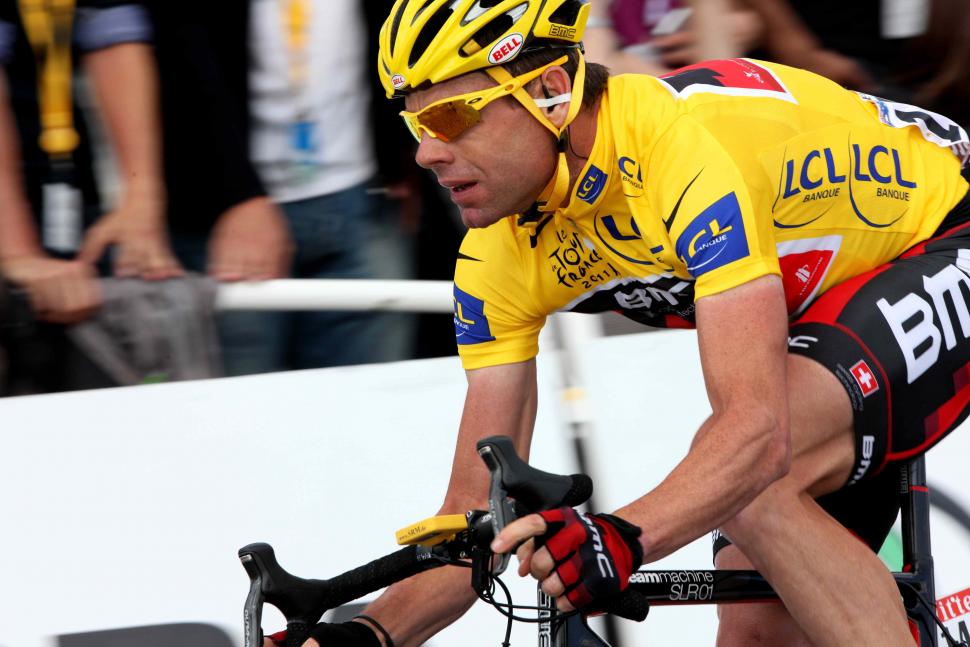 Cadel Evans on last day of 2011 Tour de France (credit: Photosport International)
In an attempt to deal with this increase in crashes, earlier this year the UCI announced its much-maligned plans to introduce a raft of safety-focused equipment changes, including a new minimum handlebar width rule, new rim height and fork width limits, the banning of time trial helmets in road races, and a new gear restriction rule to slow speeds (with the attempt to trial the latter sparking a legal battle with components brand SRAM).
Describing the UCI’s bid to intervene in cycling’s technical revolution as a “series of Band-Aid patches”, Evans told the podcast: “There’s been this accumulation of one percenters that have really come one after the other. I had my last race was in 2015, the first edition of my race [the Cadel Evans Great Ocean Road Race] was my last professional race.
“Now it’s 10 years later, and the speeds and the level has just gone up phenomenally. In terms of safety, brake lever position, handlebar width, this is all part of it. And for sure, if you can reach your brake levers, well, you’re going to be able to use them more effectively. That doesn’t require much discussion.”
“But when a governing body makes rules, they also have to make rules that they can police effectively, the former Lotto and BMC leader, who converted to the road after a successful stint as a mountain biker (so he knows a thing for two about bike handling) continued.
“It’s useless just to make rules that you can’t police effectively because then you’re only disadvantaging the good people, the law-abiding participants in sport. I don’t want to put all the responsibility on the UCI, but they do make the rules. So they have to keep on top of this.
“But all of us together, whether it’s journalists, fans, race organisers, governing bodies, we also have to keep a clear North Star. This is what the sport was. This is what the sport is today. Where do we want it in the future? And we also have to keep that firmly in mind, because it’s a pity to not let the sport evolve.
“But then, there are some brake levers that you can’t reach to avoid a crash. That just seems ludicrous, but if that’s what you need to do to keep your contracts as a professional athlete, that’s what you do.”
The UCI’s plans to implement a new gearing rule, a variation on the old junior gears system, marks the first technical gear limitation in modern professional cycling and will cap the distance covered per pedal revolution to 10.46 meters, effectively limiting riders to a maximum gear ratio of 54×11 on 700c wheels – something O’Grady says is necessary to limit speeds in an era of increasing traffic furniture and poorer roads.
.jpg "GreenEdge's Stuart O'Grady at the head of the peloton at the 2012 Tour Down Under") GreenEdge’s Stuart O’Grady at the head of the peloton at the 2012 Tour Down Under (credit: Santos Tour Down Under:Regallo)
GreenEdge’s Stuart O’Grady at the head of the peloton at the 2012 Tour Down Under (credit: Santos Tour Down Under:Regallo)
“I just think every motorised sport has gear restrictions, or motor restrictions right?” he asked. “You can’t, you know, put a drag racing vehicle on a Formula One track, because it’s just going to go fast and go off the course, right?
“So, I do think there needs to be gear restrictions because with the technology and equipment, everything’s just going faster and faster. But the roads, if anything, are deteriorating and they’ve got more traffic furniture. Every region, every town is trying to slow traffic down, minimise traffic, safety, speed limits are all coming down.”
“More speed bumps, more traffic islands, more roundabouts,” Evans interjected.
“Yet in cycling the peloton is bigger and faster than ever,” O’Grady continued. “And with a sprinkling of inexperience due to the younger peloton, it’s the perfect storm at the moment. So I think gear restrictions are just an absolute no-brainer.”
“I can see it from both sides”
One of the other big stories of the 2025 cycling season centred on the pro-Palestine protests targeting Israel-Premier Tech’s participation in the sport’s biggest races amid the devastation in Gaza.
O’Grady experienced the protests firsthand at the Tour Down Under in January, before they eventually reached a crescendo at the Vuelta and culminated in Israel-Premier Tech’s rebranding as NSN Cycling, complete with dual Swiss-Spanish nationality and a Barcelona-centric image fronted by the friendly face of footballing legend Andrés Iniesta.
 Pro-Palestine protests in Madrid, 2025 Vuelta (credit: Zac Williams/SWpix.com)
“I can definitely see it from both sides,” O’Grady says now, reflecting on the impact of the protests on the cycling season.
“The organisers are bound by the UCI regulations, okay? We’ve got mandatory participation [in the WorldTour]. The teams have to be invited, that’s part of their licensing agreement. We’ve got to go with whatever the UCI says.
“As a race organiser, it’s not quite as simple, but I also think from a team’s point of view, when you see the disruption going on and the magnitude of it day after day – I think everyone’s probably got a different opinion on what should and shouldn’t happen.
“And if you’re a rider in that team, then it’s obviously going to be very difficult as well, because you’re just out there doing your job. [NSN rider] Simon Clarke, our good mate, is just trying to get through his last season and retire in front of his home fans in Australia. So of course you feel for the rider, you feel for the humans.
“I’m definitely not going to get into the politics of it, but as a race organiser, life becomes complicated and I definitely followed it very, very closely. But let’s just hope we don’t have to deal with those things in the future.”
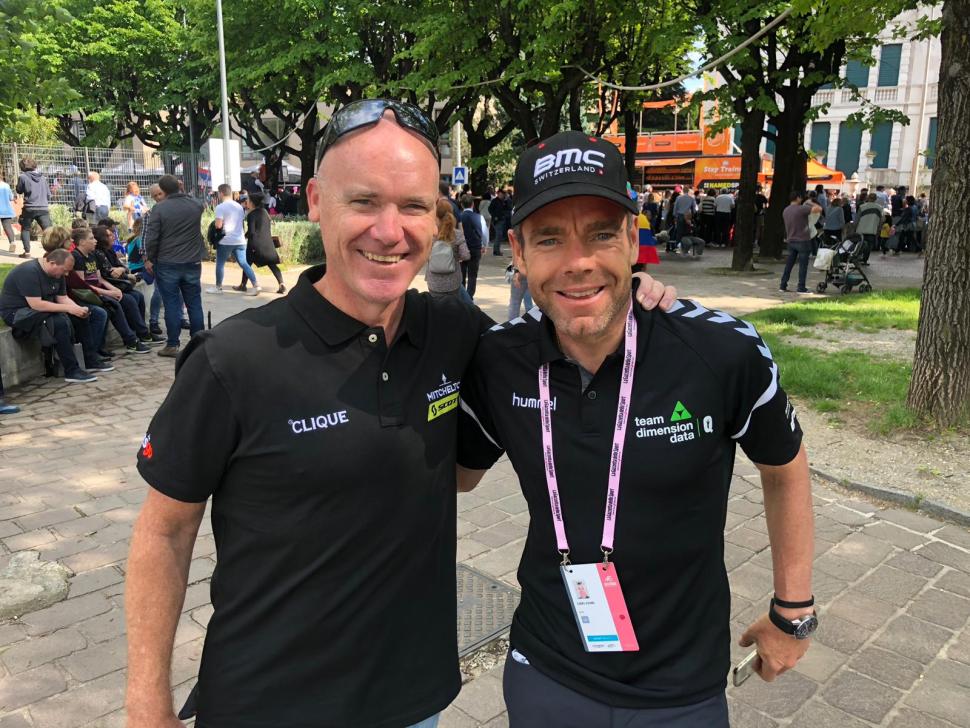 Cadel Evans and Stuart O’Grady (credit: Mummu Cycling)
While Israel-Premier Tech’s rebranding operation may, at least superficially, quell the controversy surrounding the team, one other, less serious, debate shows no signs of slowing down: Has Tadej Pogačar made men’s cycling boring?
O’Grady and Evans are unequivocal – no, he hasn’t.
“At the end of the day, Pogačar’s just a freak,” O’Grady says. “What he’s doing, his capacity to just be so dialled in on every race now, it’s basically seeing guys just race for second. As soon as he goes, they just sit up and go, okay, I’m not going to try and follow him. I’m going to try and get on the podium.
“His job’s almost becoming easier. I don’t mean that disrespectfully, but the other guys now who have tried to follow him are just exploding and not getting their second or third. So now it’s almost just letting go and then we can concentrate. All I know is it’s bloody good to watch when you’re when you’re not racing.”
“I’m just happy just to sit on the sidelines,” Evans adds. “I didn’t know he was going to go so far out at the worlds this year. That was a bit unpredictable, wasn’t it?”
“I enjoy watching greatness,” O’Grady argues. “I think people are very quick to go, ‘this is boring’. Come on, man, this guy’s up there with the greatest of all time. Just enjoy watching greatness, enjoy watching history, because this is a pretty special moment.
“And those battles will resurface, there’ll be the next Pogačar in a few years. There’ll be someone in the junior ranks, who we’ve never heard of, who we’re going to be talking about in five years’ time. You’ve just got to enjoy the moment, honestly.”
The road.cc Podcast is available on Apple Podcasts, Spotify, and Amazon Music, and if you have an Alexa you can just tell it to play the road.cc Podcast. It’s also embedded further up the page, so you can just press play.