

The blockbuster trade of Quinn Hughes from the Vancouver Canucks to the Minnesota Wild on Friday sent shockwaves across the hockey world.
In undoubtedly the biggest trade for each franchise, and one of the biggest in NHL history, the effects of the Norris Trophy-winning star defenseman’s relocation are going to be felt league-wide.
From teams that missed out on a good opportunity to teams that now face an even tougher Central Division, how does the deal impact each NHL club?
In the aftermath of the trade, The Athletic asked its NHL staff. Here’s what they said.
Anaheim Ducks
Adding Hughes to an already dangerous offense with Leo Carlsson, Cutter Gauthier and Beckett Sennecke might have been unfair for the rest of the NHL. But the price to get into the mix might have included a major piece (Sennecke? Mason McTavish? Olen Zellweger? Jackson LaCombe?), their best prospect or two and their 2026 first-round pick. They’ll still be fine without Hughes. — Eric Stephens
Boston Bruins
The impact of the Hughes trade on Boston is minimal, aside from the Bruins playing the Wild in his first game Sunday. The Bruins are happy he didn’t end up with the Devils, who are Eastern opponents. As for the Bruins themselves, they did not have the trade currency to pursue Hughes. — Fluto Shinzawa
Buffalo Sabres
It shows they’re trying. Pierre LeBrun reported the Sabres were among six teams that showed serious interest in Hughes. They have the assets to swing a deal like that, but Hughes signing in Buffalo might have been a long shot. Still, getting involved in the deal shows the Sabres are willing to make a significant shakeup. — Matthew Fairburn
Calgary Flames
The second-best defenseman in the game has left the Pacific Division, and the Canucks are staring a rebuild in the face. Meanwhile, the Flames still have Rasmus Andersson in the fold after not dealing him away in the summer, among a handful of veterans who are mired in trade rumors (Blake Coleman and Nazem Kadri come to mind). With Flames fans antsy for their team to start rebuilding, it’ll be frustrating for them to see the Canucks get a head start on that process. — Julian McKenzie
Carolina Hurricanes
The Hurricanes are always in on every big name, and that was reportedly true for Hughes, too. They certainly could have rivaled the package given up by the Wild (Logan Stankoven, Alexander Nikishin, Bradly Nadeau and a first is about on par). That would have been a lot to part with (and further thin Carolina at center). Most important for the Hurricanes is that Hughes didn’t end up in New Jersey with his brothers. With Hughes staying out of the East, Carolina remains the Metro favorite. — Cory Lavalette
Chicago Blackhawks
The trade probably doesn’t impact the Blackhawks, at least in the short term. If Hughes re-signs and the Wild take another step, they could be, like the Avalanche, another hurdle for the Blackhawks in the Central for years to come. Of course, the Blackhawks have to get further along in their own rebuild and develop into that type of team, too. — Scott Powers
Colorado Avalanche
This trade makes the best division in the NHL even better. Colorado and Dallas have already looked like juggernauts, and now the Wild have added an elite defenseman to a team that was already beginning to look like a real contender. Minnesota hasn’t been the easiest matchup for the Avalanche recently, splitting last season’s series and handing Colorado one of its few losses this season on Nov. 28. The Avalanche still have three matchups with Minnesota remaining, starting Dec. 21 in St. Paul. — Jesse Granger
Columbus Blue Jackets
The Blue Jackets are probably relieved that Hughes didn’t end up in the Metropolitan Division, because his talent alone may have been enough to shift the balance of power. The Devils, where his brothers play, were obviously interested, but so too were the Rangers and Hurricanes. There aren’t many big trades in the NHL these days, but Blue Jackets GM Don Waddell has to hope this monster deal, along with the Edmonton-Pittsburgh goalie trade, will open things up a bit. Waddell has been trying to swing a deal to awaken his sleepy club. — Aaron Portzline
Dallas Stars
Interestingly, the Stars may have been able to make the money work, what with Tyler Seguin on LTIR. But with an already strong blue line and missing a first-round pick after acquiring Mikko Rantanen last year, a massive bid here didn’t totally make sense. Instead, Dallas gets an even bigger challenge in the Central, especially considering the Avs look like a lock to take the top seed, making Hughes the Stars’ problem. — James Mirtle

The Red Wings passed on Quinn Hughes in the 2018 draft, taking Filip Zadina at No. 6 while the Canucks grabbed Hughes at No. 7. (Tom Pennington / Getty Images)
Detroit Red Wings
Mainly, it means they missed out on adding one of the league’s true superstars. Granted, the price Minnesota paid for Hughes was steep, and while Detroit could have plausibly matched it, it’s fair to debate the merits of doing so. You still have to be deep enough to put a complete team around him, as the Canucks have shown. What’s not up for debate, though, is that players such as Hughes don’t come around often, and Detroit lost out on a prime chance to add one. That still stings for the Red Wings, no matter how you feel about the price, especially in a wide-open Atlantic. — Max Bultman
Edmonton Oilers
The three best teams in the Western Conference are now in the Central Division (Avalanche, Stars and Wild). For the Oilers, avoiding the Central bracket by finishing in the top three spots in the Pacific Division or the first wild card (seventh) is a matter of playoff life and death. The Hughes trade has turned the Central into something resembling a hockey hellscape. A must to avoid. — Allan Mitchell
Florida Panthers
Theoretically, having Hughes in the West for the next two years helps Florida. However, the beat-up Panthers have their hands full right now just trying to make the playoffs after a tough start, never mind worrying about what the Devils, Red Wings or other East teams are doing. Florida has cap room but doesn’t really have the futures assets that made sense for Vancouver, so this outcome is probably as good as the Panthers could have hoped for. Maybe they’ll be in the mix for Hughes if he ends up a UFA in 2027? You never know with Bill Zito. — James Mirtle
Los Angeles Kings
The Kings aren’t directly affected in the sense that if Minnesota grabs one of the top three spots in the Central Division, it won’t take a wild card that L.A. may be competing for as a fallback. Without question, Hughes would have gone right to the top of a blue line lacking in defenders that can create and generate offense. Even though they didn’t adequately replace Vladislav Gavrikov, the low-scoring Kings just don’t have the kind of asset package that would have matched Minnesota’s offer without gutting part of their roster. — Eric Stephens
Minnesota Wild
Well, they got him, so it impacts them in a very positive way. It’s not often you can get a 26-year-old 90-to-100-point-capable defenseman two years removed from winning the Norris. Just imagine Hughes navigating the Wild’s No. 1 power play with Joel Eriksson Ek at the net front and Kirill Kaprizov, Matt Boldy and Mats Zuccarello providing a multitude of options. And imagine the human breakout transporting the puck up ice and putting it in the hands of Kaprizov and Boldy. The Wild took a big swing and gave up a lot, but in the Central Division, that was necessary to earn true contender status. — Michael Russo
Montreal Canadiens
With Hughes winding up in the Western Conference, the trade does not impact the Canadiens one bit. They were never going to be a player in the Hughes trade market because they have Lane Hutson locked in for the next nine and a half years at a cap number that will likely be a little more than half of what Hughes will command on his next deal. What would have directly impacted the Canadiens is if he had landed in Detroit. — Arpon Basu
Nashville Predators
There’s probably no direct impact in terms of outcomes this season — the Predators are much more likely to be the worst team in the NHL than make the playoffs — and Nashville was not a serious threat to trade for Hughes. But it does increase the possibility that Preds fans, who are sick of watching former members of their team doing well elsewhere, will have to watch John Hynes — fired by GM Barry Trotz for Andrew Brunette — make a run. — Joe Rexrode
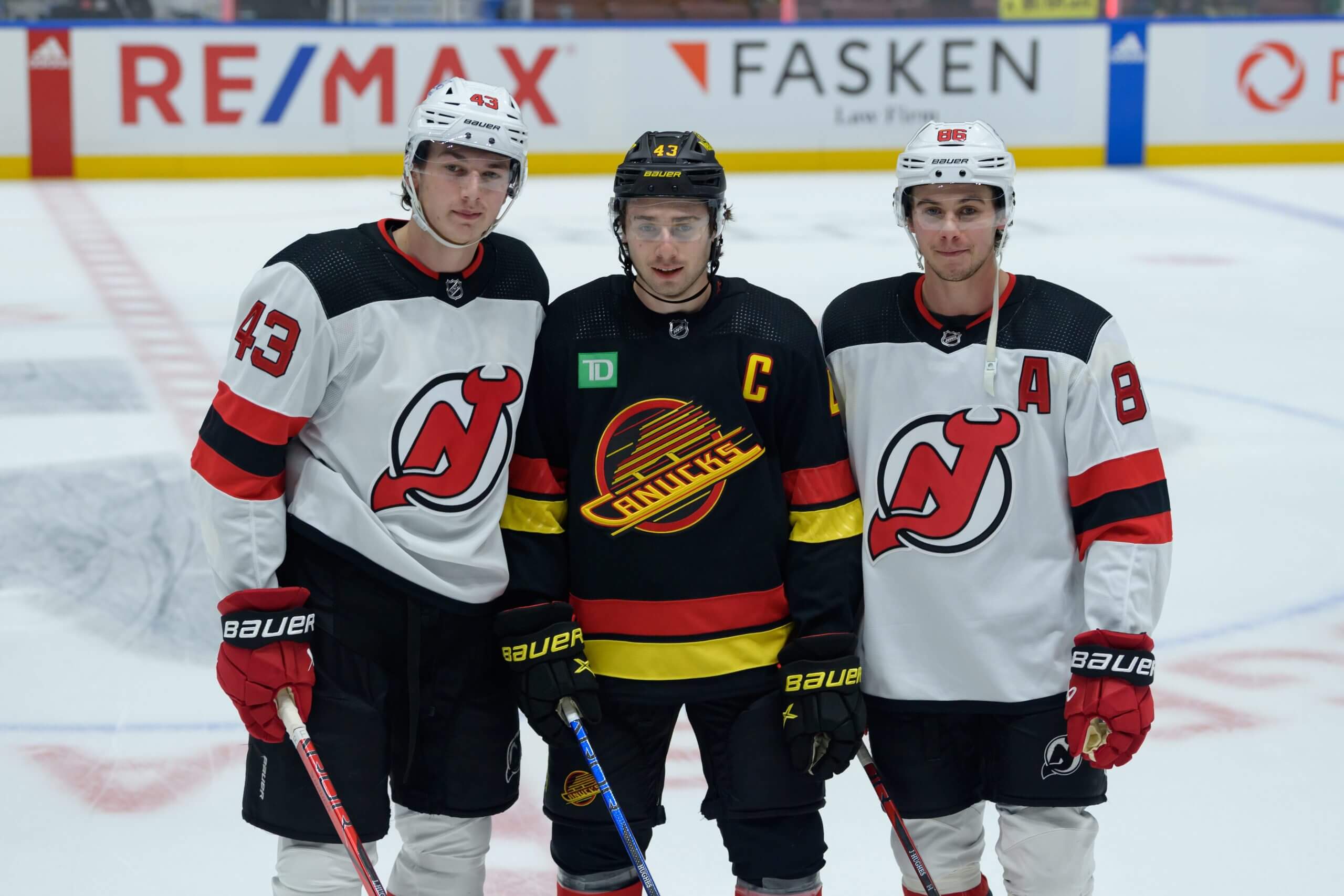
After months of speculation, Quinn Hughes (middle) didn’t join his brothers, Jack Hughes (right) and Luke Hughes (left), in New Jersey. (Derek Cain / Getty Images)
New Jersey Devils
The Devils were in on Hughes after months of speculation, but their offer came up short. They now at least have some clarity. Tom Fitzgerald no longer has to worry about saving cap space or trade chips in hopes of landing Hughes this season. Though they were in on Hughes, don’t expect the Devils to target other defensemen. Forward is a bigger area of need. — Peter Baugh
New York Islanders
The Islanders really only would have been impacted by a Hughes trade if he 1) was traded into the Metro Division, and 2) went to a team he was willing to sign long-term with after July 1. This is a retooling team with eyes on the long term, so Hughes joining an Eastern Conference contender for two playoff runs wouldn’t necessarily change anything. Had he joined the Devils or Red Wings with intentions of signing an eight-year extension, it would have been a different story. — Shayna Goldman
New York Rangers
The Rangers were in on Hughes, as Pierre LeBrun reported, but they weren’t going to be able to match the package Minnesota offered. Exploring the possibility of adding someone as elite as Hughes made sense, but missing out on him likely won’t alter the Rangers’ plans. The biggest impact of the trade is that he stayed out West and didn’t move to an Eastern Conference rival. — Peter Baugh
Ottawa Senators
The Senators might not have had the same quality of assets to compete with the six other teams reportedly interested in Hughes, but seeing a big move like that get completed will only fuel fans’ appetites for a big move of their own. The Wild completed the trade with the hopes of competing with Colorado and Dallas to win now. Ottawa, months after reaching the playoffs for the first time in eight years, is obviously hoping for its opportunity. — Julian McKenzie
Philadelphia Flyers
Hughes remained in the Western Conference and didn’t go to a team such as the Devils or Rangers, which helps the Flyers’ quest to qualify for a playoff spot this season. While some fans are surely frustrated that the Flyers weren’t more aggressive in their pursuit of the star defenseman, the fact is team management just doesn’t believe the organization is in a position just yet to be taking those kinds of big swings, particularly if it would mean giving up top prospects such as Matvei Michkov or Porter Martone. — Kevin Kurz
Pittsburgh Penguins
I can’t say it impacts the Penguins, except that it’s better for them that a player of Hughes’ talent remains in the Western Conference. Also, I expect Kyle Dubas to be active in trade talks in the next couple of years, because the best way for the Penguins to acquire a star might be in a trade, given their considerable assets and cap space. Maybe this is a template for what it takes to get such a star, for better or worse. — Josh Yohe
San Jose Sharks
It felt like the Sharks would have had a low-key opportunity to get Hughes, depending on his interest in signing an extension. They’re not in a position like the Wild, where it’s win now or else, which is why an extension would have been necessary instead of risking assets for possibly one and a half seasons of Hughes. However, the Sharks did have the assets to at least make Vancouver think. You’d imagine Sam Dickinson and one or both of the 2026 first-round picks would have been the base of an ask. While Hughes preferred an Eastern NHL home, couldn’t you see him driving an offense featuring Macklin Celebrini and Will Smith? — Eric Stephens
Seattle Kraken
The Kraken were never going to be a realistic bidder for Hughes, both because Hughes preferred to play more east and because the Canucks were never going to send him down the I-5 to a geographic rival unless the Kraken paid a premium. That premium wouldn’t have made sense for the Kraken anyway. While Seattle is desperate for the type of face-of-the-franchise-level star that Hughes clearly is, its blue line is talented and deep. If the Kraken were going to ante up for an impact star, it would need to be a star forward. — Thomas Drance
St. Louis Blues
Now that Hughes is in the Central Division, the Blues could see the star defenseman two more times per season (four total). Based on his history against them, that’s not great news. In 17 games, he has five goals, tied for the second-most against any team, and 12 points. Also, along with Colorado’s Cale Makar and Dallas’ Miro Heiskanen, the division now boasts three of the most dynamic defensemen in the league, and the Blues could see one of them in 12 of their 82 games. — Jeremy Rutherford
Tampa Bay Lightning
While the Lightning tend to circle big-name players on the trade block, Hughes was really never an option here. However, the fact that he went to Minnesota does benefit Tampa Bay, purely because this kept him out of the Eastern Conference — and more specifically, out of the Atlantic Division. If the Red Wings had added Hughes, that would have been a real needle-mover that could have become a potential problem for the Lightning. — Shayna Goldman
Toronto Maple Leafs
The Leafs would love to have a No. 1 defenseman of Hughes’ caliber. They haven’t had a guy like that in a long, long time (if ever). However, they simply lacked the assets to compete in a sweepstakes like this. How does the trade impact them then? It doesn’t really. It would have been nice to land Hughes, but it obviously wasn’t meant to be. — Jonas Siegel
Utah Mammoth
The Mammoth were a dark horse team I wondered about as a potential Hughes landing spot because they have a boatload of young assets and haven’t been afraid to make aggressive trades in the past. In the end, though, with the club struggling lately and Logan Cooley out long-term, it made sense that Utah didn’t emerge as a serious player for Hughes. As a young, up-and-coming team, Utah’s path to becoming one of the top teams in the Central does become a whole lot harder with Colorado, Dallas and now Minnesota all profiling as Cup contenders for the foreseeable future. — Harman Dayal
Vancouver Canucks
The Canucks no longer have Hughes, so this trade fundamentally alters the organization. Hughes was the best defender in franchise history, and his loss will have an incalculable impact on this team. It effectively launched the Canucks into at least a short-term rebuilding mode. Considering they rank 32nd in the NHL by point percentage, they were arguably there already, but now they’ll pursue that end with more intentionality and purpose. — Thomas Drance
Vegas Golden Knights
This blockbuster move is interesting for the Golden Knights. On one hand, the divisional-rival Canucks just lost their most talented player. However, the currently last-place Vancouver squad was never going to be much of a factor for Vegas this season anyway. On the other hand, the move should improve one of the other Western Conference contenders. While the Wild obviously aren’t in the Pacific Division, they’ve served as the Golden Knights’ first-round opponent in two of the last five years, so Hughes could still make Vegas’ eventual path more difficult. — Jesse Granger
Washington Capitals
The Capitals felt like somewhat of a wild card in the Hughes trade picture. Washington is one of the top teams in the East, and adding a player of this caliber would have been a sign that management is ready to throw its chips into winning another championship in the Alex Ovechkin era. Since that didn’t happen, the key is that he did not go elsewhere in the East, because two seasons of Hughes in-conference really would have hurt the Caps’ chances. — Shayna Goldman
Winnipeg Jets
Minnesota’s blockbuster establishes a top three in the Central Division, where the Jets had already fallen behind, losing 9 of their last 11 games heading into Saturday. Winnipeg didn’t have the top prospects to get into a trade like this one, which is supposed to be part of the price of being all in. However, the 13th-ranked team in the West stares up at the playoff cut line, knowing its path through the postseason — if it makes it that far — goes through Hughes, Cale Makar or Miro Heiskanen. Josh Morrissey belongs in that group, but the Jets otherwise fall short in volume of top-end skaters. — Murat Ates