
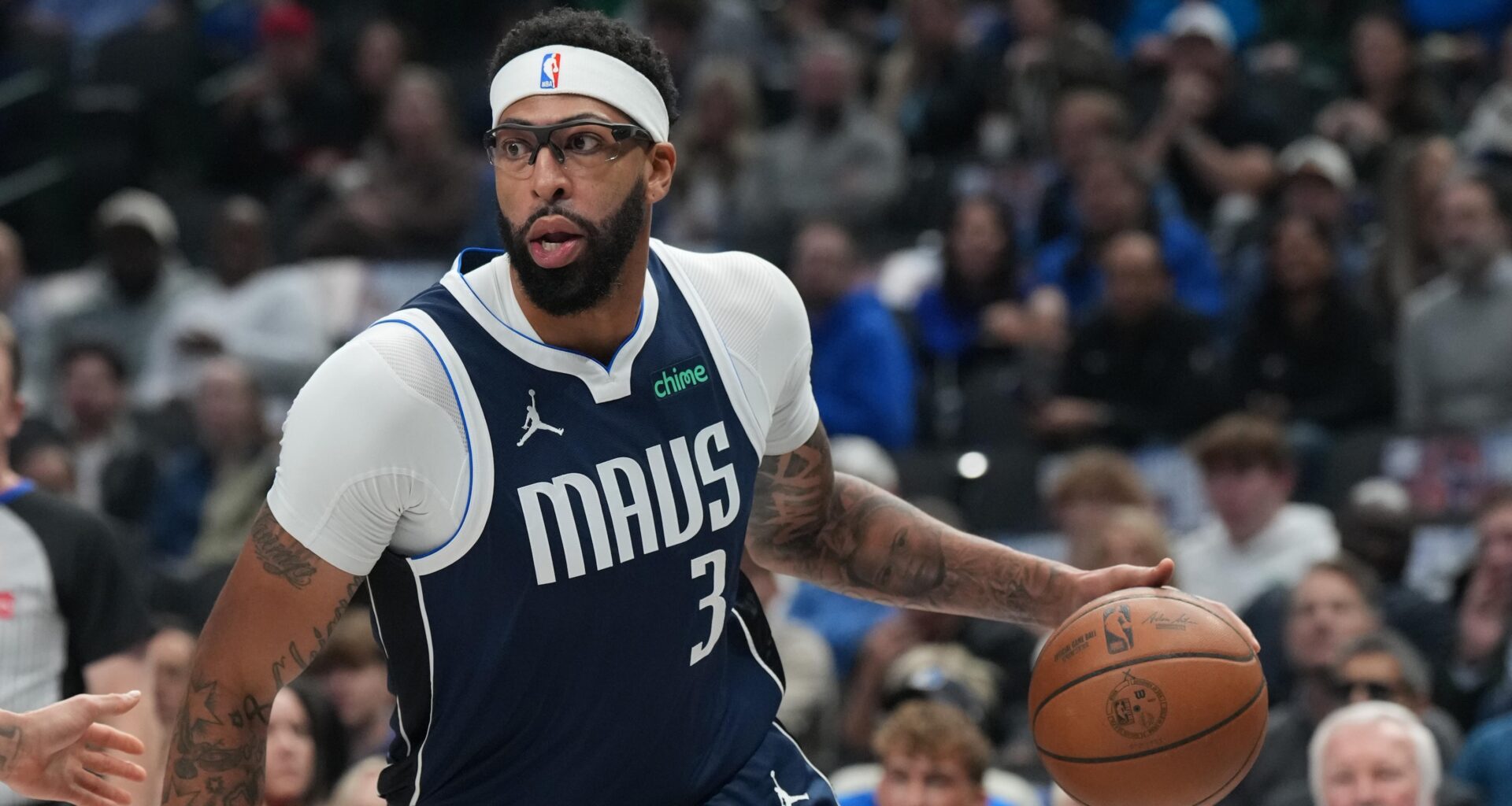
As the Dallas Mavericks have started to play better with their roster looking more like the group they were planning to have when the season began, Anthony Davis’ future is going to be a hot topic of discussion leading up to the trade deadline.
The buzz has already started with ESPN’s Shams Charania reporting on Dec. 9 that teams like the Detroit Pistons, Atlanta Hawks and Toronto Raptors are expected to pursue the 10-time All-Star.
Even though it would seem obvious for the Mavs to trade Davis, it’s not as clear cut right now. The Athletic’s Sam Amick reported on Friday that there has been some mixed messaging from the organization about what they want to do with Davis.
Minority owner Mark Cuban wrote in an email to Joe Vardon of The Athletic on Nov. 19, in the aftermath of Nico Harrison’s firing, that they “want to try to win” when asked about trading Davis.
One other factor that Amick pointed out is how Mavs governor Patrick Dumont would respond to trading Davis, who was the key player brought back in the Luka Dončić deal, if the offers aren’t particularly beneficial to the organization.
That also leads to another situation complicating things. The new financial reality teams are facing under the collective bargaining agreement means they have to be diligent about which players they want to pay big money to.
As one Eastern Conference executive told ESPN’s Brian Windhorst and Tim Bontemps, the new CBA “caused a market correction” that forced teams “to wise up.”
A different Eastern Conference vice president told Windhorst there are certain factors they look for when deciding whether or not to pay star-level players:
“When you look at big deals with star players, you start to see these checklists. Are they on the right side of 30? How old will they be when they might want an extension? Do you have the apron space to do a deal regardless of what the cost is? How does the player fit into your apron now and when you have to pay your younger players? It’s not just how talented the player is today.”
Davis is making $54.1 million this season and $58.5 million in 2026-27, plus a $62.8 million player option for 2027-28. He will turn 33 on March 11 and has a well-documented injury history, including a 14-game absence in November due to a calf strain.
It’s fair to say that Davis’ value is not high right now due to the combination of his age and salary. His stat line also isn’t as strong as it has been, with an average of 20.0 points, 10.5 rebounds and 3.2 assists per game in 11 starts.
That would be Davis’ lowest scoring average since his rookie year in 2012-13 and lowest rebound average since 2021-22.
A real argument can be made that Davis is more valuable to the Mavs on their roster than he would be in a trade.
One hypothetical trade package made by CBS Sports’ Jasmyn Winbush had the Pistons sending Tobias Harris, Isaiah Stewart and Marcus Sasser plus a future first-round pick to Dallas for Davis.
That deal works from a financial standpoint, but where is the boost from the Mavs’ side? A single first-round pick from a Pistons team that looks like it could be very good for a long time with Cade Cunningham isn’t going to have a lot of value. Harris isn’t a long-term investment as a 33-year-old. Stewart and Marcus Sasser have spent the bulk of their careers as backups in Detroit.
Maybe the Mavs could talk themselves into unlocking new levels of play in Stewart and/or Sasser since they are both in their mid-20s, but it’s not an inspiring return for Davis.
Meanwhile, as the talk of a Davis trade heats up, the Mavericks actually have the look of a competent team right now. They have won five of their last six games, including victories over the Denver Nuggets and Houston Rockets.
Head coach Jason Kidd has found a formula that’s been working, especially with regards to developing Cooper Flagg. The rookie phenom is averaging 23.0 points on 56.3 percent shooting, 5.7 rebounds, 3.2 assists and 1.0 steals per game during this recent six-game stretch.
For an offense that ranks 29th in the NBA in rating, the Mavs could also get Kyrie Irving back before the All-Star break to provide a boost.
The big thing hovering over all of this is the 2026 draft. It’s a loaded class with several players who could help the Mavs as they continue to build around Flagg.
A trio of Davis-Irving-Flagg could make the Mavericks too competitive to have a real shot at a high lottery pick, though they are coming off a summer in which they won the No. 1 selection despite having the fourth-lowest lottery odds.
The upcoming draft is significant for Dallas because it doesn’t control its first-round pick again until 2031.
It’s a tough scenario for the organization to be in because there are valid arguments for trading Davis ahead of the Feb. 5 deadline, but the possibility of a soft return might make it more enticing for the Mavs to just ride things out to see what this core with Flagg and Irving looks like before making any big decisions in the offseason.