

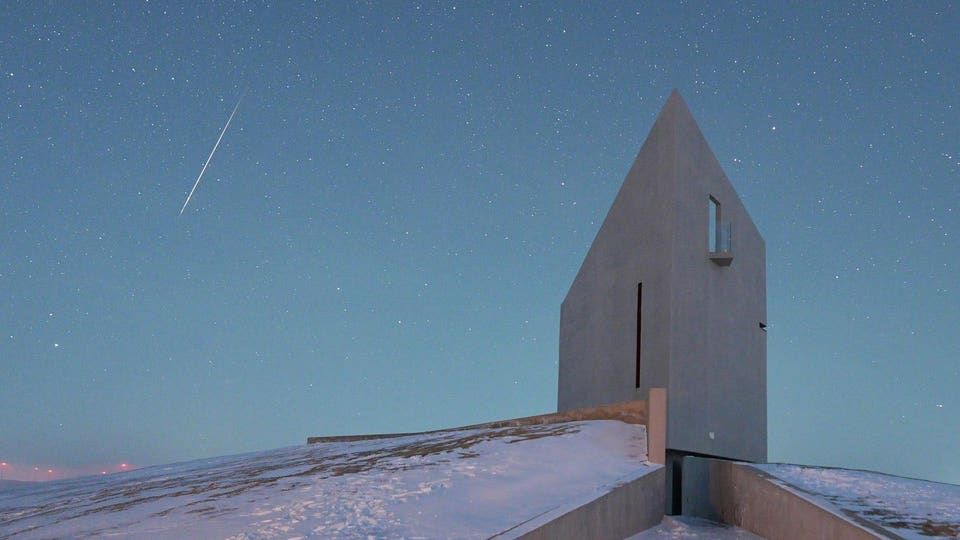
Geminid meteor shower streaks across the night sky on December 13, 2025 in Ulanqab, Inner Mongolia Autonomous Region of China. (Photo by VCG/VCG via Getty Images)
VCG via Getty Images
The annual Geminid meteor shower, one of the year’s most prolific and colorful, has wowed skywatchers across the world.
Best seen in the Northern Hemisphere overnight on Dec. 13-14, the Geminids produced dozens of “shooting stars” per hour during their peak hours.
Rated as the strongest such shower of the year, the Geminids can see as many as 150 meteors each hour.
A “shooting star” is actually just dust and small rocks. Typically, comets melt slightly as they get close to the sun, leaving debris in the inner solar system that they orbit as a stream of material.
Geminid meteor shower streaks across the constellation Orion on Dec. 14, 2025 in Dezhou, Shandong Province of China. (Photo by VCG/VCG via Getty Images)
VCG via Getty Images
When Earth moves through a meteor stream, tiny meteoroids — particles as small as a grain of sand — slam into the atmosphere. As they do so, they burn up, gaining energy. They release that energy as photons of light, becoming visible in the night sky for a split second.
The Geminids are an exception, caused by material coming off an asteroid called 3200 Phaethon, which takes 1.4 years to orbit the sun. The Geminid meteor shower is thought to result from an explosion or a high-speed collision between two objects, according to researchers.
A view shows the Geminids meteor shower streaking across the night sky as stargazers gather at the Valley View of Yosemite National Park in California, United States, on December 14, 2025. (Photo by Tayfun Coskun/Anadolu via Getty Images)
Anadolu via Getty Images
3200 Phaethon mostly behaves like a comet, according to NASA, brightening and forming a sodium gas tail when it’s near the sun. As its surface warns, sodium inside 3200 Phaethon vaporizes into space.
The Gemini’s work much like fireworks. Although mainly yellow or white in color, Geminids can also be green, red and blue, with the color of each “shooting star” determined by trace metals including sodium (yellow), iron (white), nickel (green), copper (green), calcium (purple) and magnesium (blue-white).
Geminid meteor shower streaks across the night sky on December 14, 2025 in Garze Tibetan Autonomous Prefecture, Sichuan Province of China. (Photo by Fu Yujianglin/VCG via Getty Images)
VCG via Getty Images
The Geminid meteor shower is becoming more productive each year. Giant planet Jupiter is exerting a gravitational pull on 3200 Phaethon’s debris stream, bringing it closer to the Earth’s orbital path around the sun.
Although the peak night has now passed, the Geminid meteor shower is active until Dec. 20, though rates of “shooting stars” will now quickly dwindle. The best views come around midnight, when radiant constellation Gemini is high in the sky, with more seen in dark skies.
The next meteor shower is the Ursids, which peaks overnight on Dec. 21-22, with about 10 “shooting stars” per hour visible in the northern night sky as soon as it gets dark. They will be followed by the Quadrantids on Jan. 3-4, 2026, before a pause in major meteor showers until the Eta Aquariids on May 5-6, 2026.
Wishing you clear skies and wide eyes.