
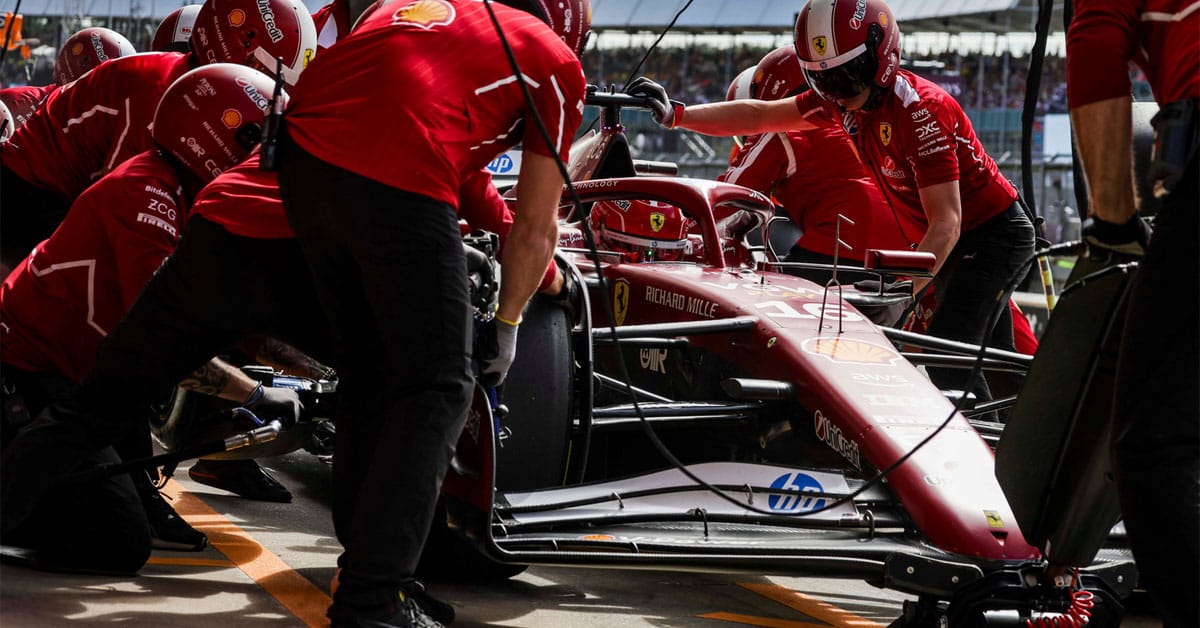
Ferrari is taking a clear and decisive technical direction for the 2026 Formula 1 season by placing tyre management at the very core of its overall performance philosophy. For the upcoming regulatory cycle, the Maranello-based team is making a deliberate and calculated commitment to understanding and exploiting tyre behaviour in far greater depth than in previous seasons. Loic Serra, Ferrari’s technical director, has identified the management of tyre compounds as one of the fundamental pillars of the new era, treating it as a non-negotiable reference point around which many other design decisions are being built.
This is a crucial technical area in which the Scuderia has chosen to invest a significant amount of human, computational and financial resources. The objective remains clear and unchanged: to extract the maximum possible performance from the tyres in order to access peak grip across a wide range of operating conditions. Tyre grip directly affects lap time, consistency over a race stint, and strategic flexibility, making it one of the most influential factors in modern Formula 1 performance. Ferrari’s intention is to ensure that the car can operate within an optimal tyre window more consistently, regardless of track layout, ambient temperatures or race conditions.
There has been extensive discussion throughout the paddock regarding the end-of-season tests that concluded yesterday at the Yas Marina circuit in Abu Dhabi. These post-season on-track sessions have proven to be extremely valuable, particularly for Pirelli, as the Italian tyre manufacturer continued its development work ahead of the 2026 Formula 1 regulations. The primary objective for Pirelli was to assess whether the data generated through advanced simulations correlates accurately with real-world tyre behaviour observed on the circuit.
At the same time, the information collected during these tests is also of fundamental importance for the teams themselves, even if the spotlight is rarely on them during such sessions. The drivers, including experienced race winners and younger talents, were mainly tasked with executing predefined run plans rather than extracting outright performance. Their role during the test day was therefore largely operational, allowing engineers and tyre specialists to focus on data acquisition rather than lap time.
The 2026 Formula 1 cars will be completely different from the current generation of machines, a fact that may appear obvious but remains essential to underline. Both longitudinal loads, such as braking and acceleration forces, and lateral loads, generated during cornering, will change significantly. This is due to a combination of revised aerodynamic regulations and altered power unit characteristics, which together will reshape how forces are transmitted through the tyres.
This context naturally raises an important question: how is Pirelli able to extract meaningful and representative data from these tests, given that the current cars do not reflect the 2026 specifications? It is understood that Pirelli has access to highly detailed simulations of the future cars, developed in collaboration with the teams and the FIA.

For this reason, the tyre supplier already has so-called first-attempt reference values for the longitudinal and lateral loads acting on the tyres. Based on the layout and characteristics of the Yas Marina circuit, specific cornering speeds are imposed during the test runs. These parameters are carefully selected to emulate the conditions that the 2026 cars are expected to generate on the tyres, even if the physical cars on track are still based on the current regulations.
The new tyres themselves will also feature different dimensions, introducing another layer of complexity. The front tyres will be reduced in width by 25 millimetres, while the rear tyres will be reduced by 30 millimetres. This change represents a substantial shift in the way tyres interact with the asphalt.
Within Formula 1, such a modification inevitably produces a series of highly significant, and potentially decisive, consequences. A reduced tyre footprint means a smaller contact patch between the tyre and the track surface. As a direct result, the surface area responsible for dissipating heat is reduced, increasing the risk of overheating under certain conditions. For Pirelli, it was therefore extremely important to assess the blistering resistance of the 2026 tyres, particularly when subjected to sustained loads and high-energy inputs.
F1, 2026: key data for tyre usage from next season
As previously mentioned, Formula 1 teams can also begin to extract valuable and actionable information about the new tyres during these tests. Tyre management is widely regarded as one of the most critical characteristics of a competitive Formula 1 car. Season after season, the same pattern emerges: when a car is able to treat its tyres correctly, maintaining them within the ideal operating window, it tends to deliver a consistently high level of performance.
This trend has been evident across multiple championships and different regulatory eras. A clear and recent example is Ferrari’s tyre management, which proved to be a notable weakness, particularly during the most recent season. Despite having drivers Charles Leclerc and Lewis Hamilton capable of extracting performance, the car often struggled to preserve tyre life over a stint, compromising both qualifying pace and race-day competitiveness.
Each team provides Pirelli with its own internal estimates for the expected 2026 load levels. These projections are then processed by the tyre supplier to create an average reference model that reflects the overall grid. At the same time, each individual team is able to derive its own dataset from the test runs, and these results can differ significantly from one team to another depending on design philosophy and setup choices.
One of the most important parameters collected during this process concerns the vertical stiffness of the tyre. This value describes how much the tyre compound compresses vertically when a given load is applied. Vertical stiffness plays a crucial role in determining how the car reacts to aerodynamic loads, kerbs, and surface irregularities.
This parameter is especially important for aerodynamic development, as the millimetres of vertical deflection must be accurately accounted for when defining the ride-height operating window. Although the wing-car era has officially come to an end, the floor will remain a crucial component for generating downforce in the next regulatory cycle. Its efficiency is still strongly linked to its distance from the reference plane, namely the asphalt surface.
Naturally, this value is not constant and varies depending on speed, fuel load, tyre wear and track conditions. This variability makes precise modelling even more important.
For this reason, the accuracy of the estimates that teams will produce after the Abu Dhabi tests is fundamental to the correct and efficient management of their 2026 Formula 1 projects. At this stage of development, teams already have a tyre model integrated into their simulators. However, they are now in a position to update and refine this model using real-world data. This brings the focus back to Ferrari, which struggled significantly to fully understand tyre behaviour during the 2025 championship.
F1, 2026: Ferrari has designed its next-generation car with a strong focus on tyres
There is little doubt that Ferrari’s difficulties in managing tyres stemmed from an incorrect baseline technical approach with the SF-25. The car often failed to operate the tyres within their optimal working range, leading to inconsistent performance across different circuits. For this reason, the ability to conduct extensive indoor simulation work on such a decisive component as the tyres is considered absolutely crucial in preparation for 2026.
It is widely understood throughout the paddock how vital it is to exploit the tyres correctly in order to unlock maximum grip. According to available information, Ferrari has placed this aspect firmly at the centre of its 2026 project, treating tyre behaviour as a guiding principle rather than an afterthought.
The current generations of Formula 1 tyres have an enormous influence on overall performance, and modern cars are heavily dependent on them. As a result, the Maranello-based team has designed its new car with tyre behaviour clearly in mind. Among other elements, specific development work has been carried out on both the front and rear suspension systems.
Regardless of whether a pull-rod or push-rod configuration is ultimately adopted, these suspension groups must be capable of maximising the exploitation of the tyre compounds. Their role is not only to control mechanical grip but also to manage how loads are transferred to the tyres throughout a lap.
Another important area of focus concerns the tyre hysteresis cycle. Ferrari has collected a large amount of data relating to how much heat the compound absorbs and subsequently dissipates under specific operating conditions. This information is extremely valuable for refining and improving the mathematical tyre model used in simulation environments.
As a direct consequence of these findings, Ferrari is also updating the complete car model within its simulator. This holistic approach allows engineers to study interactions between tyres, suspension, aerodynamics and vehicle dynamics in greater detail.
The ultimate objective is to understand precisely under which conditions the tyre delivers maximum grip. This analysis extends beyond purely thermal considerations and also includes the loads applied to the tyre in complex scenarios, such as combined braking while turning the steering wheel. While a mule car cannot provide perfectly absolute or definitive data in this area, it still delivers vital information. Ferrari is expected to analyse this data extensively through simulation work in the coming weeks, using it as a foundation for finalising key decisions for its 2026 Formula 1 car.
Dec 15, 2025Luca Marini
Let other Scuderia Fans know about us


