
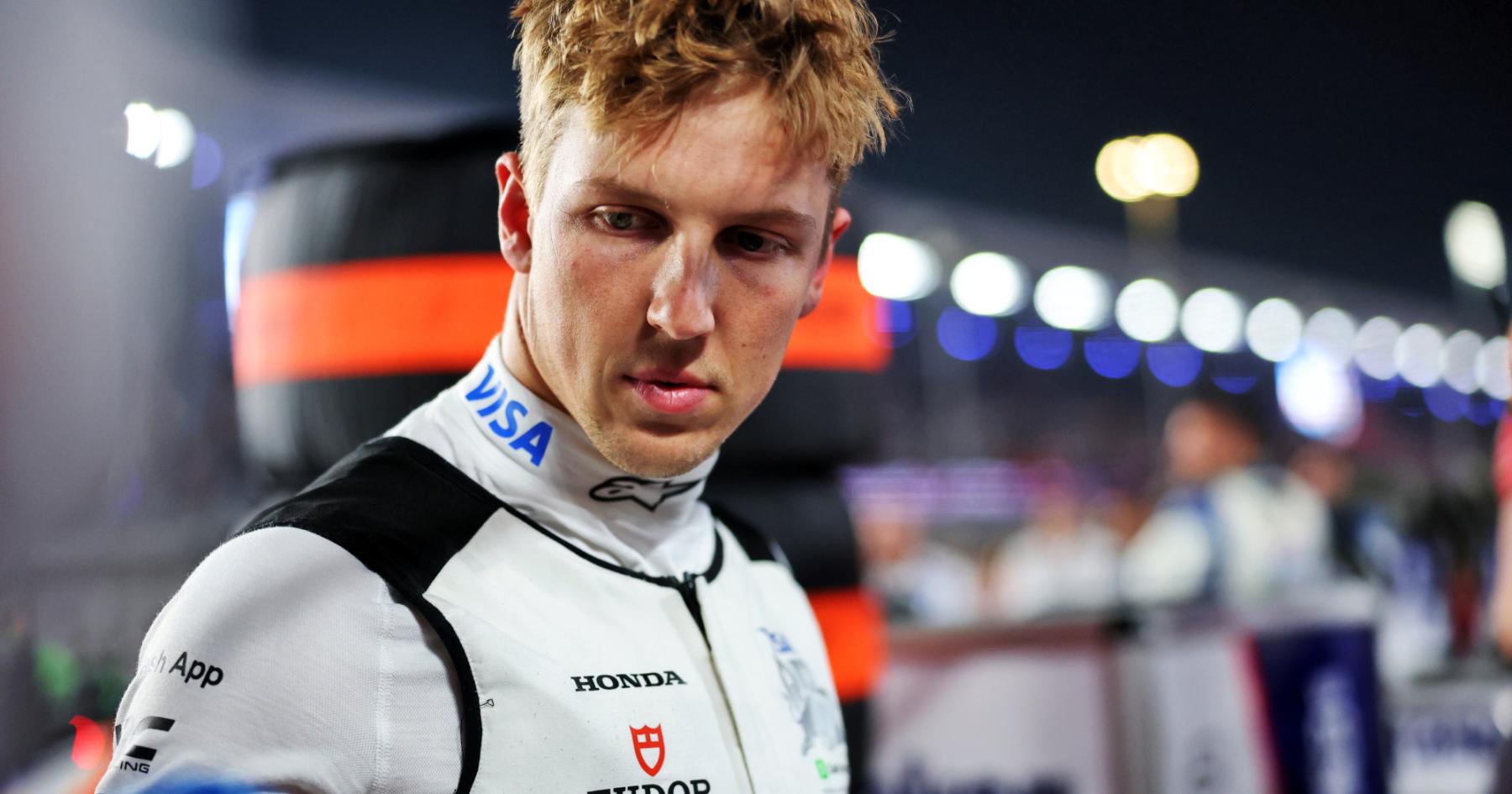
Ahead of the F1 season-ending Abu Dhabi Grand Prix, Red Bull confirmed its 2026 driver lineups, with Liam Lawson prevailing against Yuki Tsunoda in the fight for a Racing Bulls seat.
In Formula 1, reputations can unravel as quickly as they are forged and, for Lawson, the events of early 2025 looked terminal.
Dropped by the main team after just two grands prix, the New Zealander appeared to be another prodigy ground up by the championship’s most unforgiving environment.
Yet, barely a year on, the narrative has shifted again in his favour, with the 23-year-old partnering rookie Arvid Lindblad next season.
Given the fate of Tsunoda, who replaced him alongside Max Verstappen after the Chinese Grand Prix, the question now is whether the brutal early demotion has ultimately saved his F1 career.
Lawson’s brief stint at Red Bull bordered on the nightmarish. A crash in Australia was followed by a disastrous weekend in China, where he qualified last for both the sprint and the grand prix. The writing was on the wall.
“Unfortunately, I don’t really have time,” Lawson admitted at the time, a rare moment of candour that underlined the pressure of adapting to a car developed around Verstappen.
Helmut Marko was typically unsparing. “Liam qualified 20th twice. And that’s difficult to do worse than that,” he said, later conceding the situation had become “a downward spiral” that needed to be stopped to protect Lawson’s future.
How he saved his F1 future
That intervention came swiftly, with a return to Racing Bulls. The immediate results were underwhelming — five rounds without a point — but the underlying performances told a different story.
A return to form in Monaco offered a glimpse of revival, before Austria became the true inflexion point. Sixth on the grid, sixth at the flag, and suddenly Lawson looked like a driver reborn, despite long maintaining it was not a “turning point” in his campaign.
From there, consistency followed. Points finishes across Belgium, Hungary, Azerbaijan, Brazil and Qatar delivered 38 points and restored credibility, even in the face of some difficult rounds, like his disastrous weekend in Singapore.
“The confidence came back once I could build things step by step,” Lawson reflected later in the season. “That’s something you don’t get time for at the front.”
It is that trajectory which explains why Red Bull opted to retain Lawson for 2026, rather than Tsunoda.
Laurent Mekies spoke repeatedly about Lawson’s technical feedback and resilience, qualities seen as vital alongside teenage sensation Lindblad.
“Liam showed maturity in the hardest circumstances,” Mekies noted. “That counts for a lot.”
Tsunoda’s move into a reserve role suggests Red Bull sees a ceiling Lawson has yet to reach. In a sport obsessed with momentum, losing the Red Bull seat looked like the end.
Instead, it may have been the reset Lawson needed — proof that, in Formula 1, survival often matters more than speed alone.