

EDITOR’S NOTE: Call to Earth is a CNN editorial series committed to reporting on the environmental challenges facing our planet, together with the solutions. Rolex’s Perpetual Planet Initiative has partnered with CNN to drive awareness and education around key sustainability issues and to inspire positive action.
Malati Mondal’s husband was killed by a tiger. He was attacked about a decade ago, as he went out fishing on a small raft through the mangroves. Living in the Sundarbans, the planet’s largest mangrove forest which straddles West Bengal, in India, and southern Bangladesh, it’s a risk communities increasingly face.
The UNESCO World Heritage site is a labyrinth of tidal waterways, mudflats and islands, home to an astonishing range of endangered species, including river dolphins, the Indian python and the Bengal tiger.
Unlike most big cats, these tigers live an amphibious lifestyle, swimming long distances to hunt fish and crabs. There are an estimated 125 living across the Sundarban region of Bangladesh, and around 88 on the Indian side. But a combination of shrinking tiger habitat due to deforestation and growing human populations has led to an increase in human-tiger conflict, according to conservationists.
There is more competition for food resources, says Saurav Malhotra, a project leader at international nonprofit Conservation International. Men, who venture deep into the forest to hunt for fish, are disproportionately attacked.

Official records of these killings are sparse –– one estimate suggests that 300 people and 46 tigers have been killed in human-tiger conflicts since 2000 –– but there is lasting evidence of their deaths in the number of “tiger widows” that have been left behind.
These women, like Mondal, have traditionally been treated as outcasts and blamed for their husbands’ deaths. They are called “swami khejos”— which translates as “husband eaters” in Bengali — which prevents them from traditional occupations like farming and fishing. The stigma not only leaves women without livelihoods but government aid. Many of the tiger attack deaths result after illegal entry into the forest, so they’re disqualified from financial compensation, leaving them with little to care for themselves and their children.
A new conservation initiative targeted at tiger widows hopes to help these families reestablish their places within the communities, providing them with a source of income while restoring the environment they –– and the tigers –– depend on.
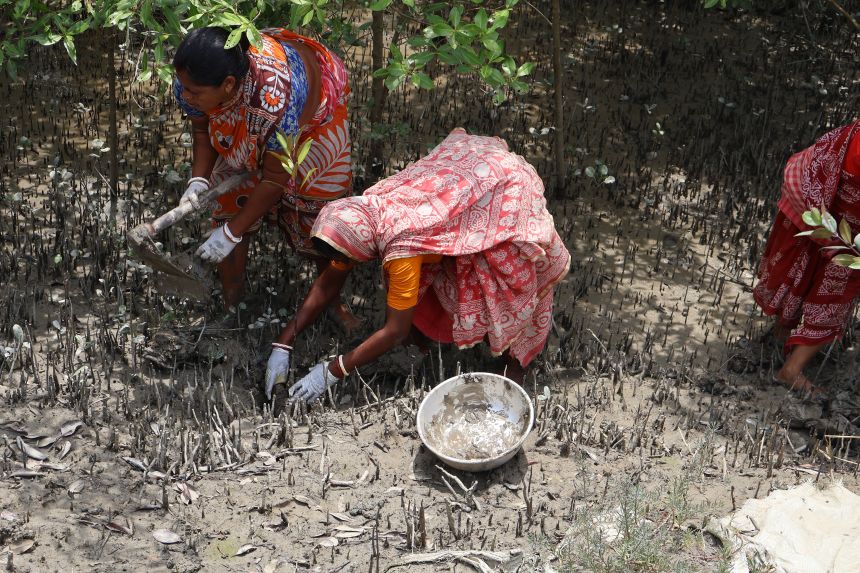
Focused on the Jharkhali region of the Sundarbans, along the Matla River, Shahif Ali, a 26-year-old fellow at i-Behind The Ink (IBTI), a social enterprise that runs a youth rewilding program, is leading the effort from the ground. He has brought together tiger widows, along with other local women, to restore 100 hectares of mangrove forests. This week, they are planting more than 100,000 saplings across 40 hectares of coastline between the two villages Laskarpur and Vivekananda Palli.
Currently, these villages are vulnerable to rising seas and storm surges, protected by a single embankment, says Ali. “If the embankment breaks, the entire village can be destroyed: homes, agriculture, lands, everything.”
Native mangrove saplings that have been grown and cared for by the women over the last six months are planted in front of the embankment, helping to restore the dense forest that was cleared to make way for farms and fishing, and provide an extra defense against the violent cyclones that are becoming more intense and frequent with climate change.
The forest will also act as a barrier against increasing water salinity caused by flooding, which threatens the health of mangroves, destroys soil and crops, and disrupts fish populations.
The idea is that with time, fish populations will rebound, providing more food both for humans and tigers, resulting in less human-tiger conflict.

Mondal is one of the seven tiger widows currently involved in the project, out of a total of 59 women. Twenty more widows are joining the initiative later this month, and Ali says he has interest from at least 75 more. The challenge is that the women are scattered across the region and safe travel options are limited, plus it takes time to build their trust, he says.
The women are paid 300 rupees ($3.30) a day for the work, which may not sound like a lot but “brings real change,” says Ali. “It’s the difference between ignoring an illness and getting treatment; between skipping meals and feeding their children properly.”
Across the Sundarbans, on both the Bangladeshi and Indian side, similar efforts to restore mangroves through livelihood programs have taken place, including others targeted at tiger widows, like the community-led initiative Jharkhali Sabuj Bahini.
Restoring forest and lives
The mangrove restoration forms part of Conservation International’s larger “Mountains to Mangrove” initiative, which spans the Himalayas to the Sundarbans, aiming to protect and restore 1 million hectares of forest over this area. It has one of the densest human populations of any biodiversity hotspot on Earth, says Malhotra, and is facing huge challenges from climate change and deforestation.
The 100 hectares of mangrove restoration in the Sundarbans is a tiny proportion of the overall target, but Malhotra hopes the project will scale and provide a blueprint for restoration across the wider area.
“The ultimate goal is to bring mangrove ecosystems back, because bringing mangrove ecosystems back is the most holistic way of creating resilience against all the challenges of climate change,” he says. Being able to do this while providing income opportunities for women whose lives have been disrupted by tiger attacks is a huge bonus.
“The women are working towards a cause that has disrupted their own life,” he says. “It’s about restoring dignity and building resilience for these women and for the broader community.”
Ali’s vision is to do just that. “I want to expand the project in most backwaters and vulnerable parts of Sundarbans, and I’m ready to travel, walk into remote places … because when the project grows, we can reach more people,” he says.
“I have met many tiger widows,” he adds. “My focus is to build a safe space for women who are working with us … Once they feel secure and respected, others will be inspired to join too.”