

Listen to this article
Estimated 5 minutes
The audio version of this article is generated by AI-based technology. Mispronunciations can occur. We are working with our partners to continually review and improve the results.
A pair of artificial intelligence companies plan to build a data centre south of Winnipeg powered by natural gas turbines.
In a series of communications to potential investors over the past month, Las Vegas-based Jet.AI and Vancouver’s Consensus Core announced plans to build an AI data centre on a 141-hectare (350-acre) parcel of land north of Île-des-Chênes, in the R.M. of Ritchot.
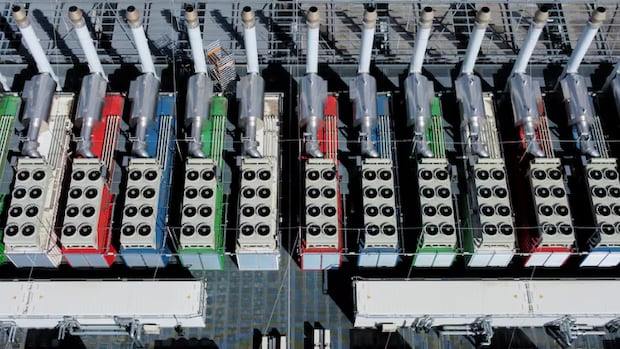
A natural gas-fired power generation plant with as many as six turbines would be built on the same Ritchot campus, the companies said in their communications.
The companies did not disclose a dollar value for the proposed investment but suggested it would be significant.
“If approved, this development proposal would deliver a business and technology win for Manitoba,” Consensus Core CEO Wayne Lloyd said in a statement issued Friday.
“The Ile-des-Chênes project would create a made-in-Manitoba world-class data centre, create new, well-paying jobs, and also add new local electricity generation to the provincial grid, reducing Manitoba’s reliance on imported power.
“We look forward to continuing to work with government officials as well as engaging the local community to bring this project to reality.”
Consensus Core bills itself as a provider of “high performance GPU infrastructure for AI,” which means it allows clients to access graphics processors over the Internet. Jet.AI is an aviation software company that has diversified into artificial intelligence.
In a document published on its website, Jet.AI states that it has reached an agreement to purchase the land north of Île-des-Chênes, which was once slated to serve as the home of a cryptocurrency operation owned by a company called Blockharvest Inc.
Jet.AI said the Ritchot land sits at a “unique confluence of abundant hydroelectric power and significant natural gas capacity, making it an ideal site for data center development.”
Consensus Core said in a statement the project is in a preliminary stage.
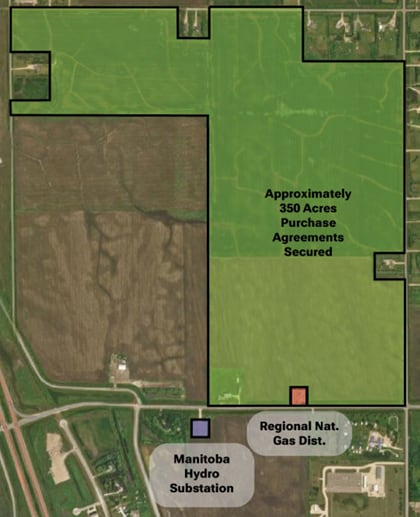 The proposed location for a data centre north of Iles-de-Chenes, in Ritchot. (Jet.AI)
Ritchot Mayor Chris Ewen said the companies have made some early inquiries to the rural municipality but have not many any proposals of any sort.
Manitoba Hydro is not aware of the project and cannot comment, communications director Scott Powell said.
A spokesperson for Adrien Sala, the minister responsible for Hydro, said there are no requests to connect an AI data centre in Ritchot to Manitoba’s power grid.
The province placed a moratorium on connecting cryptocurrency operations to Manitoba Hydro’s grid in 2022 and passed legislation this year to require more scrutiny of energy-intensive companies before they are allowed to connect to Manitoba’s power grid.
The provincial government also plans to wean Manitoba Hydro off natural gas as a source of power, although it has approved Hydro plans to build three new gas turbines in Brandon capable of generating 750 megawatts of electricity.
Sala said last week in an interview said the province will be choosy when energy-intensive new projects, including data centres, request access to electricity.
Premier Wab Kinew said in October preference will be provided to data centres that keep information in Canadian hands and have significant economic benefits for Manitoba.
“Some data centres have specific focuses, like supporting sovereign data and AI, that could create more value for Manitoba. Some will have greater levels of FTE [full-time equivalent jobs] associated with them,” Sala said in an interview on Thursday.
“So we need to look at every project on its own merits and then determine what the best path forward with the lens on creating the greatest benefits for Manitobans.”
Laura Cameron, a program director for Manitoba’s Climate Action Team, expressed concern of the provincial support for data centres, which require a lot of electricity to function as well as water for cooling during the summer months.
“It’s unclear how Manitobans would benefit from this very energy-intensive and water-intensive industry that doesn’t create very many jobs at all,” Cameron said in an interview.
According to Statistics Canada, Manitoba has eight data centres. Seven are located in Winnipeg and one in Winkler. None are large and none specialize in artificial intelligence.
Blockharvest, the company that proposed the cryptocurrency operation at the site where the AI data centre is now proposed, sued Manitoba Hydro International and Manitoba Hydro’s board in 2024.
In a statement of claim filed with Manitoba’s Court of King’s Bench, Blockharvest claimed Hydro and its board conspired to put off the project until the province enacted a moratorium on crypto connections to Manitoba Hydro’s grid.
No statement of defence has been filed.