
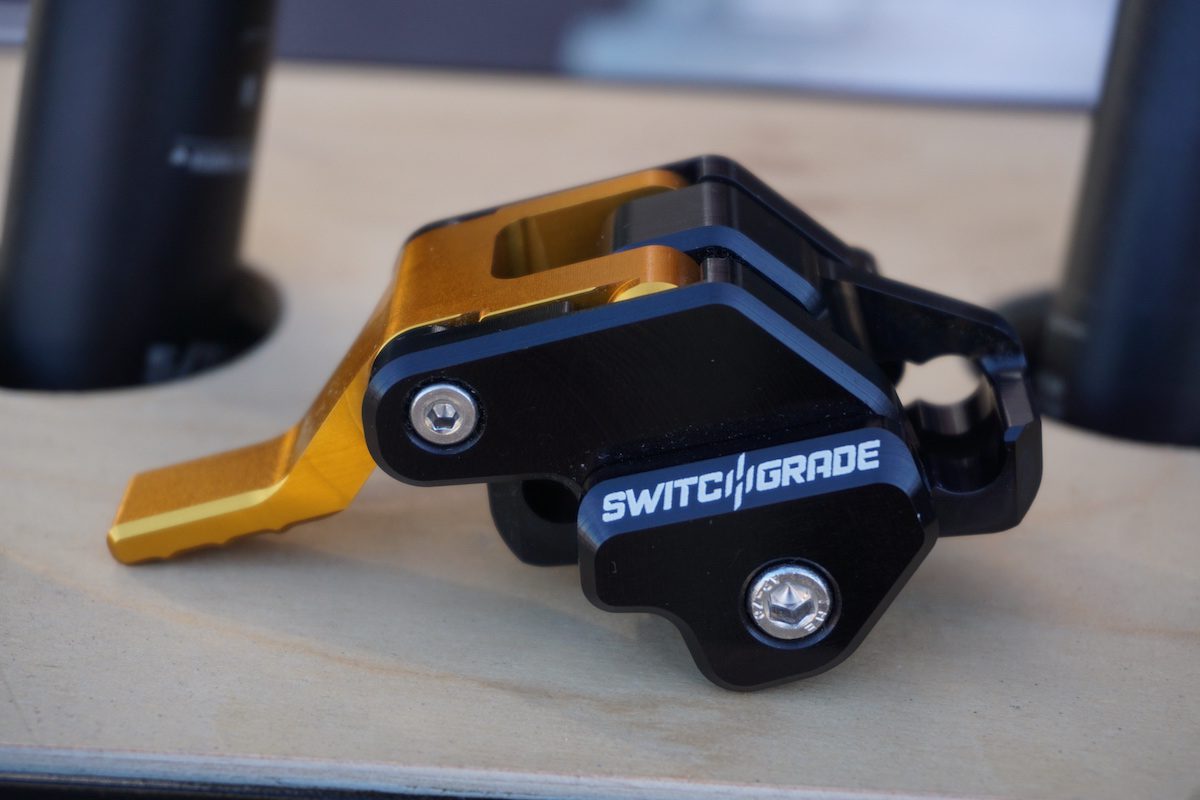
In the history of mountain biking, there is a long list of tech that was deemed “unnecessary,” only to become ubiquitous. 29″ wheels and dropper posts stand out as two of the more glaring improvements that were initially rejected. While Aenomaly’s SwitchGrade, a seat angle adjuster, may not ever achieve the pervasive acceptance that dropper posts have, I think it could be a truly-game changing part for a wider range of riders than you might expect.
After over a year of riding with the SwitchGrade on different bikes, and missing it while riding others, here’s some thoughts on why more riders should consider upgrade to this B.C.-made innovation, and why others might want to give it a pass.
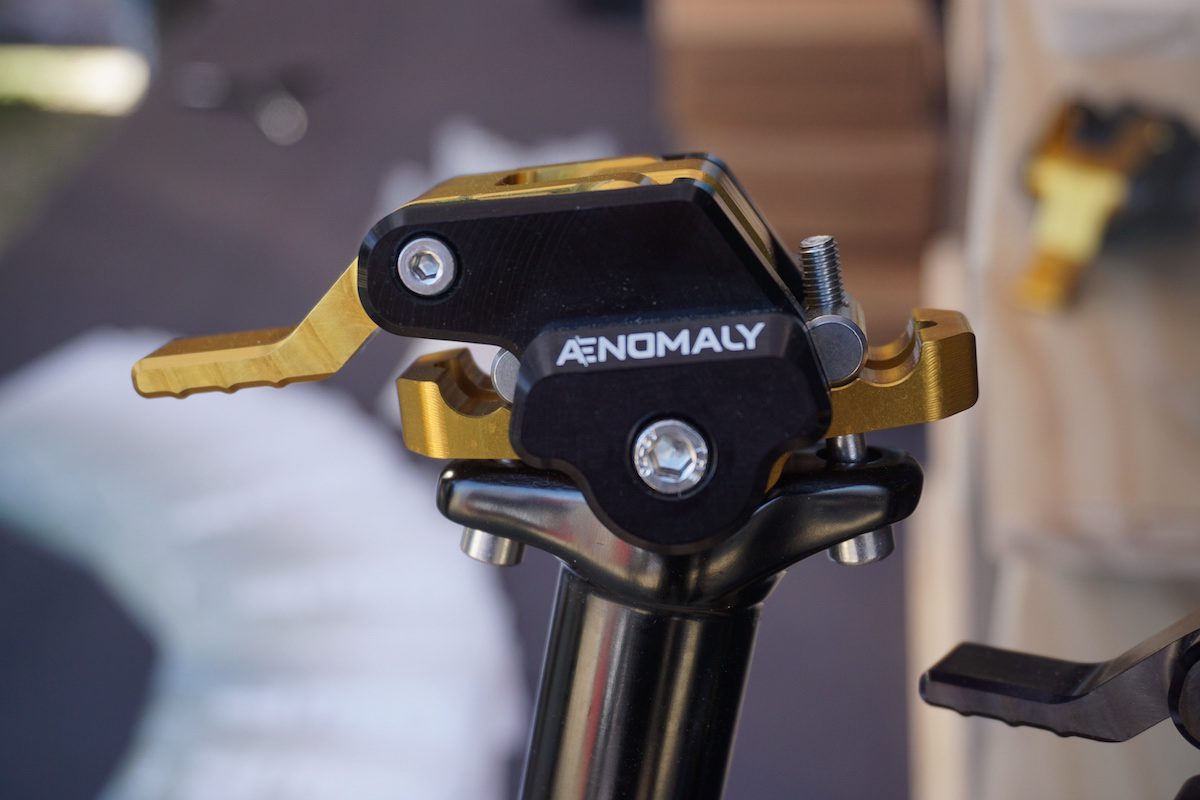 Aenomaly SwitchGrade, installed without a seat.
Aenomaly SwitchGrade: What is it?
Aenomaly is a lever-activated seat angle adjuster. Replacing the upper mounting bracket on a seatpost, it gives the option of quickly moving between three different seat angles. It’s the answer to the question, what if there is no such thing as a perfect seat angle? What if the best seat angle is different when you’re descending versus when you’re climbing?
It’s also the answer to quieting the many aches and nagging back pains so many riders experience while climbing. It’s not an e-bike, it won’t do the work of climbing for you. But it’s truly impressive how much of a difference it can make to how hard climbing feels.
It’s not just about climbing, though. The three angles are set for climbing, neutral and descending. The latter allows you to take full advantage of the dropper post the SwitchGrade is more than likely installed on top of, giving more range of movement on the bike when the seat post is slammed for descending.
Freedom to rethink seat angle
Most rider’s seat position, I would argue, is an imperfect compromise. It’s a balance between what’s most comfortable pedalling across and what’s most comfortable, and powerful, while climbing. If you set your angle for climbing, it puts a ton of weight on your hands while riding on flat terrain (and is just generally uncomfortable). If you set your seat angle for the most comfort on the flats, climbing can feel like you’re sliding off the back of your seat. It can also reduce the power you’re able to tap into at a time when you want it most.
This is something we all know in the back of our heads. We set our angle to be comfortable when it annoys us the most and deal with it the rest of the time. Then we mostly don’t think about it. The SwitchGrade opens up that conversation in a way that I can’t quite quiet when I’m not riding with it.
Old ideas made new
The first time I really thought about seat angle – or getting wild with seat angle – was long before the SwitchGrade came along. It was seeing 2012 Olympic XCO champion Jaroslav Kulhavy ride for the first time. In his heyday, the Czech racer was as fast as his seat angle was weird. It was a constant “bike check” headline, and punchline, to show the nose of his saddle aggressively diving down from a neutral angle. The reasons made sense, or a certain kind of racer-sense: it gave Kulhavy way better power transfer on the hills. And Olympic XC racing is all about the hills.
In the extreme world of World Cup racing, his function-first seat angle made sense. It also won him two Olympic medals. But that was pretty much the only world it made sense in. For the rest of us, no matter how much a different seat angle would help on the climbs, it was not a realistic path to follow. Kulhavy retired and a more reasonable approach to seat angles has reigned supreme since.
But not talking about seat angle is not the same has having the best seat angle. After riding with the SwitchGrade for a year, it’s changed how I set my seat, even when I’m not riding with it.
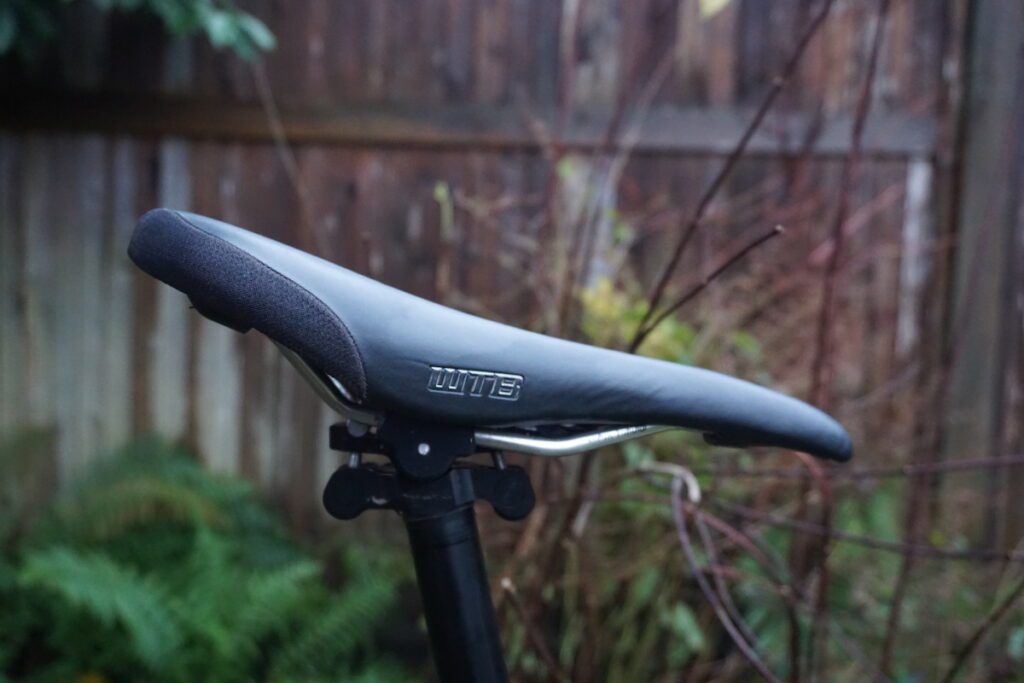 Nose down for climbing
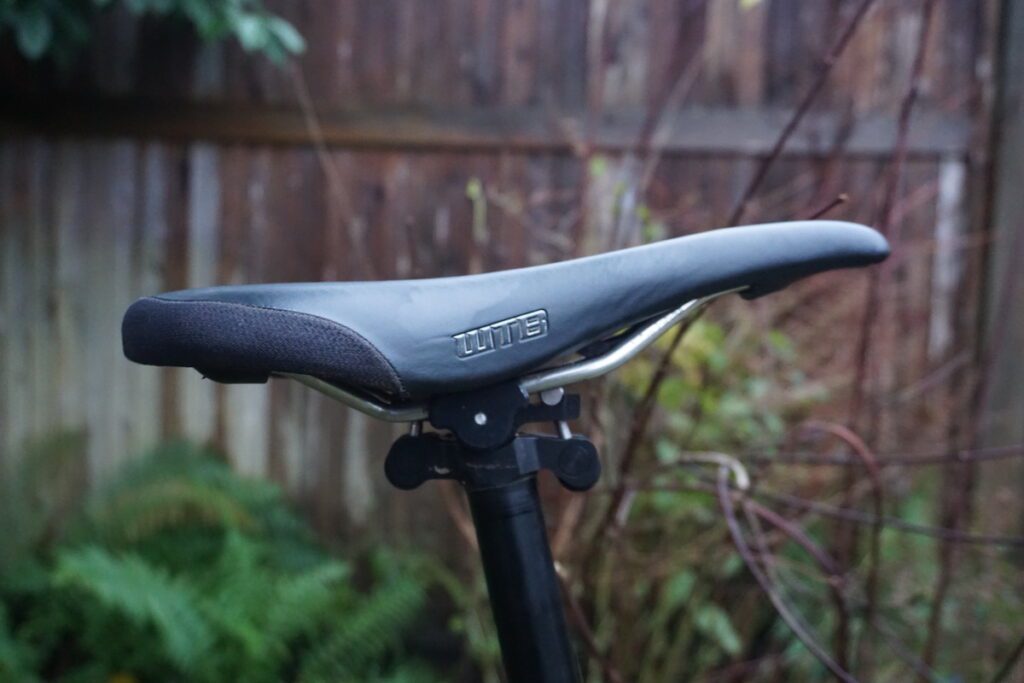 Tail down for descending
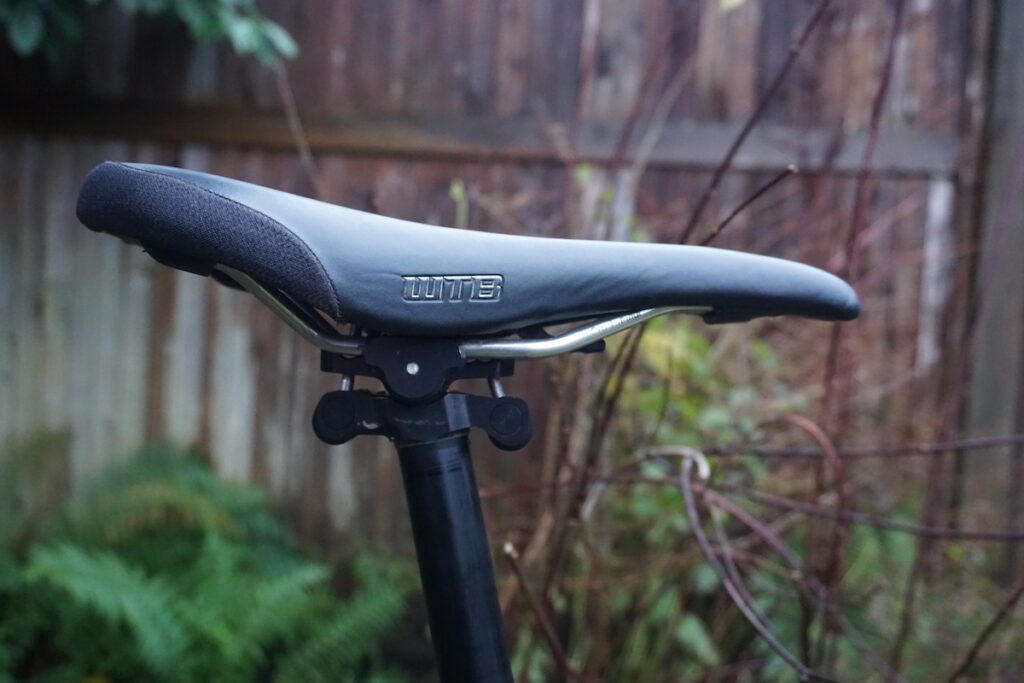 Neutral, or neutral for my very long bike
Back pain, other pains and dropper posts
Ask any mountain biker and they’ll tell you something about lower back pain. Even the fittest riders start to feel the burn when steep grades last long enough. But, as some of us age along with our maturing sport, it no longer takes hours, or even being on a bike, for the thought of climbing for an ache to start swelling up in the lower back. But what if there was a solution? Like, a really easy solution? Like changing your seat height on the fly.
That’s exactly what Aenomaly promises. Despite knowing that, I was still amazed how much of a difference it made in practice. Clicking it into climb-mode when I hit the first big hill, I was amazed how much more power it felt like I had, not just how much more comfortable it was. It doesn’t actually give you more power, but it does access let you access all the potential you have. If you’re not hunched over, clinging on to the bars you can get a lot more power down.
That seat position also improves control, since your weight is driving directly down into the back wheel. That makes it easier, especially on modern long and slack bikes, to keep more balanced weight on both wheels. One pleasant surprise was that this made it easier, in turn, to tackle trickier sections of steep singletrack climbs. Tight switchbacks were notably easier.
A new neutral
After seeing how much of a difference it made climbing, the next step was going back and finding the best neutral position. As I mentioned earlier, I think most rider’s seat angle is a compromise. With no longer having to set my neutral position with climbing in mind, I was able to re-set the neutral position so it was more comfortable on flat terrain.
The last element of this is that Aenomaly designs this to be used with most models and brands of dropper post. The third, descend position allows you to maximize the benefits of long dropper posts. Get the seat down, then tilt it up (like most downhill riders would) to reduce the chance of catching clothing on the seat and let you move around more freely on the bike.
Now, it can be easy to be sold on new gadgets. The proof that SwitchGrade is onto something is that, after a year of going back and forth with it, I still miss it on steep climbs when I’m riding other test bikes.
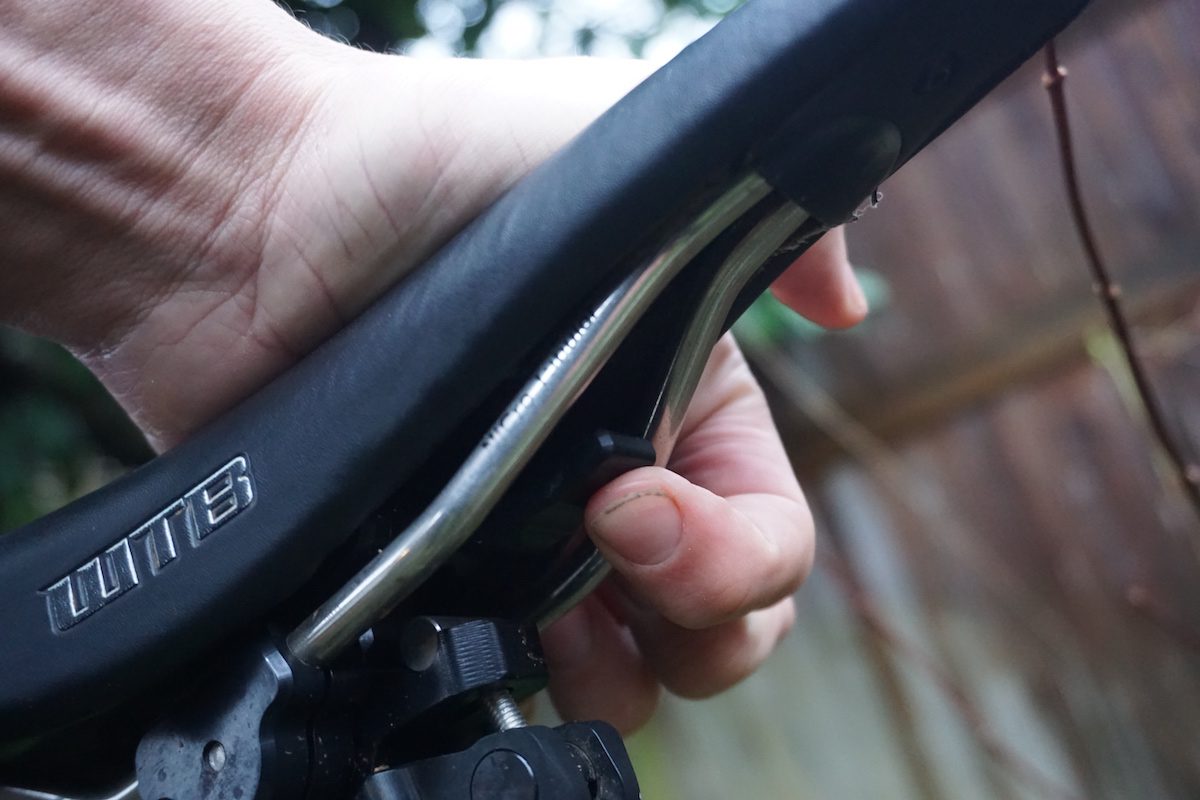 The shiny colours look nice but the black-on-black disappears on the bike. And colour doesn’t matter when you’re hunting for the lever by feel.
Practical magic and the limits of practicality
There are some limitations to the SwitchGrade that, I think, hold it back from the sort of universal adoption dropper posts enjoy.
The most obvious is the lack of a remote option. Having to reach under the seat to find the lever to adjust seat angle makes the SwitchGrade’s function better suited to long climbs and descents than rapidly rolling terrain like, say, the Don Valley. That said, dropper posts also started with under-seat levers so maybe we’ll get a remote eventually. It also took a second to get used to but, like most, new gadgets, I got the hang of finding the correct saddle position pretty quickly.
The other limitation is compatibility. The second generation of SwitchGrade (EVO 2.0) allows it to be much more broadly compatible, with different sets of shims. It also adds around 10mm of stack height, which could be an issue for some riders that already don’t have much post showing above their frame.
I also found the most benefit when climbing grades were the steepest. That’s because there are relatively substantial steps between neutral and climbing modes. On flatter rides or shallower climbs, I found myself settling into the neutral setting and not really touching the SwitchGrade.
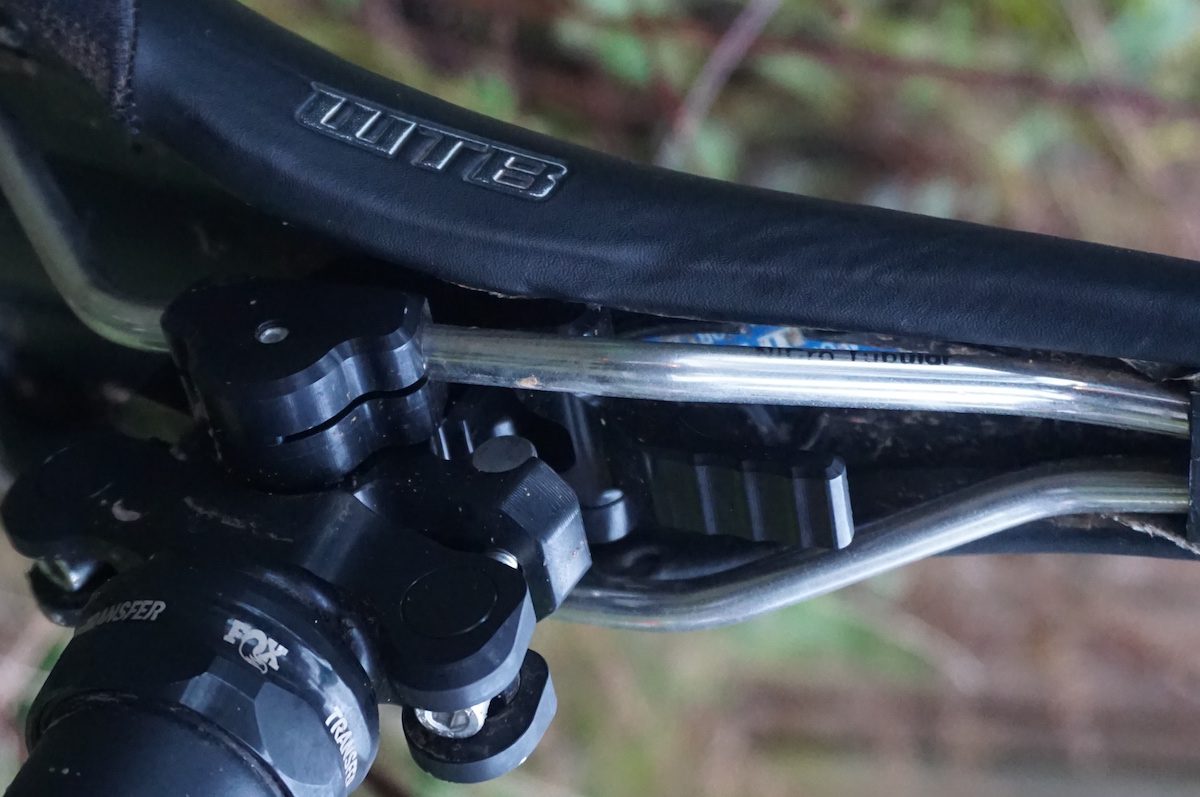 The lever tucks in nicely so it doesn’t get caught on anything, but it’s still easy enough to find while riding with some practice.
Who is the SwitchGrade for?
So, who stands to benefit the most from a SwitchGrade? I think there’s a few types of riders.
Anyone who regularly tackles long (over a few minutes), sustained, and especially technical or steep climbs will get an obvious advantage worth the minor weight penalty.
This goes doubly for eMTB, where increased control and comfort while climbing are a huge benefit. The motors already doing most of the heavy lifting, might as well take the comfortable way to the top.
Anyone, no matter where you are, that feels like back pain is limiting your riding. The added support while climbing could be a big benefit, even on shorter climbs.
Arguably, bikepacking, where there are regularly long climbs with loaded bikes, and gravel riding where steep grades and long climbs are a regular thing. For both, the Evo 2.0 model can be converted to just two positions, climb and neutral, which makes quickly switching between them quicker.
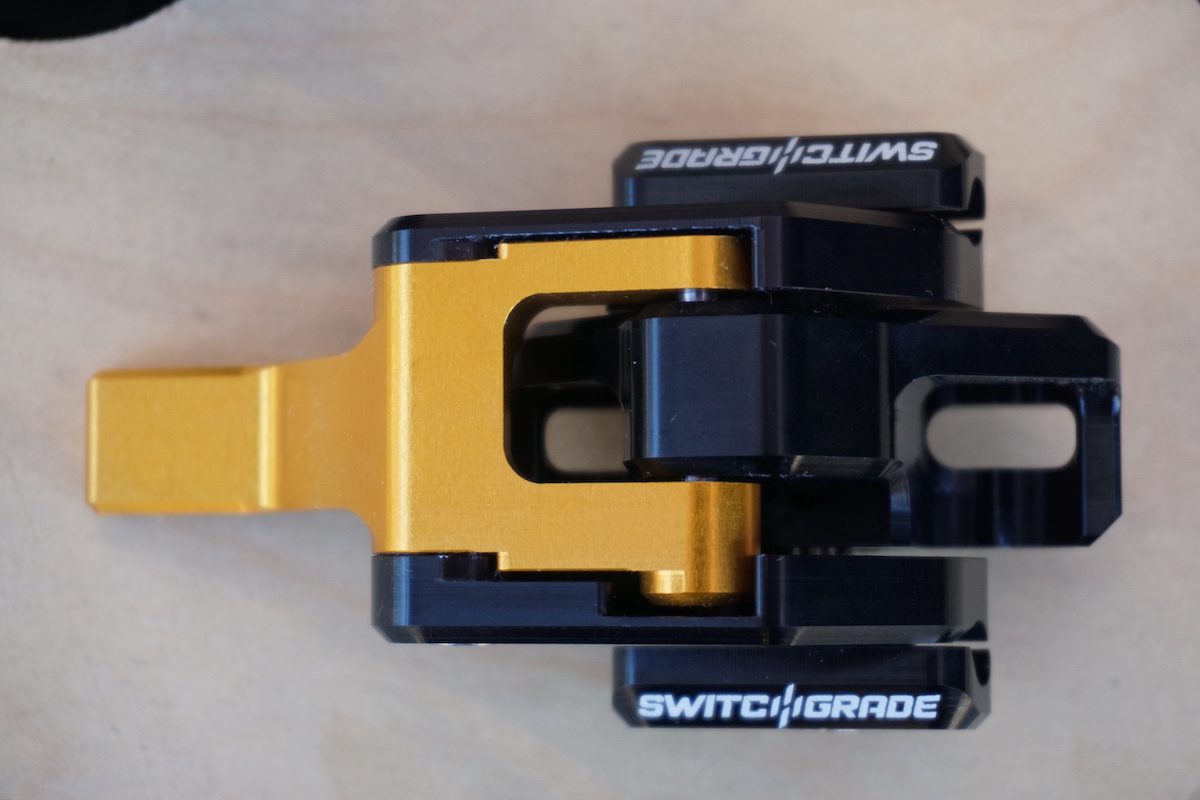 Again, fun colours are fun. And Aenomaly offers a range of colour options.
Machined in Whistler
A bonus for Canadian riders is that the SwitchGrade is designed and machined in North Vancouver. It is CNC machined from 7075-T6 and 6061-T6 aluminium. It has a very solid, robust feel while only weighing 158 grams. The beautifully machined parts have required zero maintenance in a year of riding, though Aenomaly does offer rebuild kits. There are a few colour options, as well as titanium bolt upgrade kits. The black-on-black version tested here has the advantage of nearly disappearing under your seat.
Installation was easier than expected, with clear instructions from Aenomaly. It would take a shop minutes. It took me a little longer, with a little fiddling to get the front bolt installed cleanly and to set the neutral angle. Reading the very simple instructions first would have made it faster.
Long, loooong road to production
With any truly new idea, I’m always keen to find out more about how it came to be. Why was this created? Why had it never existed before? So I asked Noel Dolotallas, Aenomaly’s founder how it about the experience of turning the SwitchGrade from an idea to a polished piece of aluminium.
Dolotallas first has the idea for an adjustable seat angle way back in 1997 (and has the napkin drawing to prove it). From there, he developed the now-patented locking mechanism to make it possible. Then he had to make that mechanism work with the wild west of post design. Work kicked into high gear in 2017. From there, it still took time.
“Making the SwitchGrade universal was really really hard,” Dolotallas explains,”There are virtually no standards for seatposts, except for saddle rail diameters.” Much, much research later, Aenomaly dealt with this by offering shim kits to make one post head design work with nearly every post style out there.
Dolotallas adds that, other than the joy of seeing people happy to use his component, “The most satisfying thing about seeing the SwitchGrade come to life has been the innumerable conversations I’ve had with like-minded riders who either had a similar idea, or were inspired to pursue their own inventions and innovations. As a lifelong dreamer and doer, I get a huge kick talking to people and helping them through their “wacky” ideas. I say “wacky” in quotations because the truth is most successful products and services started off as wild, audacious ideas which were all wacky at one point – but that’s what defines innovation.”
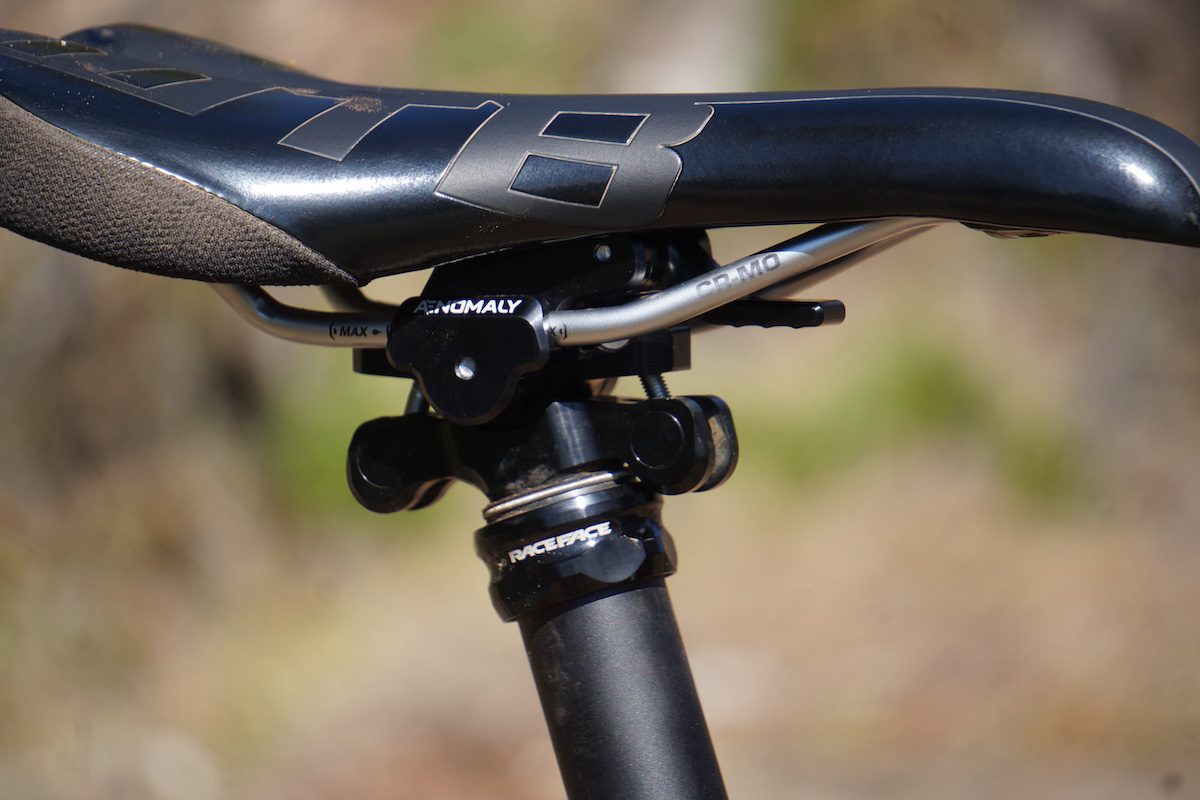 A Gen 1 SwitchGrade. The 2.0 has a lower stackheight.
Final thoughts: Aenomaly SwitchGrade
Where Aenomaly falls into the long history of mountain bike innovations remains to be seen, but it deserves a place on many rider’s bike. After over a year with one, I’m thoroughly impressed by the concept and execution. While I still wish there was a remote, it’s worth reaching for any time a climb is long enough to settle into a rhythm. SwitchGrade is a natural successor to dropper posts. We can change our seat height on the fly, why not change our seat angle to match, too?
If back pain is getting in the way of your riding, this should be a no-brainer. If you just want climbing to be more comfortable, or to go faster on climbs, this will do that. And if you want a more familiar descending position on a bike you have to pedal up, this will do that too. If you only ever ride mostly-flat trails, gradual climbs or really short climbs, it might not be your cup of tea.
Not every product has to be for everyone to be a success. I think it’s great that this idea made it into reality because it will make a good number of people’s ride experience better. That Aenomaly’s pulled off the concept with such exceptional quality is all the more impressive.