

NIAGARA FALLS, Ontario — Carson Carels was sitting in the dressing room at Victoria’s Save-On-Foods Memorial Centre. He’d just scored the overtime winner over the home Royals when Jim Playfair, Carels’ associate coach with the Prince George Cougars, came into the room and told him, “Make sure you stay by the phone, you’re expecting a call.”
He immediately stepped out and fielded a call from Al Millar, general manager of Canada’s World Junior team, inviting him as one of nine defensemen vying for eight jobs at the team’s training camp in Niagara Falls.
It’s a call that, when the season started, he hadn’t even considered getting.
“It was a little bit unexpected,” he said. “It wasn’t really on my bucket list this year.”
Carels turned 17 at the end of June, and just 12 under-18 defenseman have ever played for Canada at the tournament. If he and fellow 17-year-old defenseman Keaton Verhoeff make the final roster, they’ll be the fifth- and sixth-youngest to do so.
He knew Playfair and his head coach and general manager, Mark Lamb, had been pushing for him to get the invite, but it still came as a surprise.
Carels started the year as a potential top 10-15 pick in the 2026 NHL Draft. Now he’s being discussed as an option as early as fifth or sixth, where he could be the second defenseman taken after Verhoeff. He has become a hot topic in NHL scouting circles for his universally well-liked brand of hard, physical and firm hockey.
That brand — and who he is on and off the ice — comes from home. And it’s the first place he called after he hung up with Millar.
Home for Carels is different than home for a lot of the other top prospects who surround him at Canada’s camp.
Farm boy and Nashville Predators prospect Brady Martin can relate, but not everyone can.
Home is Cypress River, Manitoba, which he describes as a “small town of about 50 people in the middle of nowhere,” one hour southeast of Brandon and two hours southwest of Winnipeg. His family’s farm is five minutes out of town and has passed through multiple generations of Carels now. His grandfather was one of 12 kids, and his dad, Ryan, has helped turn it into a family-run business that now has 500 head of cattle. They used to work in dairy, but these days they’re a growing beef operation.
When calving is done, they can now have as many as 1,000 cows on the farm at a given time. Carels jokes that all he has ever thought about is farming and hockey.
In the offseason, he spends his days tagging cows, checking on the herd and cutting hay on the tractor. If the family needed him to, he could run the farm on his own — and will when his hockey career is over. He has helped birth cows in minus-10 Celsius temperatures in May. In season, he’s constantly calling home to check in on the farm and getting pictures from his dad and his mom, Stacy, of all of the new babies.
Earlier this year, when he had his first call with player development coach Bill Sullivan, who runs Sullivan Hockey doing video work with prospects, he’d already done 5-6 hours on the farm that day. They introduced themselves and did some video, and then Sullivan asked him what he was doing for the rest of the day. Carels answered matter-of-factly, “Well, I’ve got to go back out. What are you talking about?”
He’s quick to say there’s “for sure” a line between his game and the farm.
“That attitude and that edge comes from the farm because if you don’t have that, you might get ran over by a cow,” Carels said with a smile.
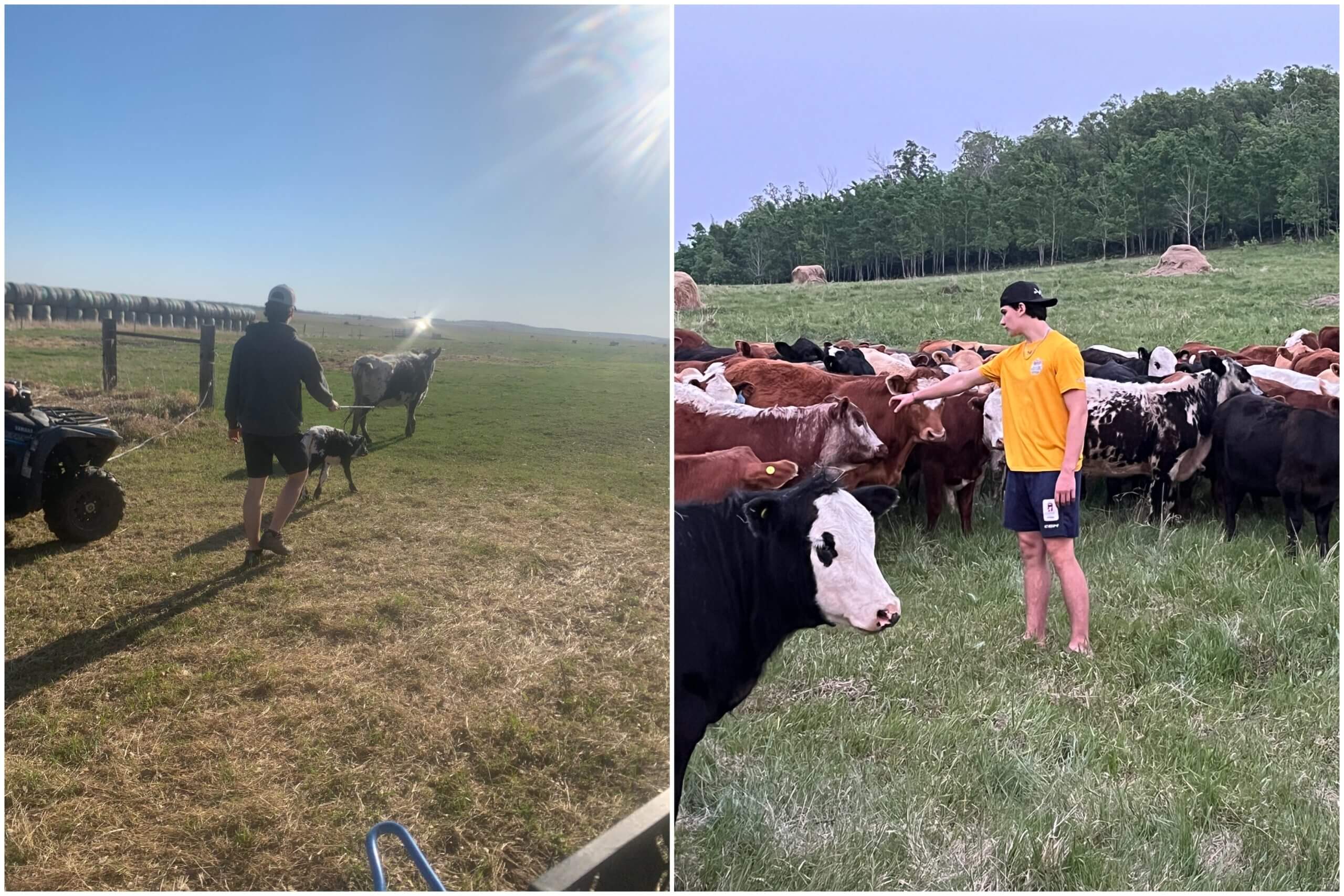
Carels out in the fields of his family’s farm. (Photos courtesy of the CHL)
Others see it, too.
Many can see it in the raw strength of his 6-foot-1.5, 202-pound frame.
“This guy’s turning into a specimen,” Lamb said.
Lamb also sees it in his down-to-earth, respectful, hardworking nature and says, “a lot of who he is on and off the ice has been shaped by the farm upbringing.”
“It’s just how he lives, it’s how he was brought up, it’s how his family was brought up before him. He’s a kid in the summer who works. He gets up out of bed, and he’s a part of the operations. And he’s a hockey player also. He doesn’t forget about his workouts and his dedication to the game. I think all of that really frames him well,” Lamb said. “A lot of these kids nowadays don’t have to do that; all they do is work out.”
Sullivan sees it in the pride he takes in standing up for his teammates.
“There’s so much farm in him, and I see so much blue collar in his game,” Sullivan said. “You can see his upbringing stylistically in his game.”
Last summer, Carels would wake up at sunrise to work on the farm and then make the drive to skate at the Winter Club in Winnipeg (with a quick pit stop post-skate for some racket sports with his buddies before returning to more chores on the farm in the afternoon) or with Evolution Hockey in Brandon.
He’s also the second-youngest of five kids, and it — the farm and hockey — is in all of them. Ethan, the oldest, played Jr. A in Manitoba. His oldest sister, Jayden, is currently playing at the University of Jamestown. His other older sister, Kadence, played and now runs the farm and “is an accountant already.” And his younger sister, Kendra, plays for the U18 Female Buffaloes at Pilot Mound.
Growing up in Cypress River, there was only single-A hockey, with teams slotted into gold, silver and bronze tiers. Carels’ team always started in silver, but he said they usually had enough good players to work their way into the gold division. He didn’t play AA hockey until 2019-20, and that season got canceled just a few months in by the pandemic. He didn’t play his first top-level minor hockey until after the pandemic, when a hockey academy opened 45 minutes south of Cypress River in Pilot Mound.
His first season at the Pilot Mound Hockey Academy was their first season with a U15 team, and they weren’t very good. In his second season on their U15 team, though, he registered 32 points in 20 games, and Lamb drafted him with the 15th pick in the 2023 WHL Prospects Draft.
“He was very mature for his age, he was the best player on his team, he played defense and not just offense, he played aggressive, he cared about his zone, and he was on a lesser team, so he really stuck out,” Lamb said of what he first saw in Carels. “And his skating was one of those things that really grabbed us right away.”
Last March, on a phone call with The Athletic, Lamb said of Carels, “He’s weighted to the offensive side.” He also lauded him as a 16-year-old who was second on his team in ice time and “an all-around player (who’s) a real good skater, has a real good head on his shoulders, and can really see the plays.”
But he started with the offense.
Eight months later, when anyone talks about his game — whether it’s scouts, those around Carels, or Carels himself — that’s not where they start.
Sullivan starts with the pride Carels takes in defending. Then he describes him as a confident sponge who wants information — to know why and how the positives are working, and also the intricacies of how he can be better. Together, both Sullivan and the Cougars staff have worked with Carels to improve his stick placement and make more of his plays in stride instead of while standing, all in an effort to turn small nitpicks into strengths.
They don’t need to teach him how to bring it and be tenacious. That part, Sullivan insists, is in his DNA.
“My favorite part of his game is that he’s mean,” Sullivan said. “He’s not window-dressing-mean. He’s legit mean. He finishes his checks with bite, and he’s never standing next to somebody; he’s giving it to somebody.”
Carels said he sat down early on with Playfair to talk about the importance of defending, details and putting yourself in good ice as a defender, and that those fundamentals have become pillars of his game over time.
He models his game after Ottawa Senators defenseman Jake Sanderson, and now describes himself as a two-way defenseman with a lot of attitude to his game around the net and in the corners who shuts down plays early and can quickly move the puck but has worked to expand his game offensively this year.
“I’ve really pushed defense,” he said.
And yet when he left for Canada’s camp, his 29 points in 28 games were sixth among all WHL defensemen in scoring.
According to Sullivan, that offense has also importantly come in a variety of forms.
“He has production in transition joining the rush, he has production leading the rush, he has production from well-placed shots from the blue line, so he’s showing that he can produce in different ways,” Sullivan said.
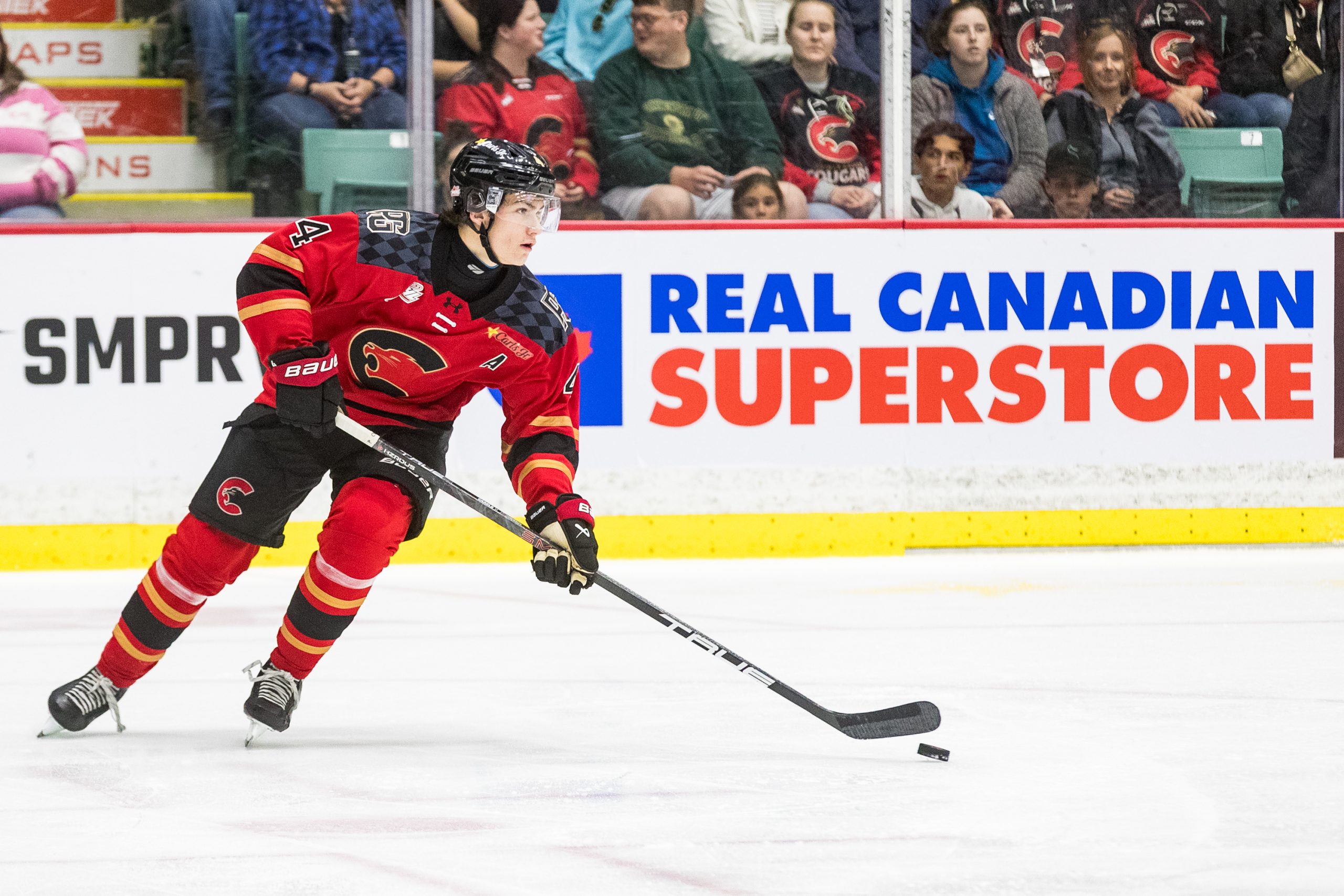
Carels has 29 points in 28 games this season for the Cougars. (James Doyle / WHL)
He also wears an “A” and has played 30-32 minutes per game in every situation this season.
Hockey Canada took notice of all that.
Ask Millar about Carels, and he starts with his strength, his maturity and his “complete, good-all-around” game.
“Every time we saw him, he just got better and better,” Millar said. “Even though he’s 17, he pushed his way to get this opportunity.”
Over the last two years, fellow Team Canada invitee and Prince George goaltender Joshua Ravensbergen has seen it all first-hand in front of him with the Cougars.
“I think he’s just a really good two-way defender,” Ravensbergen said. “He understands the game, he’s really physical, and he’s really mature and confident for his age. He’s super strong, and he’s got a great work ethic.”
So has Canada assistant coach Brad Lauer, who is in charge of the defense this year and also coaches against Carels in the WHL as the head coach of the Spokane Chiefs. Lauer lauds his maturity, his significant workload, his size, his good feet and the heaviness of his game.
“He plays a game that can calm things down,” Lauer said.
Coming into camp, some felt he had a leg up to make the team over Verhoeff and the more veteran Ethan Mackenzie and Jackson Smith. And in camp, he has started alongside Maple Leafs first-rounder Ben Danford on what looks like the team’s early third pairing.
If he makes the team, Carels plans to play a reliable, defensive, penalty-killing role.
Lamb doesn’t just think he’s ready for that; he knows it.
“He cares about a 200-foot game. It’s not all about points. And all coaches, we all speak the same language and say the same things, and he just gets it already,” Lamb said. “He’s ahead of most kids in that area — on playing his position.”
After the World Juniors, Sullivan expects him to do it in the NHL for a long time, too. He works with first-round picks like James Hagens, Lynden Lakovic, Bill Zonnon, Henry Brzustewicz, Trevor Connelly and Quentin Musty, but thinks Carels might actually have “the highest basement” of any of his clients.
“I’m going to be taking my son to see him play in the NHL for the better part of two decades, and I think for the better part of that you’ll see Carson Carels within a top four,” Sullivan said. “And then within that top four is going to be up to him. (But) that’s who you want when it comes to April and May in the NHL.”
— With reporting in Calgary and Lethbridge, Alberta