
Breadcrumb Trail Links
Councillors are joining conservation authorities in pushing back against the a proposal to fold all 36 agencies into seven mega-authorities.
Published Dec 16, 2025 • 2 minute read
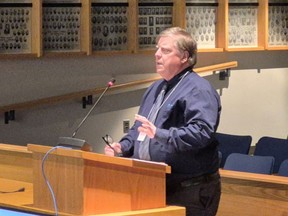 Mark Peacock, secretary-treasurer and chief administrator for the Lower Thames Valley conservation authority, addresses Chatham-Kent council Monday. (Trevor Terfloth/The Daily News)Article content
Chatham-Kent councillors are joining area conservation authorities in pushing back against the province’s proposal to fold all 36 agencies into seven mega-authorities.
Advertisement 2
This advertisement has not loaded yet, but your article continues below.
Article content
Announced in late October by Environment Minister Todd McCarthy, Queen’s Park aims to create a new provincial conservation agency that will oversee the amalgamation process and the new authorities.
Article content
Recommended Videos
Article content
In a presentation Monday, Mark Peacock, secretary-treasurer and chief administrator for the Lower Thames Valley conservation authority, told council there are concerns about ensuring proper representation within the new model.
“Local municipalities will lose their say on how their money is being spent,” he said. “That is a pretty huge issue.
“We now tailor programs to our local areas. How will that happen in a regional conservation authority?”
The changes are a part of an omnibus Bill 68, the Plan to Protect Ontario Act, which already has received royal assent.
Advertisement 3
This advertisement has not loaded yet, but your article continues below.
Article content
Ontario’s conservation authorities are responsible for the management of watersheds, drinking water protection, recreational conservation and flood mapping.
The minister justified the move by saying different processes and rules created a patchwork of standards.
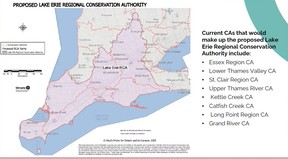 A map of the proposed Lake Erie regional conservation authority is shown. (Supplied)
Under the present proposed boundaries, the Lower Thames Valley, Upper Thames River, Long Point Region, Grand River, Catfish Creek, Essex Region, Lower Thames Valley, Kettle Creek, and St. Clair Region authorities would be merged into a mega-agency: The Lake Erie Regional conservation authority.
Those eight conservation authorities represent 81 municipalities.
More than 100 Ontario municipalities found themselves split between two or more conservation authorities, and the amalgamation would lead to less duplication and would not result in job losses, McCarthy has said.
Advertisement 4
This advertisement has not loaded yet, but your article continues below.
Article content
Part of the intention behind the province’s move is to streamline permitting for builders, landowners, and farmers, according to the Environmental Registry of Ontario. The new authorities would still be governed by municipalities.
While municipal control is still part of the equation for the new mega-authorities, there are worries about maintaining local influence.
Peacock noted much of the land within a conservation authority has been donated.
“Those conservation areas were given to the local conservation authority by families for their communities,” he said.
The province already has the power to compel conservation authorities to improve efficiencies, and Peacock believes a more sensible proposal is possible, adding the conservation authorities are willing to discuss further.
Advertisement 5
This advertisement has not loaded yet, but your article continues below.
Article content
“Maybe we need to amalgamate, but it should be amalgamations within like areas, like economies, like communities,” Peacock said.
North Kent Coun. Rhonda Jubenville called the centralization “very concerning.”
“I agree, we’re losing our local voice and local representation,” she said, before putting forth the successful resolution in support of the conservation authorities.
In a statement, a ministry spokesperson said the government aims to empower conservation authorities to deliver faster, more efficient outcomes for their communities.
They will still provide the same programs and services, Alexandru Cioban said, adding: “Their mandate, service areas, and funding models will remain unchanged, and boards will continue to be municipally appointed.”
The proposed boundaries are currently open to feedback until Dec. 22, with comments being accepted at ero.ontario.ca/notice/025-1257.
With files from Jack Moulton and Ryan Goodison
Article content
Share this article in your social network