
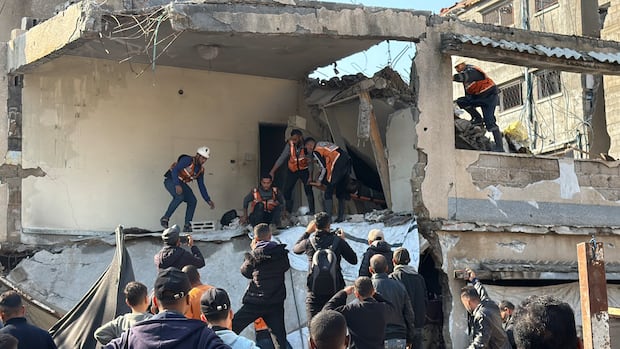
Families in Gaza face an agonizing choice following last week’s winter storm: endure exposure in tents after floods destroyed encampment shelters along with their possessions, killing one baby due to exposure — or shelter in buildings damaged in Israeli strikes earlier in the war that could collapse without warning.
A two-storey home in northwest Gaza City was the latest to partially collapse Tuesday, trapping a family underneath the rubble, killing a man and seriously injuring a family of five, local authorities say. The latest collapse comes as authorities warned a day earlier that more weakened buildings are at risk of falling as strong winds and heavy rain persist in Gaza.
Abu Rami Al-Husari, 46, said his brother and nephews were in the Hamid Junction in northwest Gaza City when the top floor of a two-storey home they were sheltering in, which had been damaged by Israeli bombing in the war, caved in on them.
“This [winter storm] wave affected everything so the home collapsed on them,” Al-Husari told CBC’s Mohamed El Saife on Tuesday.
“There’s no place to live … there’s no space anywhere. They were forced to live here.”
Torrential rains and frigid temperatures plunged Gaza into a deeper humanitarian catastrophe in recent days, with families losing their few belongings and food supplies soaked inside their flooded tents and people killed from exposure or due to a sudden building collapse.
Humanitarian groups have been warning that the amount of aid being allowed into Gaza since a ceasefire deal was signed by Israel and Hamas on Oct. 10 is nowhere near what was promised under the terms of agreement.
WATCH | Storm wreaks havoc on Gaza’s displaced population living in destroyed infrastructure: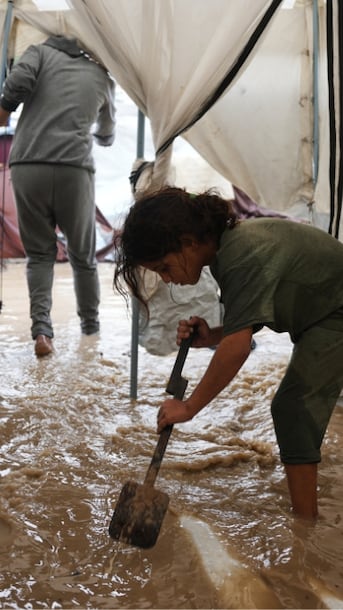
Displaced Palestinians in Gaza struggle in winter storm, floods
At least 12 people are dead or missing, including a baby girl who died from exposure to the cold, after torrential rain from storm Byron swept across the Gaza Strip this week.
According to the Gaza government media office, at least 11 people were killed and one person remains missing as a result of the collapse of war-damaged buildings affected by the storm and weather conditions.
Meanwhile, it logged more than a dozen buildings that have collapsed and more than 27,000 tents that were being used as shelter that have been swept away or flooded since the storm hit.
The Palestinian Civil Defence has warned people not to stay inside damaged buildings, saying they, too, could fall on top of them. The United Nations and Palestinian officials said at least 300,000 new tents are urgently needed for the roughly 1.5 million people still displaced, as many are left with no option but to shelter in partially standing structures.
Rescue crews working with basic equipment
Muhammad Shraim, director of the Palestinian Civil Defence in the northern governorate, said crews managed to rescue family members with “very basic” equipment.
“There are many buildings damaged by Israeli forces that are at risk of collapsing,” Shraim told CBC.
On Friday, 12 people were killed after two buildings collapsed, according to local health authorities.
Mohammad Nassar went out on Friday to buy necessities. When he returned to a six-storey building — badly damaged by Israeli strikes earlier in the war — where his family was sheltering, it had turned into a scene of carnage with rescue workers struggling to pull bodies from the rubble, including his children.
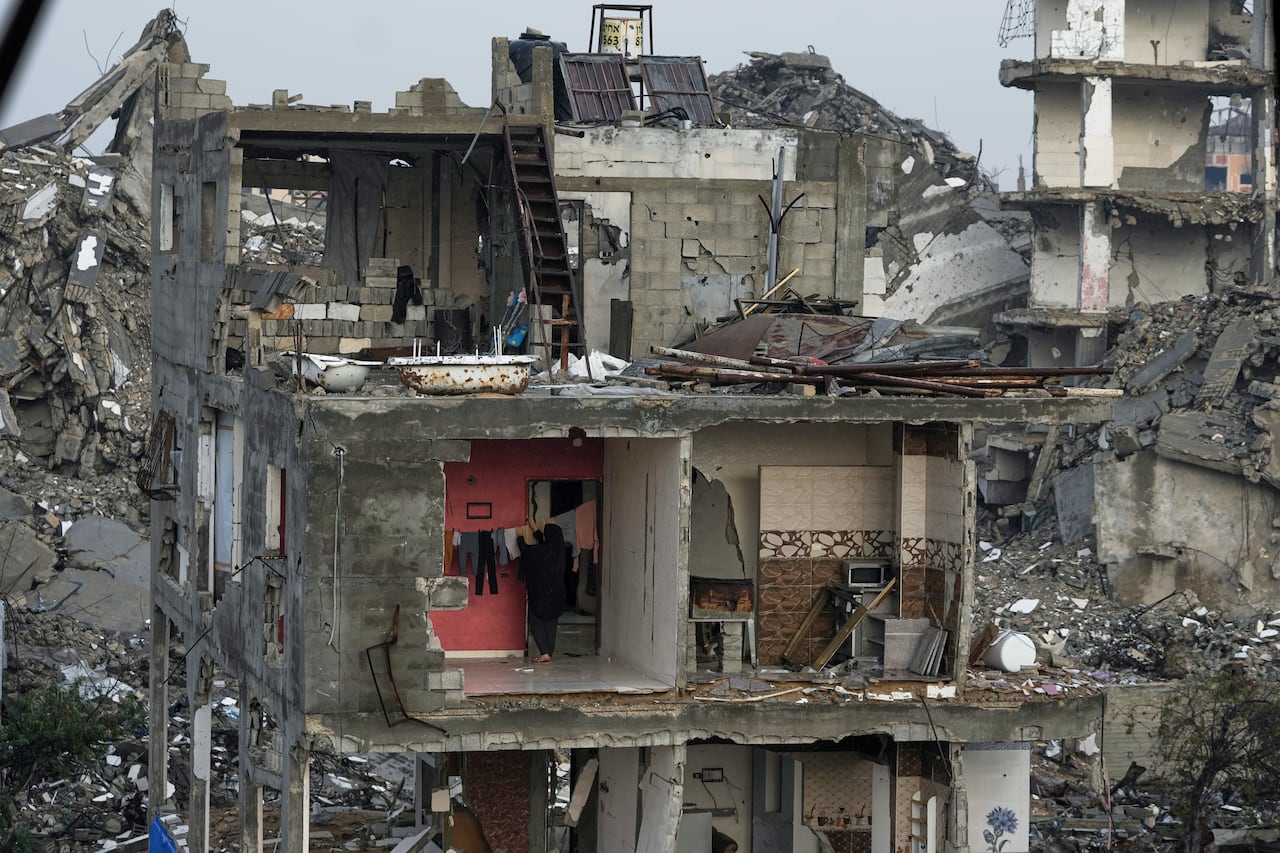 A Palestinian woman hangs laundry inside of partially destroyed apartment building with exposed walls in Gaza City Monday. Recent torrential rains have flooded the war-battered territory, wreaking havoc on Palestinians already living in precarious conditions during the Israel-Hamas ceasefire. (Jehad Alshrafi/The Associated Press)
His 15-year-old son and 18-year-old daughter died in the building collapse.
“I saw my son’s hand sticking out from under the ground. It was the scene that affected me the most. My son is under the ground, and we are unable to get him out,” Nassar told Reuters.
He said his family had struggled to find alternative accommodation and had been flooded out while living in a tent during a previous bout of bad weather.
Gaza Civil Defence spokesman Mahmoud Basal called on the international community to provide mobile homes and caravans for displaced Palestinians rather than tents.
“If people are not protected today we will witness more victims, more killing of people, children, women, entire families inside these buildings,” he said Monday.
New tents urgently needed
The head of the UN Palestinian refugee agency said more aid must be allowed into Gaza without delays to prevent putting more displaced families at serious risk.
“With heavy rain and cold brought in by storm Byron, people in the Gaza Strip are freezing to death,” UNRWA commissioner-general Philippe Lazzarini said in a post on X Monday. “The waterlogged ruins where they are sheltering are collapsing, causing even more exposure to cold.”
Lazzarini said they have supplies that have been waiting for months to enter Gaza. Most existing shelters are worn out or made of thin plastic and cloth sheeting.
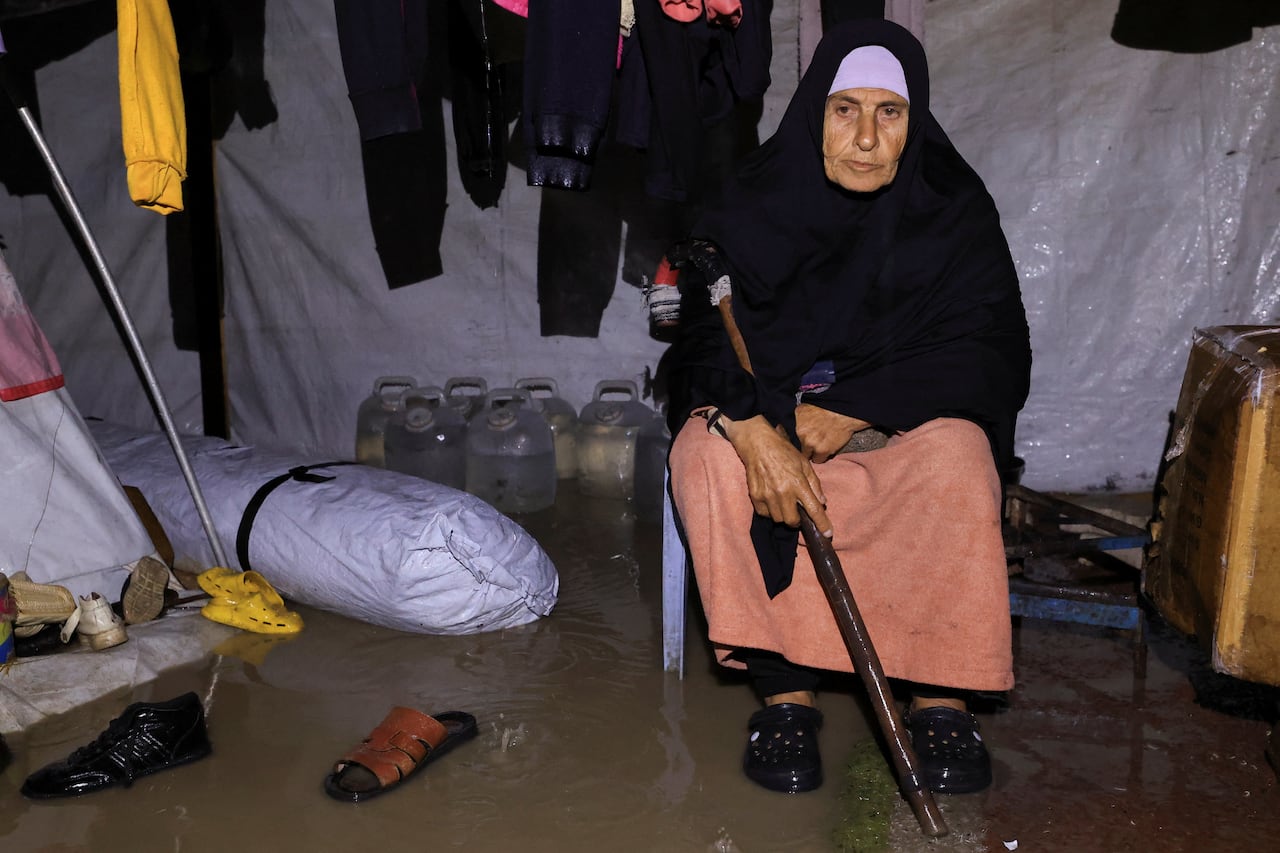 A displaced Palestinian woman shelters in a flooded tent Monday in Gaza City after last week’s storm Byron hit residents across the territory, damaging their tents, belongings and food supplies. (Dawoud Abu Alkas/Reuters)
COGAT, the Israeli military arm that oversees humanitarian matters in the Palestinian territories, rejected the UN’s figures, saying Monday that roughly 310,000 tents and tarpaulins entered Gaza “lately.”
“Claims suggesting that weather-related impacts result from deliberate restrictions are inconsistent with facts on the ground, and the ongoing co-ordination taking place daily,” COGAT said on X.
Fighting broke out in October 2023, following a Hamas-led attack on southern Israel that killed about 1,200 people and saw 250 taken hostage, according to Israeli figures. Israel’s military response in Gaza has killed more than 70,600 Palestinians, local health authorities say, with some 393 people killed in Israeli fire during the truce, since Oct. 11.