
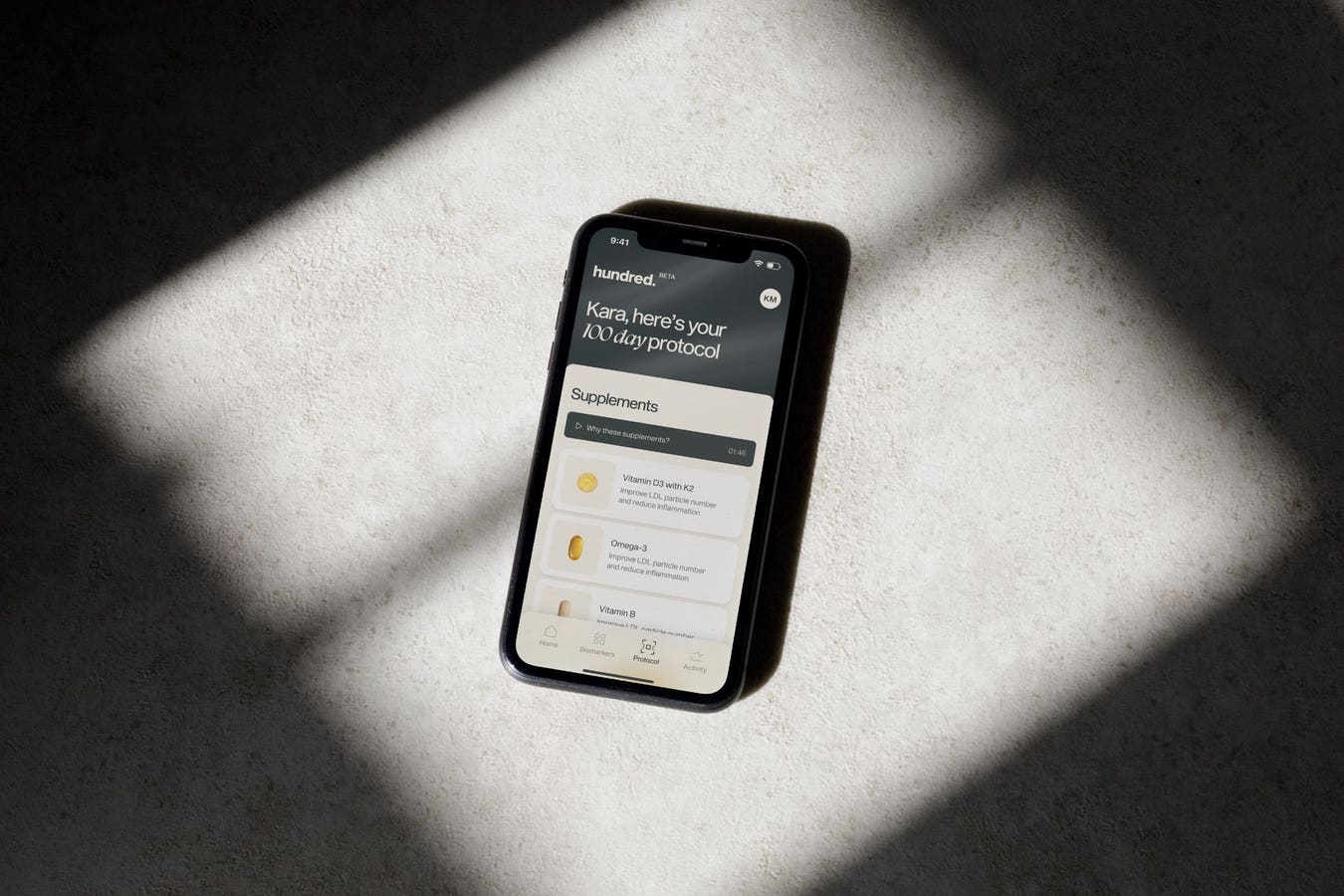

Hundred Health launches this week in hopes of using AI to better translate medical data into actionable steps for longevity.
Hundred Health
According to Bank of America analysts, living longer is a $600 billion business today. And factors like AI are predicted to help propel the industry to $8 trillion in four years, according to UBS
Launching this week is Hundred Health, a behavior change healthcare company, led by serial AI and longevity investor Tyler Smith, hoping to tap into that growing market.
Having invested in the likes of Function Health (now estimated at $2.5 billion) and TruMe (as well as companies like Nucleus Genomics, Devoted Health, Superhuman and SkySlope which he founded and sold to Fidelity (NYSE: FNF)), Smith saw gaps across the industries he invested in: generic AI, biological age tests lacking utility, and gaps between AI and human rigor.
These frustrations hit personally, as Smith struggled through the early loss of his father, fueling his search for an end to preventable early death. The serial longevity investor realized there was a major gap in the industry: most biometrics and biological age tests on the market fell short on actionability, he argues. So he built Hundred to fix that.
The platform pulls together medical records, lab work, and wearable device data to generate what Smith calls “100-day protocols”—specific instructions on diet, exercise, and supplements. For $499 a year, users get access to 160+ lab tests and ongoing health tracking. Smith’s bet is that people don’t need more health data. Rather, they need someone to tell them what to do with it.
Tyler Smith, founder of Hundred Health
Tyler SmithChhabra: Let’s start with the wake-up call. What exactly happened?
Smith: A few weeks after my wife and I learned we were having our first child, I took a biological age test. I expected it to be significantly lower. It came back 47. I was in my late 30s.
That number shook me. My dad had died suddenly of a heart attack at the age of 47. I looked healthy, but my biology told a different story. When I received those results, I decided to go all in. Deep testing. Some of the most elite doctors. A full care team. And ultimately, I reversed my biological age by 15 years.
The real shock came after, though. I realized how rare that access was. This level of care isn’t broken — it’s gated. It works incredibly well, but it only exists for people who can afford to pay for private doctors, endless testing, and personal attention.
That didn’t sit right with me. Health shouldn’t be a luxury product. Hundred was built to take what only the wealthy get today and make it available to anyone who actually wants to take their health into their own hands.
You’ve gone from real estate to proptech to longevity. What connects all of that?
I’m drawn to systems that are clearly broken but widely accepted.
In real estate, transactions ran on paperwork and friction, so I fixed it. In healthcare, people have more data than ever yet don’t know what to do with it.
Different industries. Same instinct: Remove friction and give people control.
How has your experience been raising capital. It’s been widely reported that Black entrepreneurs get less than 1% of VC funding.
I didn’t raise traditional venture capital. SkySlope was bootstrapped from day one and grown profitably until we sold a majority stake to Fidelity National Financial (NYSE: FNF). That forced discipline early and kept us focused on customers and execution instead of fundraising.
That mindset still guides how I build today.
So you bootstrapped SkySlope to $12M in annual revenue. Hardest lesson of that journey?
No one is coming to save you. When it’s your own money, every decision hurts a little more. You learn quickly what actually matters, what’s noise, and how to out-execute better-funded competitors. That mindset never leaves you.
Was bootstrapping SkySlope a choice or a necessity?
It was a strategic choice. I wanted to build with customers, not committees. Bootstrapping forced focus, speed, and accountability. It let us grow a real business before worrying about optics or fundraising narratives.
What would you tell your 2011 self?
Stop overthinking and ship it. Momentum solves more problems than perfection ever will.
Hundred is also currently self-funded. Strategic?
Yes. I’m a product-first founder.
I wanted real users, real feedback, and real outcomes before optimizing for fundraising. Especially in healthcare, you earn the right to scale by getting the product right first, especially in this space.
Healthcare is hard to disrupt — why take it on now?
Because for the first time, the system can actually be rebuilt. Not patched.
The infrastructure is affordable, intelligence can scale, and consumer expectations have already shifted. When the constraints disappear, disruption stops being bold and becomes inevitable.
Why price Hundred at $499?
That’s where we found value, commitment, and scale intersect.
For less than $1.50 a day, members get continuous insight, personalized protocols, and a system that adapts as their data shifts. That level of guidance used to require a concierge doctor and a five-figure annual spend.
Over the next few years, I believe the cost of lab work trends toward free. Blood tests become a commodity. The value shifts downstream to interpretation, prioritization, and knowing exactly what to do next. That’s what Hundred is priced for.
Biggest hurdle in integrating with 300+ Electronic Medical Records (or EMRs)?
Nothing was designed for a world where data actually moves. EMRs were not built to be shared. We had to unlearn how healthcare software thinks and force interoperability.
What’s Hundred’s advantage compared to others?
We’re built around outcomes, not data.
Hundred takes everything about a person’s health and turns it into a living system that adapts as they do. That mindset — designing for behavior change and follow-through — is hard to replicate.
QUICK HITSBest business book you’ve read recently?
That’s a hard one. I tend to revisit founder biographies more than new business books. Patterns matter more than tactics.
Biggest mistake at SkySlope you won’t repeat?
Trying to win alone. Companies don’t scale on effort. They scale on ownership. Everything changed when I stopped being the hero and built a team that could move faster than me.
One thing you’d change about the VC industry?
Less pattern-matching, more original thinking. Innovation dies when everyone funds the same founder profile.
Hundred metric that surprises you most?
How fast people change once confusion is removed. Give someone clarity and a simple plan, and behavior shifts almost immediately. Consistency beats motivation every time.