
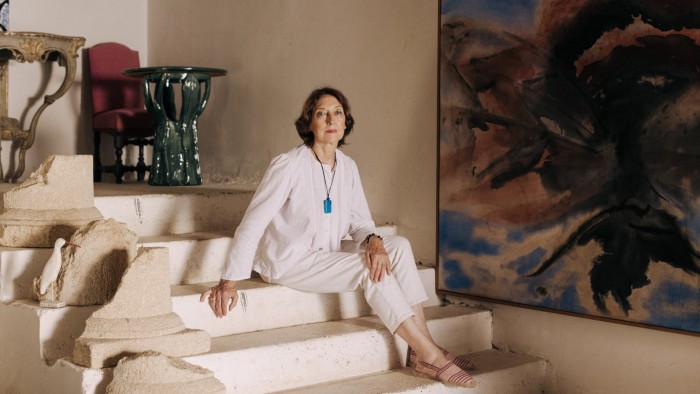
Stepping through the front door of artist Marie Hugo’s 18th-century bergerie — a converted sheep barn in the Camargue region of southern France — is a dramatic entrance into her bohemian and theatrical world. It is a world that draws on generations of artistic heritage; down from her great-great grandfather, the novelist Victor Hugo, and father, the artist Jean Hugo.
Her own bold, colourful paintings and ceramic artworks sit alongside antique furniture, family heirlooms and curiosities collected on her travels. Blue-painted panels — designed as theatre set decor by her father — add colour to a sitting room dominated by a tall oriental bureau that belonged to Victor. An 18th-century Provençal cupboard stands opposite a huge pink painting by her father:“La Chasse à la Licorne”. A console table with deer legs and hooves was inherited from her great-grandmother Pauline Ménard-Dorian, who hosted literary salons during the Belle Époque.
Hugo, now in her seventies, is renowned for large-scale watercolours in bright pinks, yellows and black. Solo exhibitions have taken her to London, Paris, Tokyo and Arles; her work is exhibited permanently in Paris at Galerie du Passage and Galerie Diurne. “I love colour. For 20 years I only worked in black Indian ink, which in French is curiously called encre de Chine,” she says. In the past few years, since Covid, “I’ve had an explosion of colour.”
 An 18th-century Provençal cupboard stands opposite the painting amid her own artworks, family heirlooms and curiosities
She was born here, in what she calls “the main house”, one of five daughters and two sons, to Jean and his wife Lauretta Hope-Nicholson. The Mas de Fourques, a historic if somewhat dilapidated farmhouse, presides over a central courtyard and grounds that include two houses that are rented out.
Her father inherited the property from his grandmother in 1930 in a “perfect state, full of lovely furniture”, she says. Gardeners, workers and 18 mules came too — they helped tend the vineyard, which produces Muscat de Lunel. Friends who came to visit ranged from Pablo Picasso, Salvador Dalí and Jean Cocteau to the poet Louise de Vilmorin and Boris Kochno, secretary to Ballets Russes founder Sergei Diaghilev. Cecil Beaton took a photograph of the couple in the garden under their favourite tree, the Mexican mulberry. Jean Bourgoint, on whom Cocteau based his novel Les Enfants Terribles, was a friend of her father and stayed there for a number of years.
 Hugo was born in the main house of the Mas de Fourques, the somewhat dilapidated farmhouse that presides over a central courtyard; the sails lead to her front door ©
  In the gardens are cedar, green oak and black bamboo, lotus ponds and a pride of peacocks
“My father wanted [the estate] to be as self-sufficient as possible. We had sheep, chickens, ducks, pigs, rabbits, that we ate. A kitchen garden, beehives, olives, wine — red, white and Muscat. We had everything,” says Hugo. She spent her childhood roaming the gardens with her siblings, using the water tank as their swimming pool. “As a child I slept above the bergerie, and at night from our beds we heard the sheep banging their heads.”
Following her husband’s death in 1984, Hope-Nicholson divided up the barns between her seven children. The extensive gardens, with cedar, green oak and black bamboo, lotus ponds and a pride of peacocks, are still communal; the main house was emptied and remains uninhabited.
 The bohemian and theatrical sitting room
In 1998 Hugo began the task of transforming the bergerie into a home, visiting regularly from her home in London. The process took 12 months: the first job was to remove the 200 sheep and metre-deep layer of manure, which was done “bit by bit, with a digger”, she says. “Even nowadays when it’s damp, I think I can smell it. Perhaps it’s impregnated in the beams.”
Today the house is characterised by a sharp angularity. “When you draw a pattern, you have a module. It could be a circle or rectangle but for this house I chose the square. It keeps it in harmony,” she says. It’s most striking in the square doorways between the hall and kitchen, and the raw edges of the 2 metre-wide concrete staircase. For the wide square metal front door Hugo sketched out her design and took it to an ironmonger in the village. “He did it perfectly,” she says.
 The kitchen was designed around the fireplace, for extra warmth in winter
  Blue-painted panels — designed as theatre set decor by her father — in the sitting room © Claire Gaby
Hugo’s current show, Marie Hugo, la Camargue en héritage, at Musée de la Camargue, in part draws on the years spent observing her father at work. “I learnt a lot from him, but in silence. He was not a tutor, just a silent mentor. I watched him throughout my childhood. I feel very lucky to have a father like that.”
Above the vast table in her kitchen hangs a glowing sculpture Hugo made from fallen beechwood, linen and foliage from the garden. “I replace the laurel every year at Christmas; I use it throughout the year in cooking. It’s tastier once it’s dried.”
 Hugo’s studio, where her father also painted: ‘I feel close to my father when I’m in the studio. I adored him’
The pared-back room was designed around the fire, which Hugo wanted at the same height as the cooker, not only to grill on but to keep her warm in winter. The stone sink was originally used for scrubbing vegetables in the main house. “When they modernised it, the sink was thrown into the garden under a bush. Nobody else wanted it because they said it wasn’t practical, but I love it.” The ceiling remains in its original state; its small vaults are “very local”, says Hugo. The black window bars were originally intended to stop the sheep from escaping.
Hugo hasn’t bought a single piece of furniture. Her only nod to modernity is a projector and screen in the sitting room. “The one thing I wanted was to have a home cinema. Now when my children are home, we watch films in here.”
 This cabinet belonged to her father and is still filled with his things
A short walk from her house, hidden among the cedar trees, past the lotus pond and a few peacocks, lies her studio, where her father also once painted. The whitewashed, light-filled atelier with vaulted ceiling is filled with her colourful abstracted depictions of nature.
“I feel close to my father when I’m in the studio. I find peace here. There’s a kind of silence,” she says. His tall bureau remains in the corner, still filled with his oils and toys he made for his children. “I adored my father. When I was a child, I used to come here every day and bring something to him. I’d just put it on his table and leave without a word.”
 Hugo’s studio is filled with her colourful abstracted depictions of nature
Back in the garden, with its soundtrack of nightingale song and peacock calls, Hugo speaks of her ambition to create even vaster paintings inspired by nature — but that would involve having a bigger studio. “I’ll see if I can perhaps convert an empty cellar here.” She smiles: “I’d have to repair the roof first.” Here, the possibilities are endless.
Recommended

‘Marie Hugo, la Camargue en heritage’, at Musée de la Camargue until June 21 2026, muséedelacamarge.com; @atelier_mariehugo
Find out about our latest stories first — follow @ft_houseandhome on Instagram