
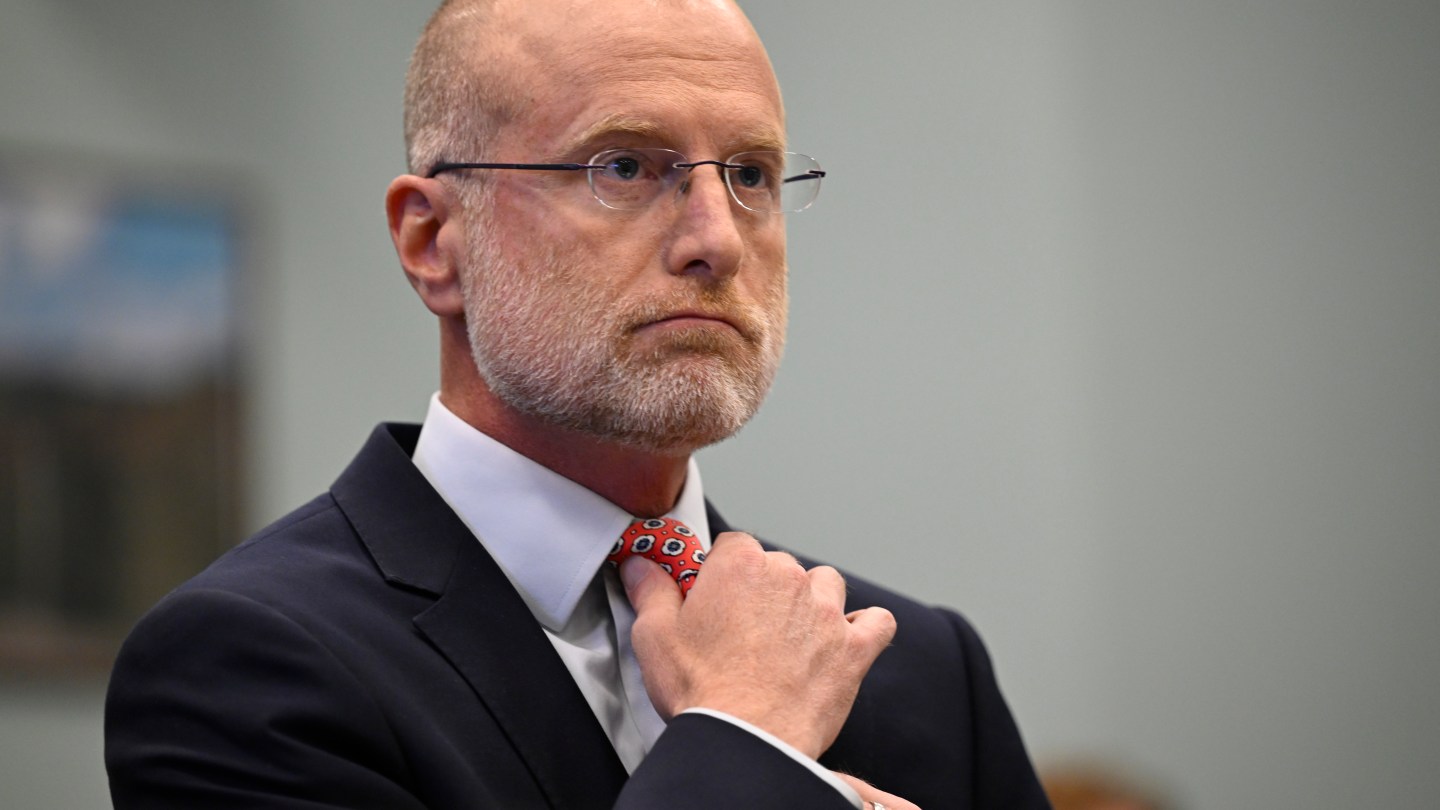
In a testy and often heated hearing Wednesday, FCC Chair Brendan Carr did not take responsibility for his statements about Jimmy Kimmel ahead of his late night show being pulled from the air.
“You look at the evidence, the express statements by every single company involved, from Nexstar to Sinclair to Disney, as recently as last week, is that they made these business decisions on their own,” Carr said.
After comments Kimmel made on his late night show about the assassination of conservative activist Charlie Kirk, Carr appeared to threaten the licenses of ABC affiliates that broadcast Jimmy Kimmel Live! in a Sept. 17 appearance on a conservative YouTube show.
“When we see stuff like this, look, we can do this the easy way or the hard way. These companies can find ways to change conduct, on Kimmel, or there’s going to be additional work for the FCC ahead,” Carr said at the time.
After these comments, Nexstar and Sinclair Broadcast Group, major owners of local TV stations and ABC affiliates, said they would preempt Kimmel’s show. Disney, which owns ABC, then said the network would “indefinitely” suspend Kimmel. Kimmel’s show returned to air Sept. 23 amid public outcry, including from Republican Sens. Rand Paul and Cruz who said the FCC shouldn’t meddle with policing political speech.
On Wednesday, Carr claimed Kimmel’s comments “appeared to be an effort to mischaracterize the motivations of one of the most significant political assassinations of our time.” (Kimmel said: “We hit some new lows over the weekend with the MAGA gang desperately trying to characterize this kid who murdered Charlie Kirk as anything other than one of them and doing everything they can to score political points from it.”)
However, Carr claimed Wednesday that there was “was no threat to revoke a license there.”
Asked by Sen. Ben Ray Luján (D-NM) and others on whether the FCC is an independent agency, as it says on its website, Carr said it is “not formally an independent agency,” and would not directly answer whether or not President Donald Trump was his boss when pressed by Sen. Andrew Kim (D-NJ), but said he did have the ability to fire any commissioner.
“Would it be appropriate for the President or senior administration officials to give you direction to pressure media companies?” Kim asked.
“Sorry, I’m not going to get into hypotheticals,” Carr said.
Luján then asked Carr: “Is it appropriate for the FCC to revoke broadcast licenses based on the viewpoint of the licensee?”
“It’s appropriate for the FCC to take action under our public interest standard and hold broadcasters accountable, things like broadcast hoax, news distortion, localism, these are things that we should be taking action on and enforcing,” Carr said.
He added that even if a broadcaster is critical of Trump, “any broadcaster that complies with the public interest standard is not in any risk at all,” but when pressed on whether he would commit to not retaliating against those broadcasters added that “there is no First Amendment right to an FCC license.”
Anna Gomez, the lone Democratic commissioner at the FCC, vehemently disagreed on both of Carr’s responses to Luján’s questioning, while Olivia Trusty, the other Republican commissioner agreed with Carr.
At one point during the hearing, which sometimes turned to yelling, Sen. Ed Markey (D-MA.) called for Carr’s resignation.
“He is turning the Federal Communications Commission into the Federal Censorship Commission. It’s a betrayal of the FCC’s mission. You should resign, Mr. Chairman,” Markey said.
Sen. Amy Klobuchar (D-MN) also pointed to additional investigations Carr is enacting, saying that the Kimmel comments were not an “isolated incident.”
“We do have investigations going on NPR and PBS. We have a number of investigations that are ongoing. I think you step back over the years, I think the FCC has walked away from enforcing the public interest standard, and I don’t think that’s a good thing,” Carr said.
She also critiqued what she saw as his position targeting liberal voices rather than conservative voices, pointing to Trump’s recent tweet blaming director Rob Reiner’s death on his dislike of the president.
“Do you think that’s appropriate for the President of the United States to do that? And if Jimmy Kimmel would have said that would you have threatened to take him off the air?” Kloburchar asked.
Throughout the hearing, Carr defended his position by pointing to the news distortion rule and broadcast hoax rule, saying he’s making sure broadcasters are operating in the public interest. However, as lawmakers and Gomez pointed out, this appears to be a misuse of those rules, and he is defining what’s in the public interest.
“That [broadcast hoax] rule was put in place because of Orson Welles and the War of the Worlds and our news distortion policy does not mean any content we don’t like. It requires a very specific circumstance in order to be used, which is why it’s really never used,” Gomez said. “The First Amendment governs what we do, as does the Communications Act prohibition on censorship and this commission is abusing it.”
Gomez also said she did think Nexstar and Tegna preempted Kimmel in order to curry favor with the administration amid their planned merger. She was directly asked: “Do you think the FCC uses merger approval approval as a lever to exert pressure on media corporations to threaten free speech in our democracy?“
“Without a doubt, the FCC is leveraging its authority over mergers and enforcement proceedings in order to influence content,” Gomez said.
While Cruz had previously spoken out about Carr’s “easy or hard way” statement, calling it “dangerous as hell” and “mafioso,” he did not press him on the issue Wednesday.
“Another area of agreement between you and I is that Jimmy Kimmel is angry, overtly partisan and profoundly unfunny. That sadly is true for most late night comedians today, who seem to have been collectively broken by President Trump’s election,” Cruz said to Carr on the matter.