
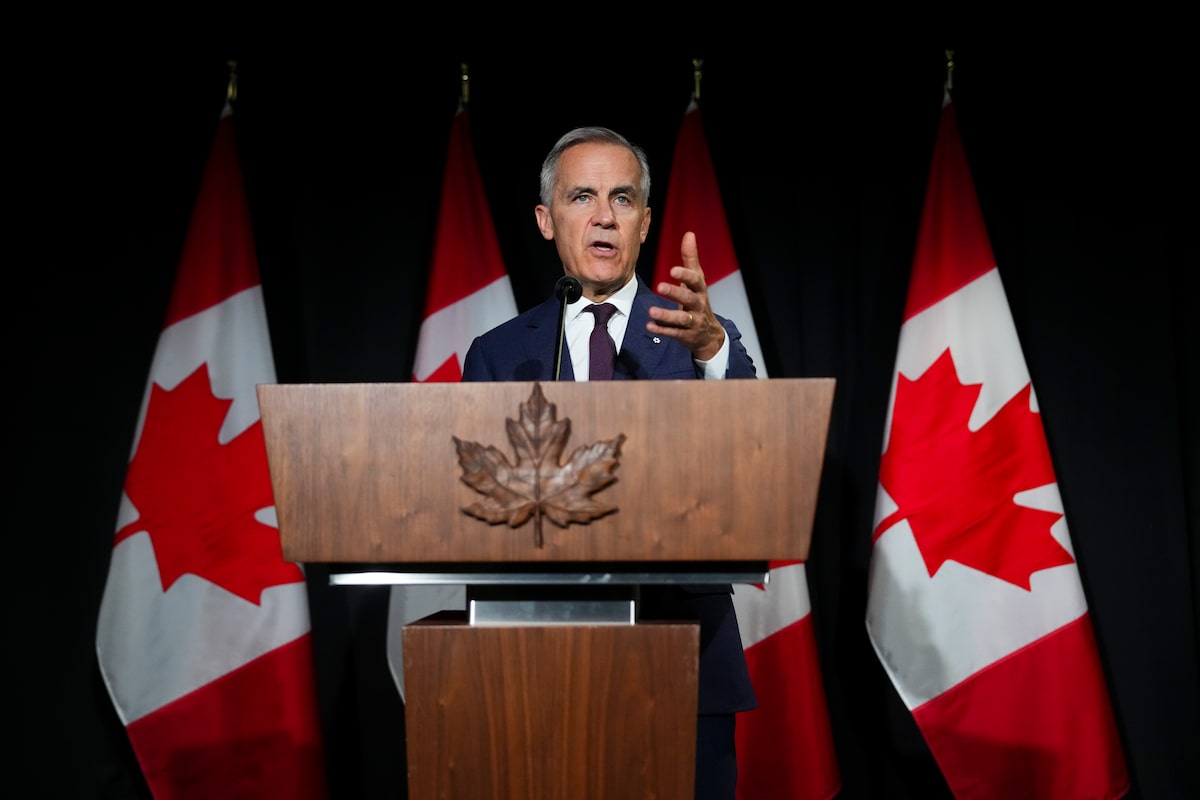
Under Prime Minister Mark Carney, Canada has responded to its changing relationship with the U.S. by focusing on nation-building.Sean Kilpatrick/The Canadian Press
Over lunch the other day, the talk was about how 2025 had triggered a surge of patriotism in this country on account of the back-of-the-hand treatment from the United States.
“It’s extraordinary,” said Duncan Ault, a lawyer friend. “As a Canadian I feel a foot taller.”
For much of our history we’ve been in the thrall of the U.S., so strongly tethered. This was the year of the big break-up – the separation, a parting of the ways unlike any other in the post-Confederation period.
As a result of the Trump administration trying to make Canadians more dependent, Canadians became more independent. They became less shackled, freer to shape their own destiny, more intent on doing so.
Twenty-nine ways Trump has changed Canada
The break-up with the U.S. came in many forms. The separation was physical. In great numbers, Canadians stopped going there. This had never happened before. We didn’t want to be in their midst.
The divide was economic. Our celebrities took to the airwaves telling us to stay in Canada, spend in Canada, shop in Canada. We did so. There was the big push to make trade agreements with countries other than the U.S. and to lessen our domestic trade barriers at home.
The new way included the military. To lessen our dependence on American might, Ottawa budgeted increases in defence spending the likes of which hadn’t been seen in decades.
A Canadian sense of national belonging usually comes from sporting triumphs, and with the victory over the U.S. in the 4 Nations Face-Off, there was certainly that. But politics was the big driver of the new nationalism, as we looked with disdain at what was happening across the border, recoiled at the Trump threats and tariff assaults, and banded together in response.
Nation-building requires consensus. And though national unity in Canada is still imperilled, 2025 was encouraging. In the U.S. and other countries, fringe forces on the right and left have been in ascendance. Not here. In Canada, the centre held and grew. Justin Trudeau’s left-side Liberals were out and the Mark Carney party of the moderate middle was in – and poaching Conservative policy turf. There was less division between left and right, less polarization in the land.
In keeping, the memorandum of understanding between Mr. Carney and Alberta Premier Danielle Smith on pipelines and increased oil production held promise of easing never-ending East-West hostilities.
Lawrence Martin: Hope springs fraternal: Carney’s push for new trading partners shows progress
In dealings with Mr. Trump, Mr. Carney didn’t put up much direct resistance. His response was to counter him in other nation-building ways.
The schism with the U.S., a weakening of ties to the world’s giant economic engine, hardly bodes well for Canadian prosperity. The increased freedom and independence could come at a big cost. But given Mr. Trump’s authoritarian nature and tariff policy obsession, the new road had to be taken.
For so long, Canada was burdened by complacency. With our natural-resource riches, and with the world’s largest economy and military on our doorstep, there was never much pressure to move onto bold new paths. Something unimaginable had to happen to change that, and in 2025 Mr. Trump delivered – not only with his direct threats to Canada, but his taking the American system on a route bordering on fascism, and finding favour with such a large portion of his population in so doing.
The condition of the great republic is so dire, the trajectory so fault-laden, that Canadians lamenting their own decline in living standards and productivity and other metrics can still readily see their own democracy as the more stable, peaceful and better choice.
It is still possible that in the post-Trump years, American sanity will reassert itself and a new president will restore some of the norms of justice, civility, democracy and respect for allies that the great republic had for so long. It’s also still possible that the Carney government will reach a trade agreement with the Trump administration that isn’t terribly destructive.
Regardless, the big Canadian turn has been set in motion and will continue apace, because it’s the rational way. It makes sense – this new, more independent phase in our history, so as to make the country less vulnerable in the future.
There’s been great nation-defining and nation-building years in our past: Among them the completion of the Canadian Pacific Railway, the battle at Vimy Ridge, the adoption of the Canadian flag, the repatriation of the Constitution, with the Charter of Rights and Freedoms.
Years from now, it’s a good bet historians will rank the breakaway from the United States in 2025 as another.