
When Netflix approached Global, one of the U.K.’s largest media and entertainment companies, about supporting the launch of the final season of Stranger Things, the idea of bringing its in-show radio station to life emerged immediately. “We knew very quickly that we wanted to create a pop-up radio station,” says James Rea, Global’s Chief Broadcasting and Content Officer. “At Global we’ve had a great response to pop-up channels before, like Capital Taylor’s Version around Taylor Swift’s tour and Radio X Oasis for the reunion of the Nineties supergroup.”
The result is WSQK the Squawk, a fully immersive Eighties-style station broadcasting on DAB across London, worldwide via Global Player’s website, and on smart speakers from Nov. 24 through Jan. 1. Its nonstop Eighties playlist is wrapped in period-accurate production and deep-cut in-universe references. Alongside classics such as Kate Bush’s “Running Up That Hill,” Diana Ross’ “Upside Down,” and Tiffany’s “I Think We’re Alone Now,” listeners hear a soundscape designed to feel as if it were beaming from Hawkins, Indiana in 1987.
Rea describes WSQK as “a live, ongoing event,” setting what he considers a new bar for “immersive pop-up radio experiences tied to television.” The goal was to let fans explore Hawkins as residents — through its music, culture, humor, and Easter eggs — rather than merely stream the show.
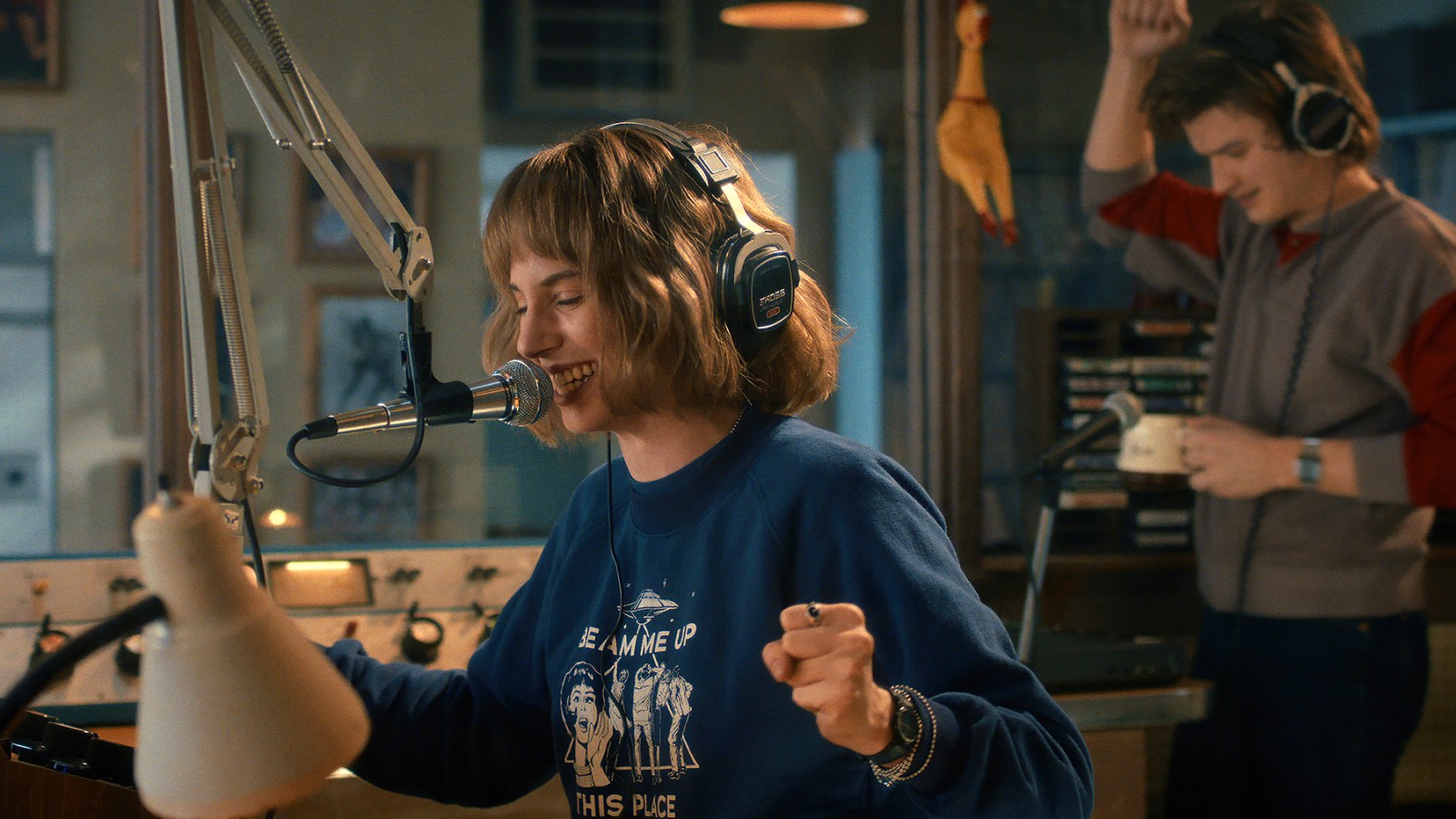
The creative foundation begins with the show’s script. Maya Hawke, who plays budding DJ Rockin’ Robin Buckley, anchors the station; Joe Keery’s Steve Harrington assists on-air, playfully loading sound effects into vintage cart machines. The meta-touch instantly establishes WSQK as a loving homage to classic American radio.
“Rockin’ Robin is a natural on the mic,” says Chris Booker, drive-time host of iHeartRadio’s Alt 98.7 in Los Angeles. “There weren’t a ton of ladies on the mic in the Eighties, so her style is much appreciated. I loved Steve working the cart decks — it brought back a lot of great memories of a time before the medium went completely digital. The show did an excellent job imagining a full-on radio station with imaging that really created the sound of a town.”
Editor’s picks
Rea says the internal brief at Global was clear: WSQK had to sound like a real station that genuinely existed inside Hawkins. “It couldn’t just feel like part of a promo run. It had to feel properly immersive. Music is almost a character in Stranger Things, so a station that lived-in Hawkins felt like a natural extension.”
A small Global team built WSQK, including lead producer Heidi Donald, music director Russ Evans, imaging directors Matt Lomax and Richard Boffin, and writers Nigel Steele and Tom Brammer. “Our senior imaging producer led the sound design and processing,” Rea says. “We had a brilliant music programmer who became obsessed with getting the ‘Hawkins in the Eighties’ brief exactly right, and a creative team writing everything from spots and promos to news and in-world content.”
The work demanded meticulous attention to detail. “The sound needed to feel like you’d just tuned a physical FM radio in Hawkins in the 1980s,” Rea explains. That meant countless hours of A/B testing, bespoke processing chains, and deep dives into every plugin. Most music and sound-design elements came from genuine pre-Nineties libraries like Bruton; anything newly created was shaped to avoid anachronism. ReelWorld dissected classic American jingle packages and rebuilt them to sound as though they’d aired on a Midwestern station for decades. Modern analog-emulating plugins were used sparingly and intentionally, then remastered through a final signal chain before broadcast.
For true period accuracy, the on-air signal passes through a vintage Inovonics FM250 processor — the same model found in thousands of U.S. stations in the mid-Eighties. “It gave us that period-accurate crunch and glue you just can’t fake,” Rea says.
Related Content
Listeners can also participate through in-world features like the “backwards track contest” — “Rewind at 9: Turning Hawkins Upside Down” — which challenges fans to decode reversed songs. Other segments include “Talk to Tammy,” an Eighties-style advice line, and “Dial-A-Dedication,” where fans send messages as if calling WSQK’s request line. These elements, layered with era-correct IDs, stagers, and promos, complete the illusion of a functioning station.
“Stranger Things is one of Netflix U.K.’s flagship shows, and the fandom is incredibly engaged,” Rea says. “WSQK gives them another way into the world. What’s been surprising is how many people who haven’t watched Stranger Things at all have stumbled across WSQK and fallen in love with it as a straight-up 1980s American radio station.”
Industry veterans have taken notice.
Radio Hall of Famer Scott Shannon — architect of Z100 New York and the True Oldies Channel — offers his take. “It’s like an Eighties oldies station,” he says. “I would have a Squawk weekend. Give away Rockin’ Robin T-shirts and Squawk shirts. Take caller 12. Have the kids from the show do the promo. It’s not far from what radio sounded like for people trying to imitate the Zoo. It’s a great promotion adjacent to Stranger Things. This is genius.”
Booker echoes the praise: “They did an outstanding job. The news updates feel like my small-town station from when I was a kid. The drops and jingles between songs are spot-on. The jocks hitting every post, using the tubular lingo — just awesome.”
Trending Stories
Nik Carter, Afternoon Drive host at KLOS Los Angeles, admires the authenticity and the U.K. perspective. “Global is a European/British-based company, so it’s interesting to hear their take on American Top 40. Comparing a fictional station to real radio is unfair, but their use of dated announcers and clichés like ‘spinnin’ the records’ is charming. It’s one of the most clever marketing ideas of the past few years.”
Scott Lowe, former syndicated host on Audacy, KROQ, and Alt 92.3, praises the technical execution: “Every transition is on point. Someone is paying close attention to audio processing, music levels, and hitting vocal posts. Bonus points for acknowledging Indiana artists like Mellencamp and the Jacksons. Except for occasional Stranger Things references, WSQK nails the feel of a small-market 1987 Top 40 station.”