
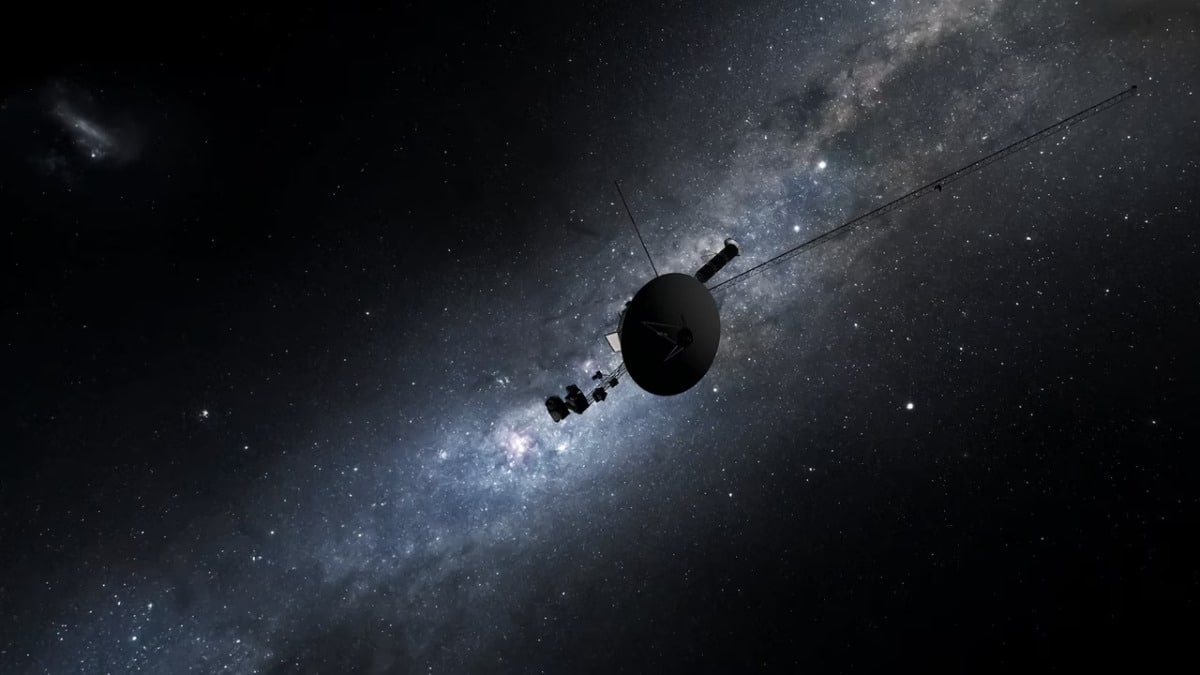
Mark your calendars for November 2026. By then, Voyager 1 will have taken nearly 50 years to complete a journey that light could cover in just one day. The question is — can the mission go even farther?
Over the past few months, Voyager 1 has made headlines again. The farthest spacecraft ever built by humanity has faced a few hiccups. For a time, it could no longer communicate properly with Earth. Thankfully, NASA’s engineers managed to bring it back online.
In a remarkable feat, NASA even reactivated thrusters that had been considered “dead” for more than 20 years — just to help the spacecraft keep moving forward through the vastness of space.
Voyager 1 will soon break a space record.
By the end of 2026, Voyager 1 will become the first human-made object so distant from Earth that a radio signal will take 24 hours to reach it. Currently, the probe is 25.3 billion kilometers away, and it takes 23 hours and 33 minutes… pic.twitter.com/9XAkwLDmW4
— Black Hole (@konstructivizm) November 24, 2025
A human-made machine, one light-day from Earth
Voyager 1 launched in 1977, crossed the boundaries of our solar system in 2012, and has been drifting through interstellar space ever since, traveling at about 56,000 kilometers per hour. As it nears its 50th anniversary in space, the probe is about to reach another breathtaking milestone. Around November 15, 2026, it will be approximately 25.9 billion kilometers from Earth — one light-day away. That’s a first in the entire history of humanity.
At that point, signals traveling at the speed of light — both to and from Voyager 1 — will take exactly 24 hours to arrive. This will make communication increasingly challenging, testing the limits of human ingenuity.
Voyager 1 is the first human-made object to reach interstellar space, having crossed the boundary of the heliosphere in 2012.
Voyager 1 carries a golden phonograph record containing sounds and images selected to portray the diversity of life and culture on Earth, intended as a… pic.twitter.com/lX91ltQKFL
— Sci-Kick (@scikickquest) April 19, 2024
The incredible journey of Voyager 1
The story of Voyager 1 is, above all, a story of wonder. This tiny probe, with memory millions of times smaller than a modern smartphone, set off on an interstellar odyssey that continues to astonish scientists. It carries with it the Golden Record — humanity’s message in a cosmic bottle, sent toward potential alien civilizations. It also gave us the most distant portrait of Earth ever captured: the iconic “pale blue dot.”
NASA estimates that Voyager 1’s power supply will run out sometime in the 2030s. When that happens, our link to the spacecraft — and to one of humanity’s most daring adventures — will finally go silent. Yet Voyager 1 will continue its voyage, gliding through the darkness toward the Oort Cloud, which it should reach in about 300 years. Passing through it will take another 30,000 years. And in roughly 40,000 years, the probe will drift within 1.7 light-years of a small star in Ursa Minor known as AC+79 3888 — closer to it than to our own Sun.

Nathalie Mayer
Journalist
Born in Lorraine on a freezing winter night, storytelling has always inspired me, first through my grandmother’s tales and later Stephen King’s imagination. A physicist turned science communicator, I’ve collaborated with institutions like CEA, Total, Engie, and Futura. Today, I focus on unraveling Earth’s complex environmental and energy challenges, blending science with storytelling to illuminate solutions.