
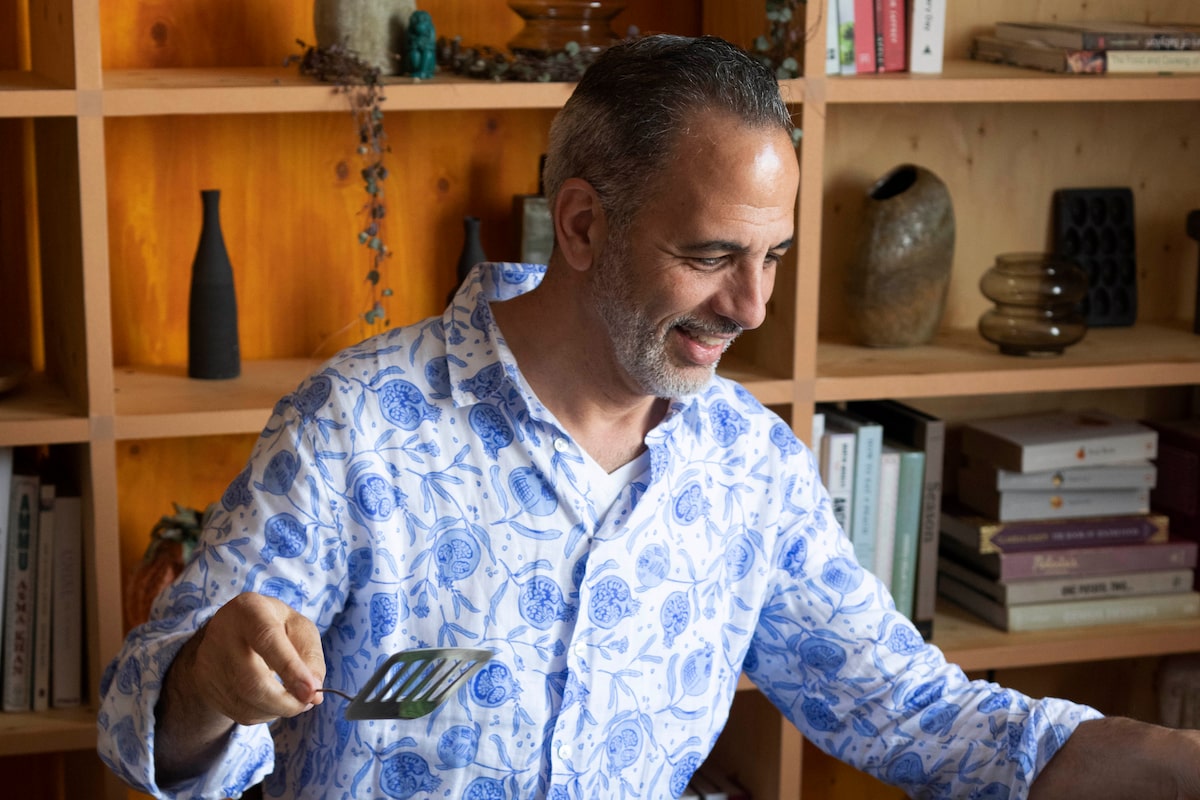
Yotam Ottolenghi’s most recent cookbook, Comfort, came out last year.Jonathan Lovekin/Supplied
Through his bestselling cookbooks, British-Israeli chef Yotam Ottolenghi prompted a generation of home cooks to stock their pantries with tahini, za’atar and bulgur wheat. But now, in the age of proteinmaxxing and self-optimization, it’s a bit harder to sell people on a 17-ingredient fregola and artichoke pilaf. Since the pandemic, Ottolenghi has simplified his style of cooking, as captured in his latest cookbook, 2024’s Comfort.
The chef spoke to The Globe and Mail about Ozempic, trendy diets and why he thinks food can be a tool for reconciliation in the Middle East.
You have published, at this point, thousands of recipes. Do you ever feel creatively stumped?
I look at cooking a bit like music. There’s an endless combination of notes and beats that you can put together. With food, every little iteration, every substitution, makes a completely different recipe.
Nowadays, you see a lot of things that I’ve had as a child in the 1970s coming back big time. These waves and these recurrences of particular dishes are reassuring. It means there’s always room for a new take on an old idea.
Much of the conversation around food today is about restriction, optimization. You tried intermittent fasting last year. Tell me about how that went.
It didn’t go well at all, because what I’ve realized is that I’ve got good instincts, and I don’t need someone else’s regime to tell me how to eat.
I think I had a pretty good rhythm of eating breakfast, lunch and dinner – it’s as old as history and I never questioned it. Once you start breaking your routines, a lot of new questions arise. If I skip the meal, what does it mean about the next meal? Can I eat a bit more? I think this is the problem with diets. It’s very, very, very confusing. We do need to find what’s good for us and for that, listening less to the outside world and listening more to yourself is, for me, the only way.
People have responded to that confusion with weight-loss drugs like Ozempic. How do you think the rise of these drugs is going to change our culture’s relationship with food?
It’s too early to tell. I think Ozempic and its likes are symptoms of our very unhealthy relationship with food. We eat in a rush. We cook less. Many of us have lost our knowledge of ingredients and how to cook. I don’t really think that weight-loss drugs are going to fix the problem. They’re just yet another incarnation of the problem.
Earlier this year, I interviewed your longtime collaborator and friend, Palestinian chef Sami Tamimi. He said when working on your co-authored 2012 cookbook Jerusalem, he felt like his concerns about the origins of some of these recipes were not heard, and he regrets not talking to you more about politics in the Middle East. How do you think about that time?
I think that we talked about the situation in the Middle East quite a lot. I’ve always been a very political person and very aware of what’s going on. What we did in Jerusalem was an attempt to tell a big story of different communities that live around the same area. And I think we did the best possible job at telling a very difficult, painful story. I think we tried to say – without saying it – look, this is what people cook. And when you look deep down inside, there’s a lot of affinities, there’s a lot of similarities, but also there’s still conflict. We tried to portray that.
What do you make of all of the discussions around food and appropriation in the Middle East? Who gets to claim hummus as their own?
I think food is in many ways borderless – things move from one culture to another, and that’s one of the reasons why humanity has such a rich culinary culture. I think we need to preserve that ability to borrow, to be influenced, to be impressed by other people’s food.
The Israeli-Palestinian conflict is one of those places where this is difficult, because claiming a dish is also a way of claiming your national identity.
I have acknowledged that in Jerusalem and then I did a TV show for the BBC on Jerusalem and trying to find the commonality around food with Palestinians. I met many Palestinians, I went to a Palestinian home and we cooked together. Reconciliation, whenever it happens, needs to start somewhere. Yes, there is appropriation going on. Yes, there are terrible things happening. I wouldn’t want to say that cooking together and cooking each other’s food is a bad thing. I think it’s the only hope we have.
Sami has been really outspoken over the last two years about the man-made hunger crisis in Gaza. In May this year, on Instagram, he was calling out his colleagues in the food world who had been silent. And you posted something that day about Gaza. Did you feel like he was calling you out?
I don’t know. Whatever I’ve done over the last couple of years has been because I felt compelled to talk and to say what I feel. I’m terribly conflicted, because I really feel pain. I feel the pain of both sides, and I feel the pain because I think both sides are reeling in different ways. I genuinely felt that what was going on and happening in Gaza was absolutely terrible. And I said that, and I thought that was the time and the place.
This interview has been condensed and edited.