
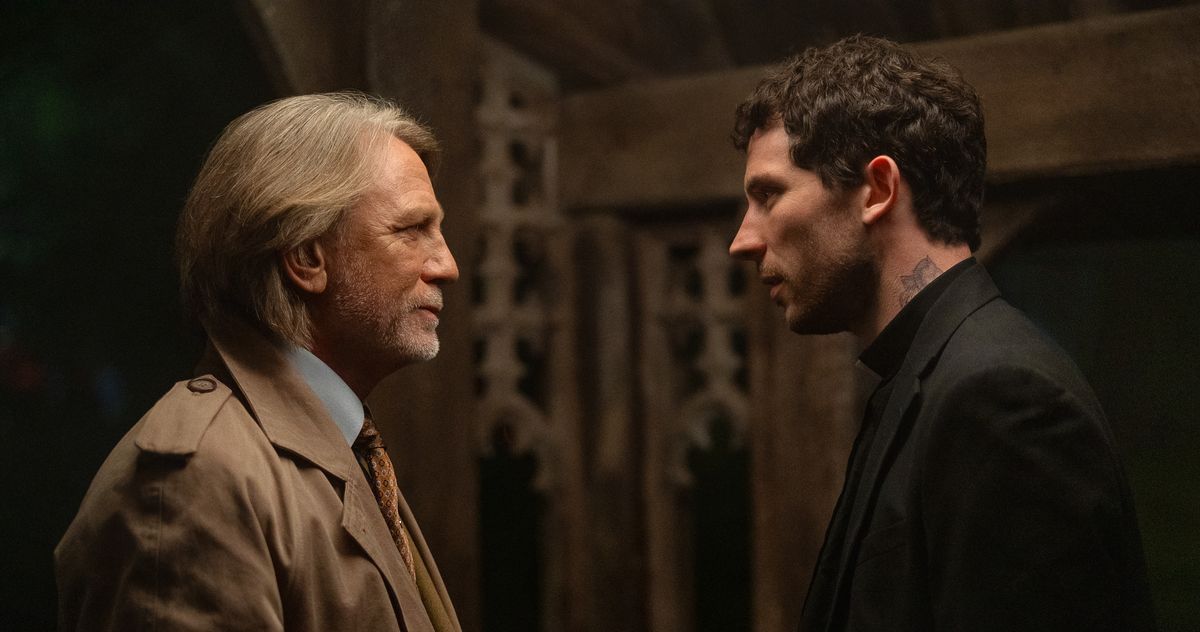
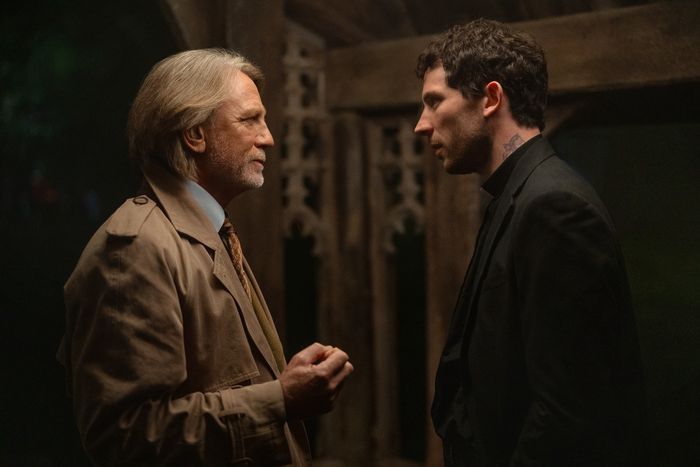
Forgive me, Lord, for I have sinned: I’ve spent hours thinking about Josh O’Connor’s neck tattoo in Wake Up Dead Man: A Knives Out Mystery again.
The way it peeks up out of his priest’s collar, winking at us. What is Father Jud Duplenticy’s body art, so blurry and indistinct? A flower of some kind? Maybe some initials? Perhaps a portrait of Jesus himself? It doesn’t really matter, actually. It’s what the tattoo suggests that’s so perfect for the character: the violent past he intentionally chose to leave behind, the mistakes of his youth that he’s now trying to redeem by being a source of guidance and advice for others, the body that was once in prime boxing condition. Okay, the latter is just me fantasizing on company time. But the tattoo! It’s only a tiny detail, but it helps build this man into a full character with a full internal life.
Wake Up Dead Man is a movie all about choices — what we choose to believe about the concept of God, who we choose to protect or defend, which elements of community we want to practice. Duplenticy gets up every day and chooses to put on his black clerical suit and white collar, reaffirming his devotion to his faith. He’s still an angry man, but nowadays that anger is deployed in defense of others. The character has a holistic, thorough view of himself in a way that no one else in the film does (certainly not the manosphere-brain-rotted author played by Andrew Scott, or the miracle-chasing former cellist played by Cailee Spaeny). It’s why Duplenticy is open about his ink, rolling up his sleeves and flashing the tattoo on his left inner forearm, too. His tattoos are a sign of how much he’s lived, and how deliberate his decision is to keep living as a different kind of man.
It’s been a good couple years for adornments or accessories that amplify characterization. Jacob Elordi’s eyebrow stud in Saltburn reflected his landed-gentry fuckboy tendencies. Denzel Washington’s shawls in Gladiator II were an extension of the aspiring politician’s grandiosity. Harris Dickinson’s (real) tattoo of a balaclava-wearing cherub holding an AK-47 was a perfect bit of nihilism for his self-destructive Babygirl seducer. Duplenticy’s tattoo serves a similar function, signaling both his hotness and his capacity for change. (The actual design — a picture of a devil and an angel with the word “serendipity” underneath it, according to an interview O’Connor did with Tudum — is almost an afterthought.) If Wake Up Dead Man is asking its viewers anything, it’s exactly for us to look at our lives and consider which sins we can lay to rest and which elements of grace we can resurrect. The neck tattoo is only a little ink, but with it the movie says a lot.
Related