

Listen to this article
Estimated 5 minutes
The audio version of this article is generated by AI-based technology. Mispronunciations can occur. We are working with our partners to continually review and improve the results.
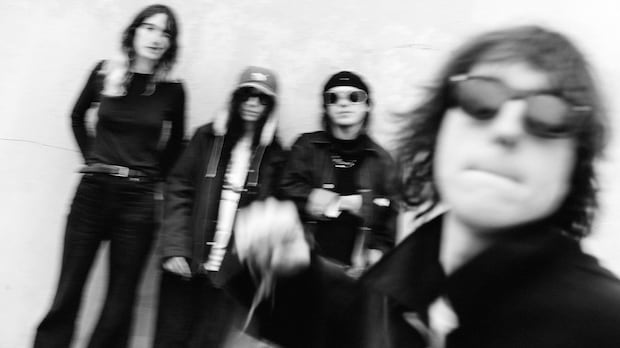
Of all the notable album releases from this year, there was one that kept popping up on the best of 2025 music lists of note: Getting Killed, the third album by Geese.
It’s a remarkable feat for the Brooklyn indie rock band, considering their members are still in their early 20s. Not to mention, their music is wilfully idiosyncratic — if not downright polarizing.
Today on Commotion, music journalist Emilie Hanskamp and CBC host Lisa Christiansen join Elamin Abdelmahmoud to explain how Geese took the music world by storm this year, and why not everyone understands the hype.
We’ve included some highlights below, edited for length and clarity. For the full discussion, listen and follow Commotion with Elamin Abdelmahmoud on your favourite podcast player.
LISTEN | Today’s episode on CBC Listen:
Commotion with Elamin Abdelmahmoud24:59The Geese divide + best new Xmas albums!
Elamin: Lisa, we’ve got to acknowledge the fact that not everyone is going to listen to Cameron Winter’s voice and go, “Oh, that’s for me. I’m interested and on board with this.” What do you make of Cameron Winter as a singer?…
Lisa: I don’t hate his voice. I mean, I’m a Smiths fan. Morrissey has always been there to surprise us with some kind of weird way to sing a song. Mostly, I find it kind of flat. Do you not hear a kind of, “I’m just whining, it’s OK”? I don’t know…. I don’t hate it, but I don’t understand. I am so impressed when someone is so in love with something, and Emilie, I am so excited for you that you are having the most wonderful time. And I’m trying, believe me.
Emilie: I see it and I respect it. And it’s also that pressure to be on the hype train when everyone’s excited about something. Like, I want to be excited too! I understand that. But sometimes you’re not, you know?
Elamin: There are many hype trains that pass me by and I go, this is going to go without me. I’m not boarding on this one…. But I think that’s why we wanted to have the two of you on. Because I think sometimes when the hype train gets so big, the reaction is actually to the hype train, right? To the idea of like, this large piece of culture that’s kind of crashed in the middle of all of this, we feel the pressure to respond to it and say, “This is a culturally definitive moment.” And not everyone is going to see the same thing in it….
It feels like every 10 years or so there comes a band that kind of catapults itself to the centre of music, right? You had that with Nirvana, and then you had that with the Strokes, and you had that with the White Stripes, you had that with Tame Impala. And then you kind of get here. But the thing that made those bands big is they were also a little bit accessible. And I don’t think that’s the same thing with Geese, Emilie. So, talk to me about the idea that even though they’re actually a little bit inaccessible, they still manage to take up that space….
Emilie: First of all, I understand that contextualization, and it makes sense to draw those parallels. But that’s what I think is so fresh about Geese, is— the way Cameron Winter has talked about it is, there’s a difference between transcribing your musical influences and feeling them. And I think what we hear from Geese is they are feeling their musical influences, and they are translating those through their music. So I think that doesn’t come with an accessibility, necessarily, that we found before. But they are in that sweet spot of, like … the lyricism will go from these absurd lines like, “A sailor on a big green boat,” and that becomes this memeable line, right? Which is such a beautiful line. It’s absurd, but it’s also packed with meaning. So everything has those, kind of, two sides to the coin. He said specifically in his lyricism, he likes to kind of jostle in that way, so you never can completely grasp it, and that makes you engaged…. It keeps you intrigued. It keeps you wanting to turn the stones over and say, what is going on here? Why is this pulling me in? What is the mirror that it’s holding up to me, instead of just being this very literal presentation of what’s going on inside an artist’s mind?
You can listen to the full discussion from today’s show on CBC Listen or on our podcast, Commotion with Elamin Abdelmahmoud, available wherever you get your podcasts.
Panel produced by Stuart Berman.