
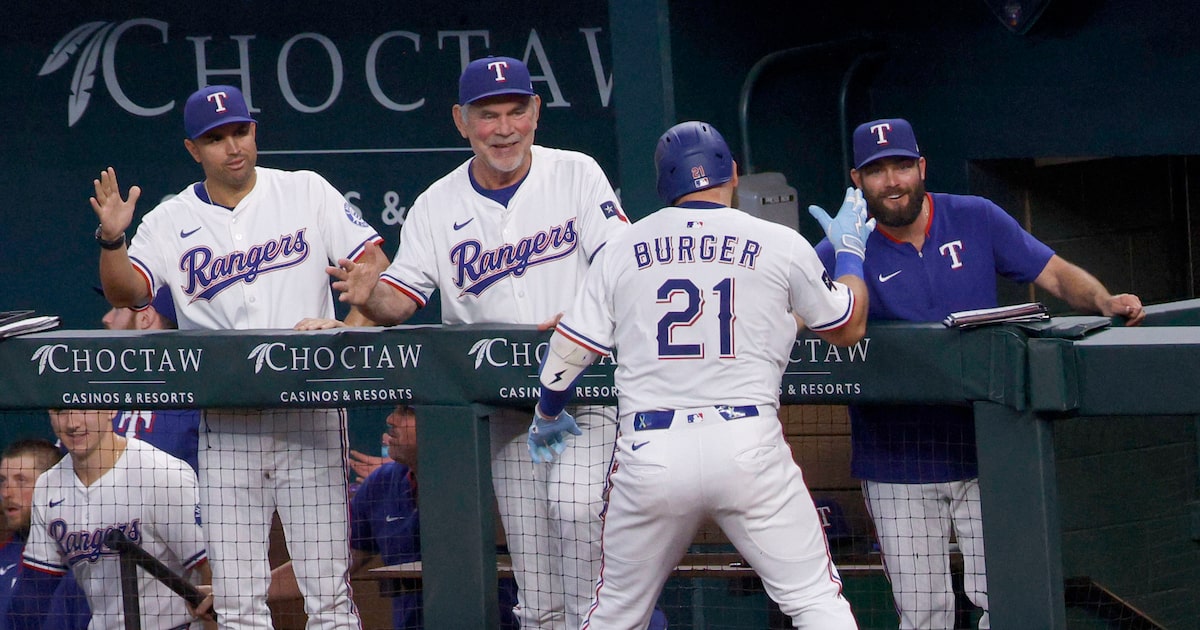
ARLINGTON – On Friday, the Rangers gathered their newly-constructed coaching staff as a group for the first time. Some interesting stories among the newcomers.
Rod Barajas, who played so well as a non-roster catcher in the spring of 2004, the Rangers spun off veteran Einar Diaz for a tall, surprisingly soft-throwing right-hander. Guy named Chris Young. Travis Jankowski is back, too, having retired as a player only a couple of months ago. And Alex Cintrón, who knows all the Astros offensive secrets from his years on the staff in Houston, has crossed the Silver Boot line to join the Rangers.
But, for all that, the most pressing story is about one of the holdovers: Justin Viele. He’s the guy charged with putting the offense back together.
It’s no small task. There are children still having night terrors after being exposed to that offense.
Rangers
When the Rangers weren’t hacking and chasing, they were inexplicably standing and watching. When they needed to be patient, they were antsy. When they needed to be aggressive, they were strangely passive. They were supposed to slug; they didn’t. Viele, as co-hitting coach to two different co-hitting coaches over the course of the year, had the unfortunate best – or worst – seat in the house.
The Rangers ranked 27th in on-base percentage in a 30-team league. In slugging, which was supposed to be their strong point, they were better; they ranked 26. It was the most frustrating offense to watch since Arlington Stadium closed down.
So, Justin, what’s the plan?
“I think it’s still strength-based,” Viele said and he was talking about skills, not physical strength. “It’s still about being a multi-dimensional offense. We can’t expect, for example, Josh Jung and Jake Burger to all of a sudden have walk rates of 10%. We need them to be really good at what they are really good at. We need the other guys that are on-base guys, to get on base. But you aren’t going to turn everybody into an on-base guy. It’s not fair to them. They feel their best when they are aggressive hitters. We want our hitters to be good at what they are really good at.”
It’s interesting that Viele started with Jung and Burger, because that’s where the Rangers can and need to make their biggest leaps. No, they aren’t going to walk 10% of the time, but they have to walk a little bit more than 3.1% for Burger, which was the third-worst in the majors (minimum 300 plate appearances) and 5.2% for Jung, which was 241st of 277.
And here’s the thing, being a little more discriminate at the plate should improve their walk rates slightly, but should improve their slugging percentages significantly.
Jung has to stop chasing up and down as much as he did in 2025. The Rangers can live with him chasing more side to side, which is more in his hot zone. Burger can chase high pitches – and crush them. But he can’t chase in three other directions, too.
“It’s maybe just him zeroing in a little bit more on his approach to be like, ‘Okay, I’m dialed in at the top of the zone; I’m okay if I chase a little bit above’,” Viele said. “If they are disciplined in their approach, looking in the areas where they get the most return, they are impacting the baseball. Their OPS is going to be more influenced by slug than OBP.”
Seems sensible enough. Seemed sensible enough when it was discussed last season, but let’s face it, 2025 was a mess. It became clear in spring training to team officials that the Rangers weren’t impacting the baseball, the way they’d like. Perhaps that led to a little panic among both players and staff. A month into the season, the Rangers were making changes in the hitting department. Along the way, both Burger and Jung endured unexpected demotions.
“I think it was just kind of an odd year,” Viele said. “There were a lot of changes. In spring training, I don’t think anyone was performing the way they wanted. So guys were a little bit panicked going into the season because they weren’t getting the numbers in spring. That bled into the beginning of the season. And when you’re playing catch, it’s really hard and really stressful. Everyone’s playing hero ball in the box.”
In Burger’s defense, he may have felt extra pressure. New guy. Brought in to slug. Didn’t slug. Dealt with injuries. Spent more than half the season trying to recover from the awful start, only digging the hole deeper. For that matter, Jung was finally healthy and may have felt something to prove, and only did himself more harm than good with his swing-at-all-costs approach. Either way, it’s a performance-based game. The Rangers just proved this offseason that one year of sub-par performance requires attention; two requires separation.
To that end, Viele has already been at work with Jung and Burger. He’s talked with Jung at length and spent time hitting with Burger last week in Arlington. In January, he will start hitting with Joc Pederson in Arizona “four or five times a week.” Pederson, who had the worst year of his career, is another guy who must step up. Viele has a relationship with him dating back to 2022 when both were with San Francisco.
“Knowing Joc, the competitor that he is, he was not happy with the way he performed,” Viele said. “I think he’s excited to get to work. He’s got a chip on his shoulder, and Joc, with a chip on his shoulder, that can be a special thing.”
The Rangers don’t need guys to work towards having their own special seasons. They need guys to work towards contributing in their areas of strength. If that happens, then the offense, as a whole, can have a special season. And that would be more interesting than any other story on the coaching staff.
Former Rangers reliever Shawn Armstrong agrees to deal with Guardians, report saysWyatt Langford, Jacob deGrom, Nathan Eovaldi among Rangers’ 2025 team award recipients
Find more Rangers coverage from The Dallas Morning News here.