
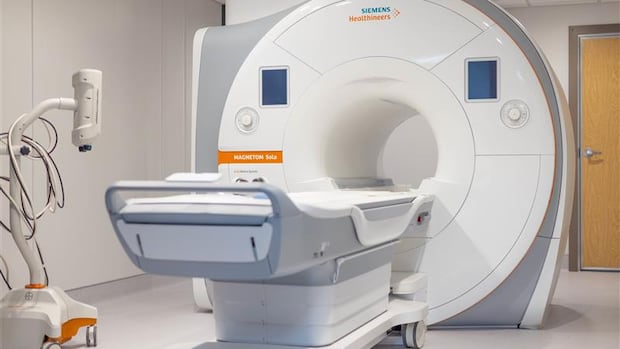
A growing number of Manitoba’s MRI machines now use artificial intelligence, with a plan to have more than half using the technology by spring.
Using AI allows crisp images and faster scans, said Dr. AbdulRazaq Sokoro, chief operating officer of provincial diagnostic services for Shared Health.
“The patient will not notice any difference,” Sokoro said, but “instead of having a 20-minute scan, it’s now going to be a 10-minute scan.”
All new MRI machines, like the mobile unit first based at Thompson General Hospital, come with AI technology built in, Sokoro said. A number of other units in the province have been or will be retrofitted to use the technology Manitoba Health is getting from Siemens Healthineers.
While they’re still in the process of finalizing their initial data, Sokoro said they are seeing positive results.
“This technology has been a centre of our strategy to deal with the wait list, the long wait list for MRI,” Sokoro said.
“It’s not the only answer. It is one of the answers, and that’s why we’re quite grateful government recognized that and gave us the investments to be able to do this. And I am confident without doubt that if we continue to leverage this technology across the province, we will make a significant dent in our wait times for MRI.”
Sokoro said nine out of the province’s 14 scanners, including machines at Boundary Trails Health Centre, the Pan Am Clinic and in hospitals in Winnipeg, Brandon and Selkirk, will have the AI software by spring 2026.
Adjusting how scans are scheduled, teaching staff how to use the technology and upgrading protocols are key in introducing the new software, he said.
While the AI technology is changing how staff use the machines, it’s not replacing people, Sokoro said.
He hasn’t heard any concerns about how it’s working but said it’s still early.
“I can tell you right now is we tried to look at every concern that we can hypothesize before we got into this business.… The biggest one was data security and privacy as well,” he said.
“That’s why we were convinced and confident that we could use this, because this is not a cloud-based system that sits somewhere. It is actually something that is sitting in that physical machine that it’s running on.”
WATCH | AI is helping health-care workers perform MRIs:
How is artificial intelligence used in Manitoba’s health-care system?
Whether it’s music, videos or how we search for information, we’re hearing more and more about artificial intelligence. See where it’s showing up in Manitoba’s medical system.
Health Minister Uzoma Asagwara said in a statement that “sites using the new AI-enhanced technology are seeing significant gains that are already making a difference for patients.”
“Preliminary data shows Boundary Trails reached an all-time high of 1,051 scans in October 2025. Pan Am has seen a 90 per cent increase over the same period, and at HSC, the first full month of AI implementation in October resulted in a 24 per cent increase in productivity,” Asagwara said.
The 2025 numbers were compared to the same month in 2022, as “it was the first period after the major pandemic disruptions where MRI volumes had started to stabilize,” their office said.
The upgrades have brought “shorter scan times, fewer repeat exams, and faster answers for patients,” the statement said.
The use of AI is also emerging in other areas of Manitoba’s health-care system.
The weapons detectors at Health Sciences Centre use it, and there’s a pilot involving note-taking during doctor’s appointments.
 NDP Health Minister Uzoma Asagwara says they’re exploring ways AI can make the health-care workload easier and more manageable for providers. (Jeff Stapleton/CBC)
Asagwara said the province is working with experts to understand where the opportunities are.
“How can AI really be a tool that helps improve care and outcomes for Manitobans and how can it be used alongside the incredible work that’s already being done to make the workload easier and more manageable for our providers?”
At CancerCare Manitoba, chemotherapy treatments vary widely, with differences in medication, how long an appointment takes, or the level of care needed during a patient’s visit, said Ken Borce, who recently worked at CancerCare Manitoba as vice-president of clinical operations and chief nursing officer.
The team there is working on launching a new AI tool that will help them schedule chemotherapy appointments.
There are currently 66 chemotherapy chairs in Winnipeg, and an average of 5,519 treatments each month, said a CancerCare spokesperson.
The goal is to allow staff to spend more time with patients and get people in for appointments faster, Borce said.
 Chemotherapy treatments can vary in complexity, medication and time needed, which factors into how appointments are scheduled, says Ken Borce, who worked as CancerCare Manitoba’s vice-president of clinical operations and chief nursing officer. (Warren Kay/CBC )
“It’s really in the context of the sustainability of the system and supporting our staff,” he said.
“We want our staff to do the best thing that they do, which is being in front of their patients and providing that care in front of their patient, not in front of scheduling, not in front of the computer, not in front of a piece of paper,” he said.
The scheduling system, from Gray Oncology Solutions, uses CancerCare’s procedures, policies and protocols, Borce said.
He said keeping patients safe and quality of care have been “paramount” while working on implementation of the platform.
“We’re not just buying a software off the shelf and implement it because it’s the nice shiny thing,” said Borce. “Our innovation does not come at a cost of safety and quality.”
 A new scheduling tool for chemotherapy treatments at CancerCare Manitoba uses AI. The goal is to allow staff to spend more time with patients, while also getting people in for appointments faster, said Ken Borce, the former vice-president of clinical operations and chief nursing officer at CancerCare Manitoba. (Warren Kay/CBC)
The platform doesn’t replace critical thinking or clinical judgment, he said.
The goal is to have the new scheduling tool in use next year.
“No scheduling positions will be eliminated as a result of this implementation,” a spokesperson said.