
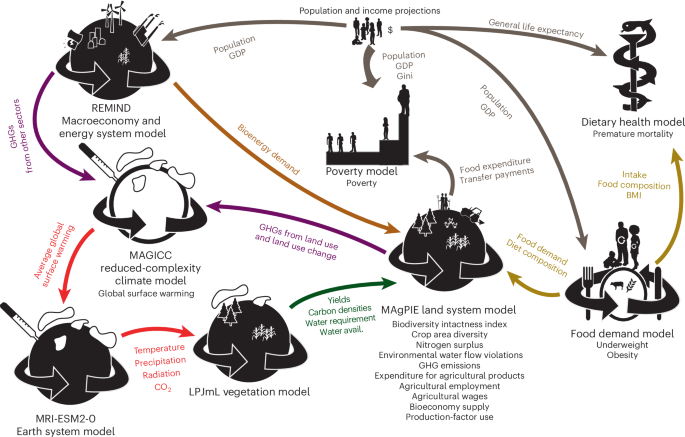
von Braun, J., Afsana, K., Fresco, L. O. & Ali Hasan, M. H. (eds) Science and Innovations for Food Systems Transformation (Springer International Publishing, 2023); https://doi.org/10.1007/978-3-031-15703-5
Bodirsky, B. L. et al. The ongoing nutrition transition thwarts long-term targets for food security, public health and environmental protection. Sci. Rep. 10, 19778 (2020).
GBD 2017 Diet Collaborators Health effects of dietary risks in 195 countries, 1990–2017: a systematic analysis for the Global Burden of Disease Study 2017. Lancet 393, 1958–1972 (2019).
Micha, R. Global Nutrition Report 2021 (Development Initiatives, 2021).
Crippa, M. et al. Food systems are responsible for a third of global anthropogenic GHG emissions. Nat. Food 2, 198–209 (2021).
Willett, W. et al. Food in the Anthropocene: the EAT–Lancet Commission on healthy diets from sustainable food systems. Lancet https://doi.org/10.1016/S0140-6736(18)31788-4 (2019).
Popp, A. et al. Land-use futures in the shared socio-economic pathways. Glob. Environ. Change 42, 331–345 (2017).
Springmann, M. et al. Options for keeping the food system within environmental limits. Nature 562, 519–525 (2018); https://doi.org/10.1038/s41586-018-0594-0
ILO/FAO/IUF Agricultural Workers and Their Contribution to Sustainable Agriculture and Rural Development (ILO, 2007).
Policy Brief: The Impact of COVID-19 on Food Security and Nutrition (UN, 2020).
Laborde, D., Herforth, A., Headey, D. & de Pee, S. COVID-19 pandemic leads to greater depth of unaffordability of healthy and nutrient-adequate diets in low- and middle-income countries. Nat. Food 2, 473–475 (2021).
The Importance of Ukraine and the Russian Federation for Global Agricultural Markets and the Risks Associated with the Current Conflict 47 (FAO, 2022).
Hainzelin, E. et al. in Science and Innovations for Food Systems Transformation (eds von Braun, J. et al.) 877–891 (Springer International, 2023); https://doi.org/10.1007/978-3-031-15703-5_47
Costanza, R. Visions of alternative (unpredictable) futures and their use in policy analysis. Conserv. Ecol. 4, 5 (2000).
Bai, X. et al. Plausible and desirable futures in the Anthropocene: a new research agenda. Glob. Environ. Change 39, 351–362 (2016).
IPBES global assessment report on biodiversity and ecosystem services of the intergovernmental science–policy platform on biodiversity and ecosystem services. Zenodo https://doi.org/10.5281/zenodo.6417333 (2019).
Intergovernmental Panel On Climate Change (ed). Annex III: scenarios and modelling methods. In Climate Change 2022 – Mitigation of Climate Change https://doi.org/10.1017/9781009157926.022 (Cambridge Univ. Press, 2023).
UNFSS Action tracks. United Nations https://www.un.org/en/food-systems-summit/action-tracks (2022).
Kemp, R. & Martens, P. Sustainable development: how to manage something that is subjective and never can be achieved?. Sustain. Sci. Pract. Policy 3, 5–14 (2007).
Dietrich, J. P. et al. MAgPIE 4—a modular open-source framework for modeling global land systems. Geosci. Model Dev. 12, 1299–1317 (2019).
Bodirsky, B. L. et al. Integrating degrowth and efficiency perspectives enables an emission-neutral food system by 2100. Nat. Food 3, 341–348 (2022).
UN Dialogues and pathways. UN Food Systems https://www.unfoodsystemshub.org/member-state-dialogue/dialogues-and-pathways/en (2020).
Riahi, K. et al. The shared socioeconomic pathways and their energy, land use, and greenhouse gas emissions implications: an overview. Glob. Environ. Change 42, 153–168 (2017).
Gaupp, F. et al. Food system development pathways for healthy, nature-positive and inclusive food systems. Nat. Food https://doi.org/10.1038/s43016-021-00421-7 (2021).
van Vuuren, D. P. et al. Pathways to achieve a set of ambitious global sustainability objectives by 2050: explorations using the IMAGE integrated assessment model. Technol. Forecast. Soc. Change https://doi.org/10.1016/j.techfore.2015.03.005 (2015).
Emissions Gap Report (EGR) 2022: The Closing Window—Climate Crisis Calls for Rapid Transformation of Societies (UNEP, 2022).
Soergel, B. et al. A sustainable development pathway for climate action within the UN 2030 Agenda. Nat. Clim. Change 11, 656–664 (2021).
Gerten, D. et al. Feeding ten billion people is possible within four terrestrial planetary boundaries. Nat. Sustain. 3, 200–208 (2020).
Leclère, D. et al. Bending the curve of terrestrial biodiversity needs an integrated strategy. Nature https://doi.org/10.1038/s41586-020-2705-y (2020).
Doelman, J. C. et al. Quantifying synergies and trade-offs in the global water–land–food–climate nexus using a multi-model scenario approach. Environ. Res. Lett. 17, 045004 (2022).
Hasegawa, T., Fujimori, S., Takahashi, K. & Masui, T. Scenarios for the risk of hunger in the twenty-first century using Shared Socioeconomic Pathways. Environ. Res. Lett. 10, 014010 (2015).
Humpenöder, F. et al. Overcoming global inequality is critical for land-based mitigation in line with the Paris Agreement. Nat. Commun. 13, 7453 (2022).
Schaphoff, S. et al. LPJmL4—a dynamic global vegetation model with managed land—Part 1: model description. Geosci. Model Dev. 11, 1343–1375 (2018).
von Bloh, W. et al. Implementing the nitrogen cycle into the dynamic global vegetation, hydrology, and crop growth model LPJmL (version 5.0). Geosci. Model Dev. 11, 2789–2812 (2018).
Meinshausen, M. et al. The shared socio-economic pathway (SSP) greenhouse gas concentrations and their extensions to 2500. Geosci. Model Dev. 13, 3571–3605 (2020).
Springmann, M., Clark, M. A., Rayner, M., Scarborough, P. & Webb, P. The global and regional costs of healthy and sustainable dietary patterns: a modelling study. Lancet Planet. Health 5, e797–e807 (2021).
Soergel, B. et al. Combining ambitious climate policies with efforts to eradicate poverty. Nat. Commun. 12, 2342 (2021).
Baumstark, L. et al. REMIND2.1: transformation and innovation dynamics of the energy-economic system within climate and sustainability limits. Geosci. Model Dev. 14, 6571–6603 (2021).
Yukimoto, S. et al. The Meteorological Research Institute Earth System Model Version 2.0, MRI-ESM2.0: description and basic evaluation of the physical component. J. Meteorol. Soc. Jpn. 97, 931–965 (2019).
Chen, D. M.-C. et al. Future food prices will become less sensitive to agricultural market prices and mitigation costs. Nat. Food https://doi.org/10.1038/s43016-024-01099-3 (2025).
Valin, H., Hertel, T., Bodirsky, B. L., Hasegawa, T. & Stehfest, E. A Review of Quantitative Assessments of Synergies and Tradeoffs Amongst the UN Sustainable Development Goals 51 (United Nations Food Systems Summit 2021 Scientific Group, 2021).
Okunogbe, A., Nugent, R., Spencer, G., Ralston, J. & Wilding, J. Economic impacts of overweight and obesity: current and future estimates for eight countries. BMJ Glob. Health 6, e006351 (2021).
Imamura, F. et al. Dietary quality among men and women in 187 countries in 1990 and 2010: a systematic assessment. Lancet Glob. Health 3, e132–e142 (2015).
Pascual, U. et al. Biodiversity and the challenge of pluralism. Nat. Sustain. 4, 567–572 (2021).
Purvis, A. et al. in Advances in Ecological Research Vol. 58 (eds Bohan, D. A. et al.) Ch 5 201–241 (Academic Press, 2018).
Brooks, T. M. et al. Global biodiversity conservation priorities. Science 313, 58–61 (2006).
Estrada-Carmona, N., Sánchez, A. C., Remans, R. & Jones, S. K. Complex agricultural landscapes host more biodiversity than simple ones: a global meta-analysis. Proc. Natl Acad. Sci. USA 119, e2203385119 (2022).
Schulte-Uebbing, L. F., Beusen, A. H. W., Bouwman, A. F. & de Vries, W. From planetary to regional boundaries for agricultural nitrogen pollution. Nature 610, 507–512 (2022).
Sutton, M. A. et al. Our Nutrient World: the Challenge to Produce More Food and Energy with Less Pollution (Centre for Ecology and Hydrology on behalf of the Global Partnership on Nutrient Management (GPNM) and the International Nitrogen Initiative (INI), 2013).
Bonsch, M. et al. Environmental flow provision: implications for agricultural water and land-use at the global scale. Glob. Environ. Change 30, 113–132 (2015).
Yi, J. et al. Post-farmgate food value chains make up most of consumer food expenditures globally. Nat. Food 2, 417–425 (2021).
Leimbach, M., Marcolino, M. & Koch, J. Structural change scenarios within the SSP framework. Futures 150, 103156 (2023).
Worldbank World Development Report 2008: Agriculture for Development. (World Bank, Eurospan (distributor), 2007).
Banerjee, A. V. & Duflo, E. Good Economics for Hard Times: Better Answers to Our Biggest Problems (Allen Lane, 2019).
Mogollón, J. M., Beusen, A. H. W., van Grinsven, H. J. M., Westhoek, H. & Bouwman, A. F. Future agricultural phosphorus demand according to the shared socioeconomic pathways. Glob. Environ. Change 50, 149–163 (2018).
Humpenöder, F. et al. Food matters: dietary shifts increase the feasibility of 1.5 °C pathways in line with the Paris Agreement. Sci. Adv. 10, eadj3832 (2024).
Bodirsky, B. L. et al. Reactive nitrogen requirements to feed the world in 2050 and potential to mitigate nitrogen pollution. Nat. Commun. 5, 3858 (2014).
Latka, C. et al. Paying the price for environmentally sustainable and healthy EU diets. Glob. Food Secur. 28, 100437 (2021).
Pfeiler, T. M. & Egloff, B. Do vegetarians feel bad? Examining the association between eating vegetarian and subjective well-being in two representative samples. Food Qual. Prefer. 86, 104018 (2020).
Herrero, M. et al. Innovation can accelerate the transition towards a sustainable food system. Nat. Food 1, 266–272 (2020).
Herrero, M. et al. Articulating the effect of food systems innovation on the Sustainable Development Goals. Lancet Planet. Health 5, e50–e62 (2021).
Hadjikakou, M. et al. Ambitious food system interventions required to mitigate the risk of exceeding Earth’s environmental limits. One Earth https://doi.org/10.1016/j.oneear.2025.101351 (2025).
Orlov, A., Sillmann, J., Aunan, K., Kjellstrom, T. & Aaheim, A. Economic costs of heat-induced reductions in worker productivity due to global warming. Glob. Environ. Change 63, 102087 (2020).
Dasgupta, S. et al. Effects of climate change on combined labour productivity and supply: an empirical, multi-model study. Lancet Planet. Health 5, e455–e465 (2021).
Barros, L. & Martínez-Zarzoso, I. Systematic literature review on trade liberalization and sustainable development. Sustain. Prod. Consum. 33, 921–931 (2022).
IPCC: Summary for Policymakers. In: Climate Change 2022: Mitigation of Climate Change. Contribution of Working Group III to the Sixth Assessment Report of the Intergovernmental Panel on Climate Change (Cambridge Univ. Press, 2022).
IPCC: Sustainable Development, Poverty Eradication and Reducing Inequalities. In: Global Warming of 1.5 °C: IPCC Special Report on Impacts of Global Warming of 1.5 °C above Pre-industrial Levels in Context of Strengthening Response to Climate Change, Sustainable Development, and Efforts to Eradicate Poverty (Cambridge Univ. Press, 2018); https://doi.org/10.1017/9781009157940
Tezanos-Vázquez, S. Why do famines still occur in the 21st Century? A review on the causes of extreme food insecurity. J. Econ. Surv. 39, 1433–1461 (2025).
The State of Food Security and Nutrition in the World: Safeguarding against Economic Slowdowns and Downturns (FAO, 2019).
The State of Food Security and Nutrition in the World 2025 (FAO, IFAD, UNICEF, WFP, WHO, 2025); https://doi.org/10.4060/cd6008en
Pörtner, L. M. et al. We need a food system transformation—in the face of the Russia–Ukraine war, now more than ever. One Earth https://doi.org/10.1016/j.oneear.2022.04.004 (2022).
ESCAP Insights on Food System Risks—INFER. Data and methodology https://www.unescap.org/projects/infer/data-methodology (2024).
Field, C. B. et al. Managing the Risks of Extreme Events and Disasters to Advance Climate Change Adaptation: A Special Report of Working Groups I and II of the Intergovernmental Panel on Climate Change (Cambridge Univ. Press, 2012); https://doi.org/10.1017/CBO9781139177245
Rohr, J. R. et al. Emerging human infectious diseases and the links to global food production. Nat. Sustain. 2, 445–456 (2019).
Moseley, W. G. & Battersby, J. The vulnerability and resilience of African food systems, food security, and nutrition in the context of the COVID-19 pandemic. Afr. Stud. Rev. 63, 449–461 (2020).
Kummu, M. et al. Interplay of trade and food system resilience: gains on supply diversity over time at the cost of trade independency. Glob. Food Secur. 24, 100360 (2020).
Fujimori, S. et al. A multi-model assessment of food security implications of climate change mitigation. Nat. Sustain. 2, 386–396 (2019).
Merfort, L. et al. Bioenergy-induced land-use-change emissions with sectorally fragmented policies. Nat. Clim. Change https://doi.org/10.1038/s41558-023-01697-2 (2023).
Newell, P. & Mulvaney, D. The political economy of the ‘just transition’. Geogr. J. 179, 132–140 (2013).
ZKL The Future of Agriculture—A Common Agenda 136 (Commission on the Future of Agriculture Office, 2021); http://bmel.de/goto?id=91482
Wang, X., Bodirsky, B. L., Müller, C., Chen, K. Z. & Yuan, C. The triple benefits of slimming and greening the Chinese food system. Nat. Food https://doi.org/10.1038/s43016-022-00580-1 (2022).
Fesenfeld, L. P., Wicki, M., Sun, Y. & Bernauer, T. Policy packaging can make food system transformation feasible. Nat. Food 1, 173–182 (2020).
Malbon, E. & Parkhurst, J. System dynamics modelling and the use of evidence to inform policymaking. Policy Stud. 44, 1–19 (2022).
Wang, X. et al. Bundled measures for China’s food system transformation reveal social and environmental co-benefits. Nat. Food https://doi.org/10.1038/s43016-024-01100-z (2025).
Köberle, A. C. et al. Livestock Intensification and the Role of Finance in the Food System Transformation in Brazil (Food System Economics Commission, 2023).
Singh, V. et al. An inclusive agri-food systems transformation pathway for India. Preprint at Research Square https://doi.org/10.21203/rs.3.rs-4767324/v1 (2024).
Lotze-Campen, H. et al. Global food demand, productivity growth, and the scarcity of land and water resources: a spatially explicit mathematical programming approach. Agric. Econ. 39, 325–338 (2008).
Meinshausen, M. et al. Greenhouse-gas emission targets for limiting global warming to 2 °C. Nature 458, 1158–1162 (2009).
Meinshausen, M., Raper, S. C. B. & Wigley, T. M. L. Emulating coupled atmosphere–ocean and carbon cycle models with a simpler model, MAGICC6—Part 1: model description and calibration. Atmos. Chem. Phys. 11, 1417–1456 (2011).
Springmann, M. et al. Health-motivated taxes on red and processed meat: a modelling study on optimal tax levels and associated health impacts. PLoS ONE 13, e0204139 (2018).
Springmann, M. et al. The healthiness and sustainability of national and global food based dietary guidelines: modelling study. BMJ https://doi.org/10.1136/bmj.m2322 (2020).
Dietrich, J. P. et al. MAgPIE—an open source land-use modeling framework. Zenodo https://doi.org/10.5281/zenodo.7920802 (2023).
Lotze-Campen, H. et al. Impacts of increased bioenergy demand on global food markets: an AgMIP economic model intercomparison. Agric. Econ. 45, 103–116 (2014).
Popp, A. et al. The economic potential of bioenergy for climate change mitigation with special attention given to implications for the land system. Environ. Res. Lett. 6, 1–9 (2011).
Weindl, I. et al. Livestock and human use of land: Productivity trends and dietary choices as drivers of future land and carbon dynamics. Glob. Planet. Change 159, 1–10 (2017).
Weindl, I. et al. Livestock production and the water challenge of future food supply: implications of agricultural management and dietary choices. Glob. Environ. Change 47, 121–132 (2017).
Dietrich, J. P., Schmitz, C., Lotze-Campen, H., Popp, A. & Müller, C. Forecasting technological change in agriculture—an endogenous implementation in a global land use model. Technol. Forecast. Soc. Change 81, 236–249 (2014).
Mishra, A. et al. Estimating global land system impacts of timber plantations using MAgPIE 4.3.5. Geosci. Model Dev. 14, 6467–6494 (2021).
Harmsen, M. et al. Uncertainty in non-CO2 greenhouse gas mitigation contributes to ambiguity in global climate policy feasibility. Nat. Commun. 14, 2949 (2023).
New food balances. Description of utilization variables. FAOSTAT (FAO, 2022); https://files-faostat.fao.org/production/FBS/New%20FBS%20methodology.pdf
Gustavsson, J., Cedersberg, C., Sonesson, U., van Otterdijk, R. & Meybeck, A. Global Food Losses and Food Waste (FAO, 2011); http://www.fao.org/3/mb060e/mb060e00.htm
Toreti, A. et al. Narrowing uncertainties in the effects of elevated CO2 on crops. Nat. Food 1, 775–782 (2020).
Lutz, F. et al. Simulating the effect of tillage practices with the global ecosystem model LPJmL (version 5.0-tillage). Geosci. Model Dev. 12, 2419–2440 (2019).
Herzfeld, T., Heinke, J., Rolinski, S. & Müller, C. Soil organic carbon dynamics from agricultural management practices under climate change. Earth Syst. Dyn. 12, 1037–1055 (2021).
Springmann, M. & Freund, F. Options for reforming agricultural subsidies from health, climate, and economic perspectives. Nat. Commun. 13, 82 (2022).
Murray, C. J., Ezzati, M., Lopez, A. D., Rodgers, A. & Vander Hoorn, S. Comparative quantification of health risks: conceptual framework and methodological issues. Popul. Health Metr. 1, 1 (2003).
GBD 2017 Causes of Death Collaborators Global, regional, and national age-sex-specific mortality for 282 causes of death in 195 countries and territories, 1980–2017: a systematic analysis for the Global Burden of Disease Study 2017. Lancet 392, 1736–1788 (2018).
Afshin, A., Micha, R., Khatibzadeh, S. & Mozaffarian, D. Consumption of nuts and legumes and risk of incident ischemic heart disease, stroke, and diabetes: a systematic review and meta-analysis1234. Am. J. Clin. Nutr. 100, 278–288 (2014).
Aune, D. et al. Nut consumption and risk of cardiovascular disease, total cancer, all-cause and cause-specific mortality: a systematic review and dose-response meta-analysis of prospective studies. BMC Med. 14, 207 (2016).
Aune, D. et al. Fruit and vegetable intake and the risk of cardiovascular disease, total cancer and all-cause mortality—a systematic review and dose-response meta-analysis of prospective studies. Int. J. Epidemiol. 46, 1029–1056 (2017).
Schwingshackl, L. et al. Food groups and risk of type 2 diabetes mellitus: a systematic review and meta-analysis of prospective studies. Eur. J. Epidemiol. 32, 363–375 (2017).
Schwingshackl, L. et al. Food groups and risk of colorectal cancer. Int. J. Cancer 142, 1748–1758 (2018).
Bechthold, A. et al. Food groups and risk of coronary heart disease, stroke and heart failure: a systematic review and dose-response meta-analysis of prospective studies. Crit. Rev. Food Sci. Nutr. 59, 1071–1090 (2019).
Global, B. M. I. Mortality collaboration. Body-mass index and all-cause mortality: individual-participant-data meta-analysis of 239 prospective studies in four continents. Lancet 388, 776–786 (2016).
Wang, H. et al. Global age-sex-specific fertility, mortality, healthy life expectancy (HALE), and population estimates in 204 countries and territories, 1950–2019: a comprehensive demographic analysis for the Global Burden of Disease Study 2019. Lancet 396, 1160–1203 (2020).
NCD-RisC Worldwide trends in body-mass index, underweight, overweight, and obesity from 1975 to 2016: a pooled analysis of 2416 population-based measurement studies in 128.9 million children, adolescents, and adults. Lancet 390, 2627–2642 (2017).
Forster, P. et al. in Climate Change 2021: The Physical Science Basis. Contribution of Working Group I to the Sixth Assessment Report of the Intergovernmental Panel on Climate Change 923–1054 (Cambridge Univ. Press, 2021).
Kikstra, J. S. et al. The IPCC Sixth Assessment Report WGIII climate assessment of mitigation pathways: from emissions to global temperatures. Geosci. Model Dev. 15, 9075–9109 (2022).
Riahi, K. et al. Mitigation Pathways Compatible with Long-term Goals. in IPCC, 2022: Climate Change 2022: Mitigation of Climate Change. Contribution of Working Group III to the Sixth Assessment Report of the Intergovernmental Panel on Climate Change (Cambridge Univ. Press, 2018).
Vuuren, D. van et al. The representative concentration pathways: an overview. Clim. Change 109, 5–31 (2011).
O’Neill, B. C. et al. The Scenario Model Intercomparison Project (ScenarioMIP) for CMIP6. Geosci. Model Dev. 9, 3461–3482 (2016).
Lange, S. & Büchner, M. ISIMIP3b bias-adjusted atmospheric climate input data. ISIMIP https://doi.org/10.48364/ISIMIP.842396.1 (2021).
Lange, S. Trend-preserving bias adjustment and statistical downscaling with ISIMIP3BASD (v1.0). Geosci. Model Dev. 12, 3055–3070 (2019).
Rao, N. D., Sauer, P., Gidden, M. & Riahi, K. Income inequality projections for the Shared Socioeconomic Pathways (SSPs). Futures 105, 27–39 (2019).
Strefler, J. et al. Alternative carbon price trajectories can avoid excessive carbon removal. Nat. Commun. 12, 2264 (2021).
Strefler, J. et al. Carbon dioxide removal technologies are not born equal. Environ. Res. Lett. 16, 074021 (2021).
Kc, S. & Lutz, W. The human core of the shared socioeconomic pathways: population scenarios by age, sex and level of education for all countries to 2100. Global Environ. Change 42, 181–192 (2017).
Dellink, R., Chateau, J., Lanzi, E. & Magné, B. Long-term economic growth projections in the Shared Socioeconomic Pathways. Global Environ. Change 42, 200–214 (2017).
Rafaj, P. et al. Air quality and health implications of 1.5 °C–2 °C climate pathways under considerations of ageing population: a multi-model scenario analysis. Environ. Res. Lett. 16, 045005 (2021).
Rauner, S., Hilaire, J., Klein, D., Strefler, J. & Luderer, G. Air quality co-benefits of ratcheting up the NDCs. Clim. Change 163, 1481–1500 (2020).
Fujino, J., Nair, R., Kainuma, M., Masui, T. & Matsuoka, Y. Multi-gas mitigation analysis on stabilization scenarios using aim global model. Energy J. 27, 343–353 (2006).
Bodirsky, B. L. et al. Reproduction package for “A food system transformation can enhance global health, environmental conditions and social inclusion”. Zenodo https://doi.org/10.5281/zenodo.17233328 (2025).
Müller, C. et al. LPJmL4 and LPJmL5 source code for FSEC Food Systems Transformation assessment. Zenodo https://doi.org/10.5281/zenodo.7912370 (2023).
Bodirsky, B. L., Dietrich, J. P., & Humpenoeder, F. m4fsdp: MAgPIE outputs R package for MAgPIE version 4.x to create outputs for FSDP project (v0.43.9). Zenodo https://doi.org/10.5281/zenodo.7899914 (2023).
Lassen, A. D., Christensen, L. M. & Trolle, E. Development of a Danish adapted healthy plant-based diet based on the EAT–Lancet reference diet. Nutrients 12, 738 (2020).
Schmitz, C. et al. Blue water scarcity and the economic impacts of future agricultural trade and demand. Water Resour. Res. 49, 3601–3617 (2013).
Humpenöder, F. et al. Investigating afforestation and bioenergy CCS as climate change mitigation strategies. Environ. Res. Lett. 9, 064029 (2014).
Braakhekke, M. C. et al. Modeling forest plantations for carbon uptake with the LPJmL dynamic global vegetation model. Earth Syst. Dyn. 10, 617–630 (2019).
Kreidenweis, U. et al. Pasture intensification is insufficient to relieve pressure on conservation priority areas in open agricultural markets. Glob. Change Biol. 24, 3199–3213 (2018).
Humpenöder, F. et al. Peatland protection and restoration are key for climate change mitigation. Environ. Res. Lett. 15, 104093 (2020).
Smakhtin, V., Revenga, C. & Döll, P. A pilot global assessment of environmental water requirements and scarcity. Water Int. 29, 307–317 (2004).
Zabel, F., Putzenlechner, B. & Mauser, W. Global agricultural land resources—a high resolution suitability evaluation and its perspectives until 2100 under climate change conditions. PLoS ONE 9, e107522 (2014).
Hurtt, G. C. et al. Harmonization of Global Land-Use Change and Management for the Period 850–2100 (LUH2) for CMIP6. Geosci. Model Dev. Discuss. https://doi.org/10.5194/gmd-2019-360 (2020).
Bodirsky, B. L. et al. Global food demand scenarios for the 21st century. PLoS One https://doi.org/10.1371/journal.pone.0139201 (2015).
Wada, Y. et al. Modeling global water use for the 21st century: the Water Futures and Solutions (WFaS) initiative and its approaches. Geosci. Model Dev. 9, 175–222 (2016).
Global Plastics Outlook: Policy Scenarios to 2060 (Organisation for Economic Co-operation and Development, 2022).
Mishra, A. et al. Land use change and carbon emissions of a transformation to timber cities. Nat. Commun. 13, 4889 (2022).
Bodirsky, B. L. Agricultural Nitrogen Pollution: the Human Food-print (TU Berlin, 2014).