
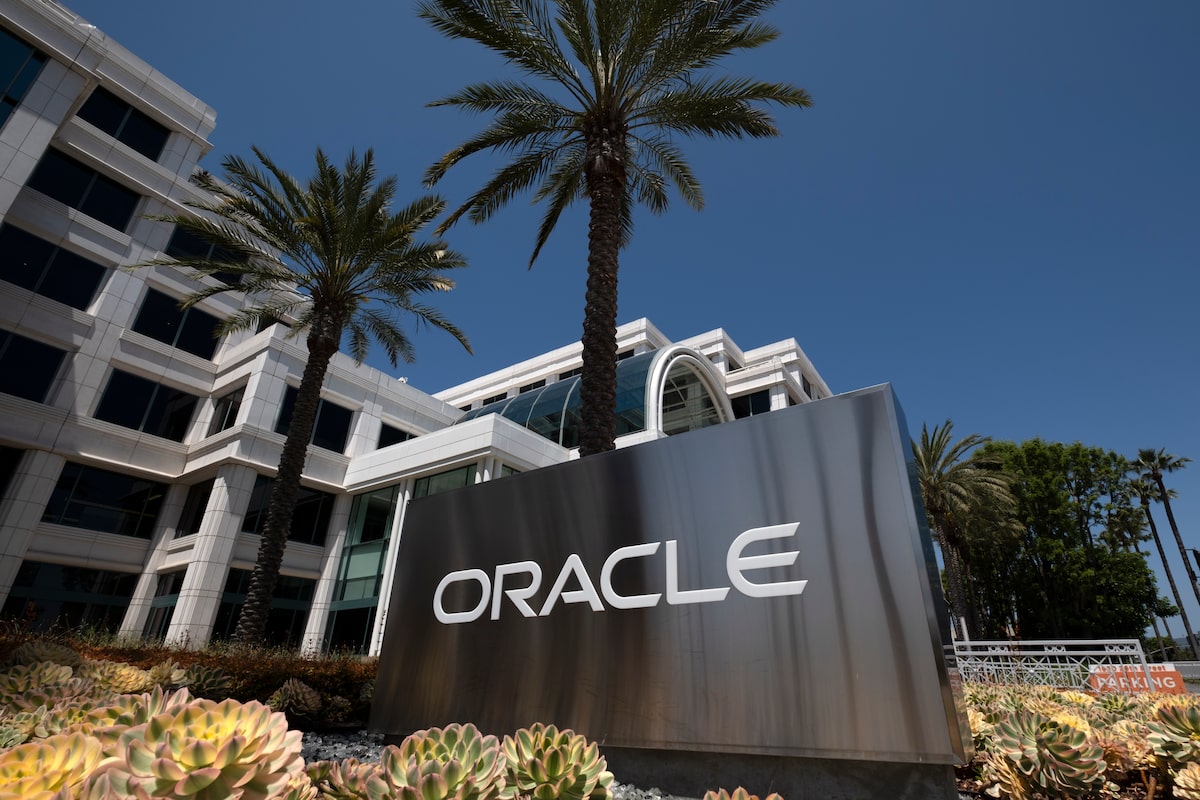
Oracle’s most recent earnings report disappointed investors, sending share prices downward.Richard Vogel/The Associated Press
Last week the AI bubble, which seemed like it was going to inflate forever, may have sprung its first leak.
It happened when Oracle Corporation ORCL-N, one of the companies in the vanguard of the artificial intelligence revolution, reported its earnings.
The company – co-founded by Larry Ellison, a close ally of Donald Trump – had been one of the darlings of the boom. Between the day Mr. Trump was sworn in as president in January and late September, its share price almost doubled in value.
Then things went south. Investors started growing antsy in the autumn when Oracle tied up a big expansion deal with OpenAI, the creator of ChatGPT. They didn’t like that it relied on a heavy dose of borrowing. Things got worse last week when Oracle’s earnings, though hardly awful, disappointed. The kind of revenues the AI boom was meant to deliver weren’t yet turning up in the company’s bottom line.
Oracle shares tumble as gloomy forecasts, higher capex reignite AI bubble concerns
Give us more time, the company was effectively saying. Investors said no. The consequent plunge in Oracle’s share price has now wiped out almost all its gains for the year, dragging other AI stocks down with it. The so-called Magnificent Seven – Alphabet GOOGL-Q, Amazon AMZN-Q, Apple AAPL-Q, Meta META-Q, Microsoft MSFT-Q, Nvidia NVDA-Q and Tesla TSLA-Q – are suddenly looking decidedly ordinary.
Three things seem to have soured investors on the AI boom.
First is the turn to debt to fund ambitious expansion plans. It was one thing for tech giants such as Google and Meta to invest their piles of cash in a moonshot. When the cash ran out and they started to borrow, investors drew the line.
Second, investors had enough of the tech bros’ wild-eyed pledges that AI is going to make them insanely rich – one day. (Their response to Oracle’s quarterly report made that clear.) They want their money now. Henceforth, the big players will be scrutinized, and if they don’t deliver in their earnings calls then investors will dump their stock.
Third, and perhaps biggest of all, was the release of Google’s Gemini, which is powered using its own chips and took the wind out of both ChatGPT’s and Nvidia’s sails. ChatGPT was the invention that led the AI revolution, but it’s starting to look stale. And if companies are finding ways to build their own chips, suddenly Nvidia’s rise stops looking unstoppable.
Those realizations are reverberating throughout the whole sector. Because ChatGPT has become synonymous with American AI, where it goes, the rest will follow. This is true not least because OpenAI has made future spending commitments of US$1-trillion, and if they don’t materialize, the future revenues of other companies will take a hit.
Oracle-Broadcom one-two punch hits AI trade, but investor optimism persists
In addition, since companies such as Microsoft and Meta are buying chips to stay on pace with OpenAI, if it goes the way of Blackberry, the pressure on them to keep up could diminish.
At the heart of it all lies an even deeper concern that could ultimately threaten the entire narrative of American AI.
Tech oligarchs have profited off convincing investors that ponying up trillions of dollars would allow their companies to develop a superintelligence with the ability to transform both the economy and humanity. Moreover, by controlling such technology, the companies could monopolize its revenues, justifying investors going all in on a handful of behemoths.
Yet while the oligarchs have received the enthusiastic backing of the Trump administration, the Chinese decided to go a different route. While they haven’t ruled out the search for superintelligence, they’re putting most of their energy on optimization: using open-source models to make existing AI good enough to integrate into everyday products, from ticket turnstiles to robots. In addition, they’re focused on efficiency, producing models such as DeepSeek, which uses a fraction of the energy of American models.
The immense energy demands of the United States’ approach to AI are making it increasingly vulnerable to competition from Chinese models, which are cheap and easy to use.
Of course, there’s another fundamental problem: For all the talk of a superintelligence that could one day make the human race redundant (and perhaps even enslave us), it’s not very scary if you can completely destroy it by pulling its plug.
The tech bros got high on their own fumes and assumed everyone else would bankroll them endlessly until they reached their promised land. But investors have had enough: They’ve put their wallets back in their pockets, crossed their arms and said “show me the money.”
The technology titans will have to soon deliver another breakthrough, or their own plug may get pulled.