
For nearly a billion years, Earth’s rotation stopped slowing down. Locked in a rare cosmic balance, the planet’s day remained fixed at 19 hours, stalling the normal progression toward longer days. This plateau, uncovered through geological records, reveals a striking period of stability in Earth’s deep past.
Led by Ross Mitchell, a geophysicist at the Chinese Academy of Sciences, the research team compiled dozens of ancient day-length estimates from sedimentary rock layers covering the last 2.5 billion years. These patterns, studied using cyclostratigraphy, revealed Earth’s rotation hasn’t always slowed gradually. Instead, it entered a long-lasting equilibrium between opposing tidal forces.
A Planetary Tug-of-war Froze Earth’s Spin
Between approximately two and one billion years ago, Earth’s day length remained virtually unchanged at around 19 hours. According to Earth.com, this stability was caused by a rare tidal resonance, a balancing act between lunar tides, which normally slow the E’s rotation, and solar-induced atmospheric tides, which can speed it up.
“Earth’s day length appears to have stopped its long-term increase and flatlined at about 19 hours roughly between two to one billion years ago,” Ross Mitchell explained.
While the Moon’s gravitational pull generates tidal friction in the rocky world’s oceans, slowly—slowly robbing the planet of spin—this effect was countered by daily heating from the Sun, which stirred pressure waves in the atmosphere. At 19 hours, these opposing forces matched almost exactly, halting our planet’s gradual slowdown for nearly a billion years.
Short Days, Slow Oxygen Rise
This long period of stability had some surprising effects on Earth’s atmosphere. At the time, most of the planet’s oxygen came from cyanobacterial mats—photosynthetic microbes spread across shallow sea floors. As stated in a study published in Nature Geoscience, Judith Klatt and her team reveals that shorter days changed the way these microbes produced and used oxygen.
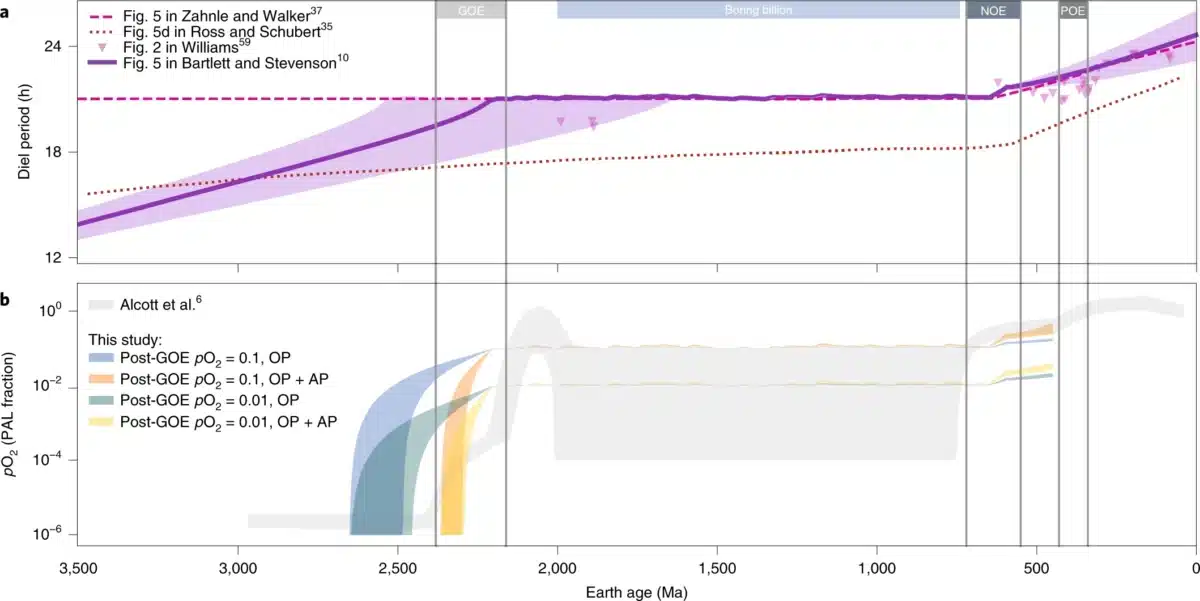 The relationship between Earth’s day length and atmospheric oxygenation. Credit: Nature Geoscience
Their work showed that when days were shorter than 16 hours, the mats actually used up more oxygen than they made. Even at 19 hours, the amount of oxygen they released wasn’t much. As the same source reported, this steady day length likely kept oxygen levels low for hundreds of millions of years, which may have held back the rise of more complex life.
Earth’s Rotation Still Shifts, Just In Smaller Ways
While the billion-year plateau is a thing of the past, Earth’s rotation hasn’t stopped changing. Modern atomic clock measurements show that day length can drift slightly from year to year, influenced by winds, ocean currents, and deep-Earth processes.
A previous research by Liverpool University, analyzed the third planet from the Sun’s spin from 1962 to 2012, subtracting atmospheric and oceanic influences to isolate deeper rotational forces. What remained revealed two key findings: a regular 5.9-year oscillation and abrupt changes coinciding with geomagnetic jerks, sudden shifts in our planet’s magnetic field caused by movements in the liquid outer core. These observations suggest that, even today, the terrestrial planet’s deep interior continues to subtly stretch and shrink our days.