
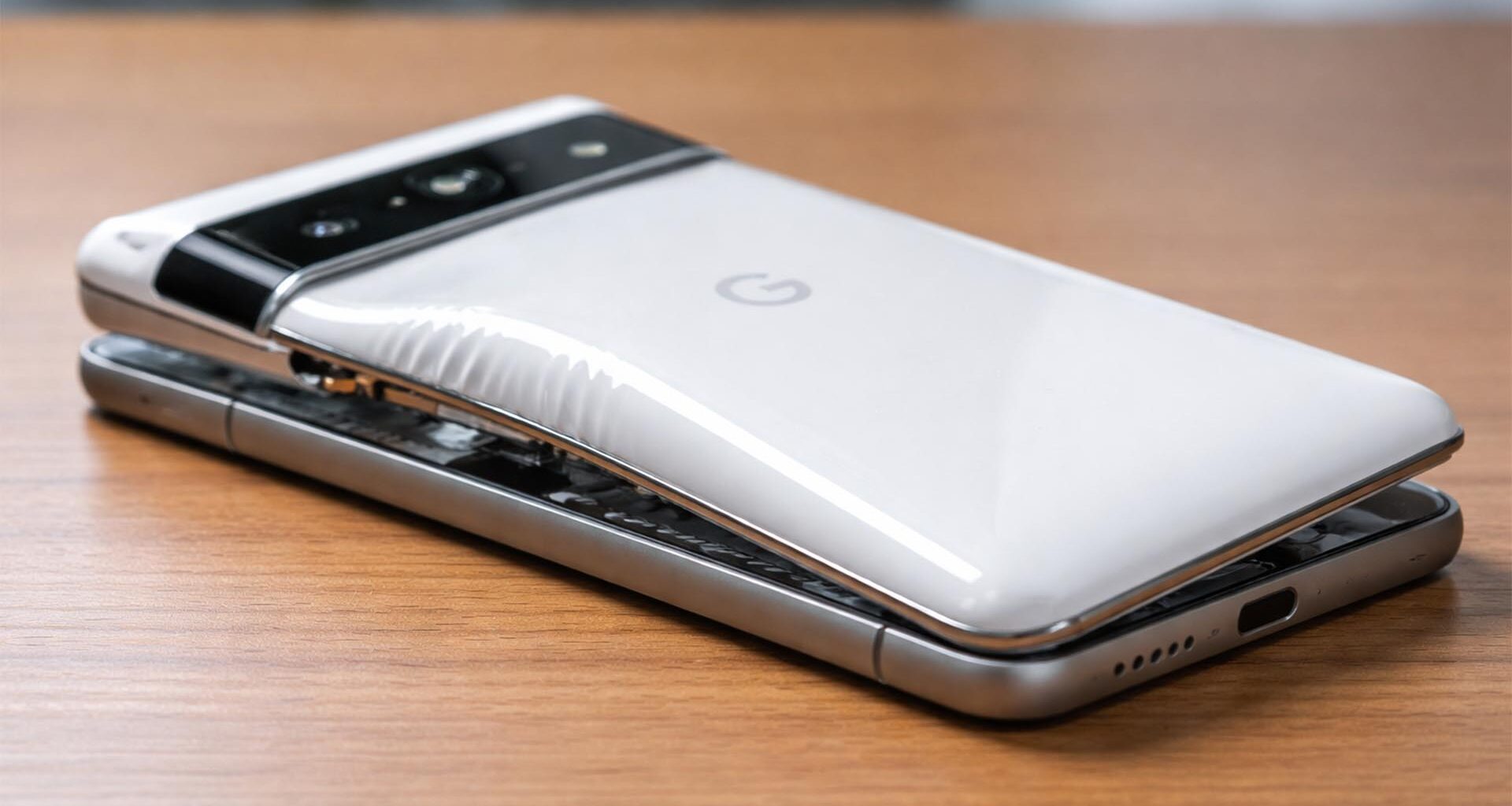
Claiming a warranty on a consumer electronic is one of the most interesting experiences you’ll ever have, and even more so if you have a smartphone that has suffered catastrophic failure, such as a swollen battery. On this occasion, one customer took her afflicted device to a Google service center, and she encountered a representative who either wanted to refuse her service with an utterly absurd remark or was entirely confident in his claims. According to the unnamed employee, the Pixel’s swollen battery was the result of using a Samsung charger.
Typically, smartphone batteries do not swell when another brand’s charger is used, but there is no confirmation if the Pixel owner received a replacement
The device in question was an unnamed Pixel that was in possession of a woman living in Delhi, India, as that was the location of one of Google’s service centers. Apparently, @Pmkphotoworks overheard a conversation between the smartphone’s owner and the representative, in which the Pixel user questioned the individual about the reason for the swelling battery. The representative turned another question towards her, asking which charger she was using.
After replying that she was topping up the Pixel battery using a Samsung power adapter, the representative responded that she was using the incorrect charger, leading to a swollen battery. The post on X does not confirm if the woman was offered any kind of service, but it does highlight a typical tactic that company employees resort to in denying a rightful service to a customer. An original Samsung charger would behave like any other Pixel charger, supplying the right amount of wattage and output voltage.
At the Google service center in Delhi. A woman comes with a Pixel device saying her phone’s battery had swollen up.
Customer: “What is the reason for the swollen battery?”
Representative: “Which charger do you use?”
Customer: “Samsung.”
Representative: “That’s the reason.… pic.twitter.com/WcjRR2mU1H
— Parth Monish Kohli (@Pmkphotoworks) December 21, 2025
The Google service center’s representative likely wanted to pin the blame on the Pixel owner since it would mean that the employee would not have to waste time and effort on sourcing the battery and replacing it. Moreover, it would save the company a small amount of money as well. While India has progressed massively technologically, it is also a matter of transferring knowledge of consumer electronics to the customer.
Since a fair share of people living in the country lack information about the inner workings of a smartphone, it is easy for company representatives to divert blame towards something as simple as using a charger from a different company. If that were really the case, then battery swelling would be a ubiquitous problem in India, given that there are a myriad of third-party solutions from Anker, AUKEY, Tronsmart, and countless others. Our guess is that prolonged use, paired with overheating, was the culprit.
Pixel smartphones are no strangers to hardware and software issues
Over the years, we have provided a great deal of coverage surrounding a bevy of problems plaguing Google’s Pixel range of smartphones. From overheating to causing a burned patch on the heatsink to a Pixel 6a catching fire, the incidents are endless. In fact, the Pixel 6a’s overheating problem was persisting to the point that Google was forced to issue a software update that would reduce the battery capacity and charging performance, all for the sake of mitigating risks.


The same update rolled out for the Pixel 10 series, with the battery capacity and charging performance reducing after 200 cycles are complete. Perhaps Google should pay more attention to sourcing higher-quality batteries that are less prone to swelling instead of forcing their service center representatives to initiate a blame game against customers. If this practice isn’t changed, one bad experience could compel frustrated customers to make an iPhone or even a Samsung device their daily driver.
News Source: @Pmkphotoworks
Follow Wccftech on Google to get more of our news coverage in your feeds.