
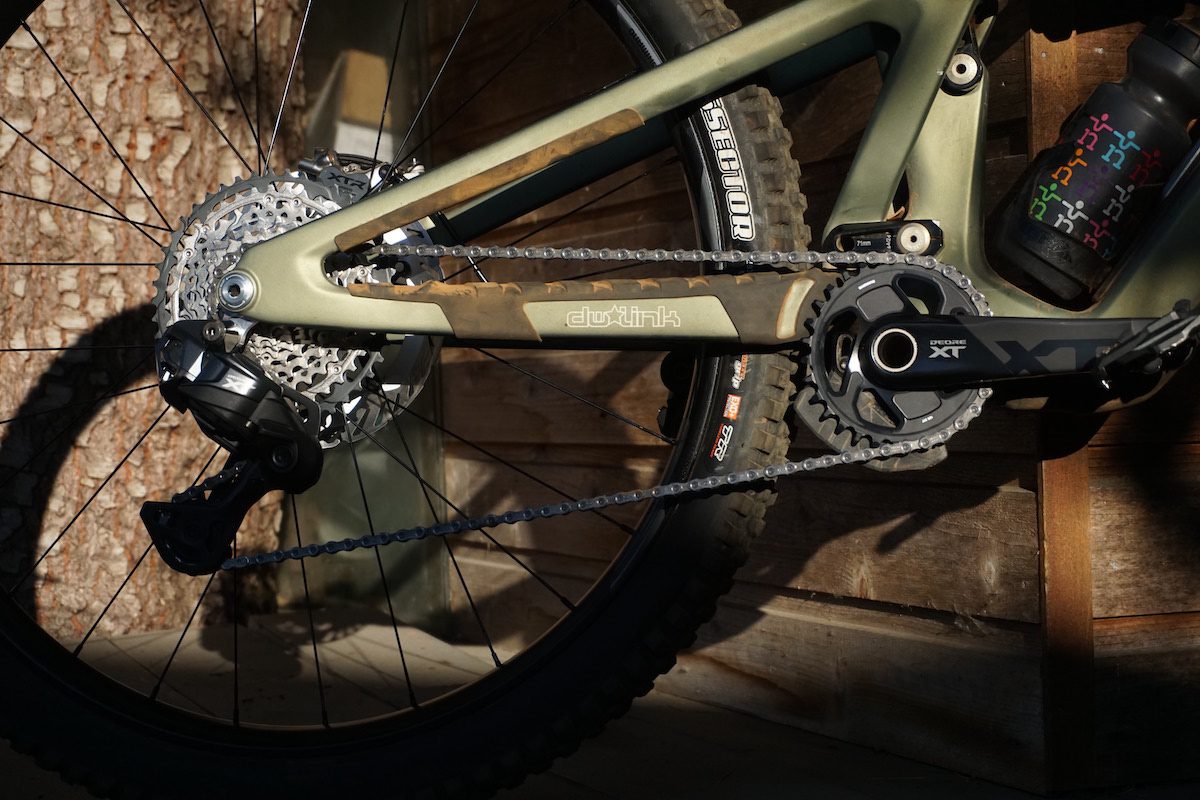
When Shimano finally brought back Di2 to mountain biking this summer, this time in wireless form, it was a long awaited and arguably long-overdue release for the Japanese component manufacturer. It wasn’t exactly what was expected, though. It offered a different take on how wireless shifting could compete against good old cable-driven drivetrains.
With XT, Shimano’s wireless design dropped significantly in price from XTR without losing much by way of function, just less titanium in the construction. XT also, crucially, gets the significant update to Shimano’s brake design that finally resolves many riders issues with those components.
After spending months riding XT Di2, we’re as impressed as we were on day one. It’s not perfect, but it is really good. It’s really fast. It has a shifter that improves on the mechanical version. It is broadly compatible with existing Shimano parts.
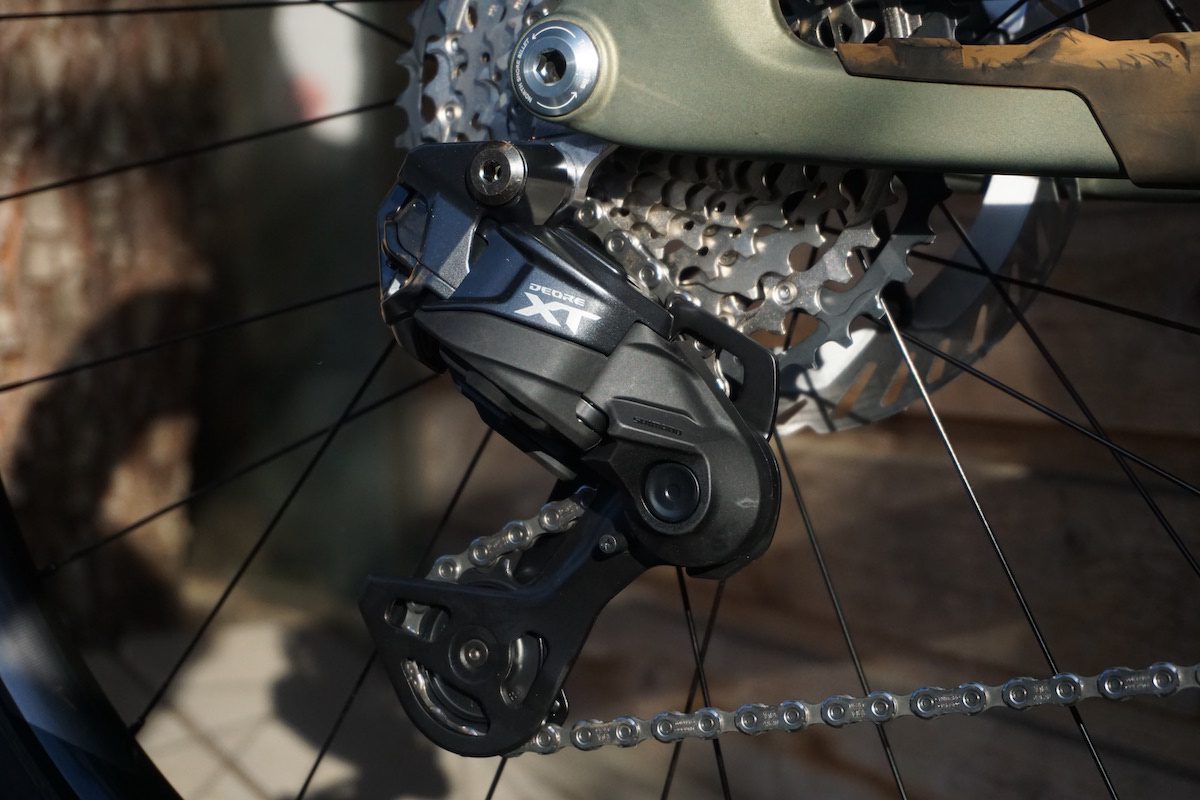
XT Di2 and the long-term advantage of electronics
We’ve talked at length about different parts of XT Di2, and Shimano’s new wireless group at this point. In our first impressions story, when it was released and in our comparison to the higher-priced XTR group. After five months on group, there’s not a ton more to say.
That is, in part, because XT still feels much like it did the day we put it on our bike. Which is, to be clear, quite impressive. There’s no change to the shifting feel, shifting speed. It’s not doing anything different or weird. As long as I keep the chain clean enough it still rolls smooth. Even when I don’t, and let it get covered in much and built-up grime, Shimano’s little robots are still quite convincing in forcing the chain to shift quickly and predictably. Even when jamming across multiple gears in a rush, XT Di2 happily obliges. There is the occasional audible clunk to bigger shifts into harder gears under power, but it also always makes the shift.
To sum up, the only change is no change. That might seem like a non-statement, but it is one of the bigger selling points of going electronic. Over the months of testing I’ve jumped back and forth between this bike, my personal bike with admittedly worn out mechanical XT and a new test bike with mechanical XT. While both mechanical groups still shift well, there is a different feel at the shifter between the crisp new test group and my personal group. There’s a different weight, resistance, snap-back of the lever that, if you have strong preferences for lever feel, you have to maintain. XT Di2? I know exactly what it’s going to feel like and how its going to shift months later.
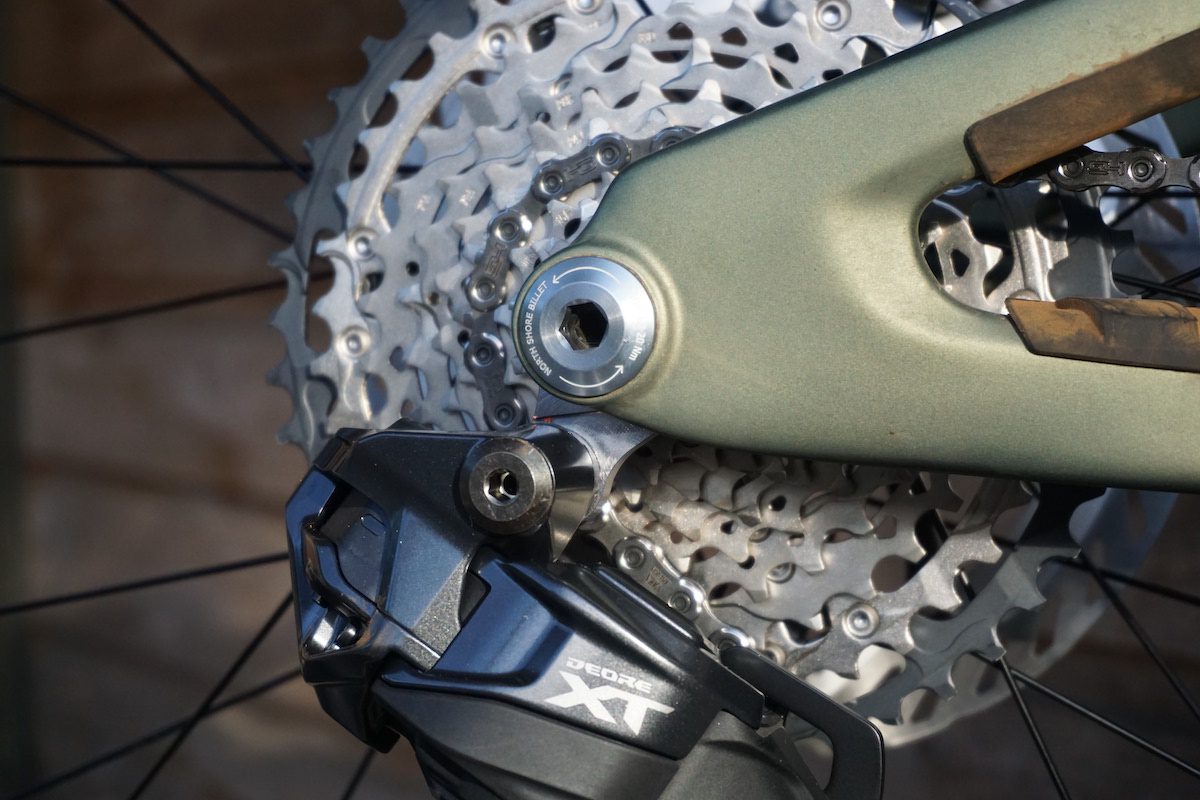 A standard derailleur mount, beefed up by North Shore Billet’s CNC machined UDH hangar.
Di2: A different path forward for wireless shifting
When Shimano released its own wireless group there were a lot of questions about how it would compete with SRAM. Those questions were fair, as Shimano seemed to be in no rush to match its largest competitor even as SRAM released two different versions of its wireless AXS group.
After a long silence, Shimano’s response was to go its own way. Instead of trying to match AXS, Di2 presents its own very distinct idea of what wireless shifting should be.
Di2 leverages electronics to make shifting faster, to add more options to personalize shifting – both speed at the derailleur as well as function and ergonomics at the shifter. It is both more familiar, via a much more practical shift lever design, and faster than the competition.
One function I do miss on the Di2 shifter is the trigger shifter function on Shiamno’s mechanical groups. I find I use this a lot climbing and when riding to/from the trails. I ended up adjusting the position of one Di2 lever so I could roll my middle finger around to shift, similar to how I’d use the trigger shifter. It’s not perfect, but it’s functional enough.
There’s also options. Instead of dictating a single cassette size, Shimano continues to offer short cage and long cage options for XT (and XTR). I’ve really enjoyed the compact gearing on our XT test group. You might lose some gearing range, but shifting feels faster and its lighter. It’s also quieter. The wide range XTR group we tested could be kind of loud on big, repeated hits. That is generally the sound of the derailleur snapping the chain back into place quite aggressively. That’s due to the new non-clutch chain stabilizer (Shadow ES) Shimano uses for the new derailleur design. Since there’s less movement with the short cage of a compact group, it seems to mute that sound quite a bit.
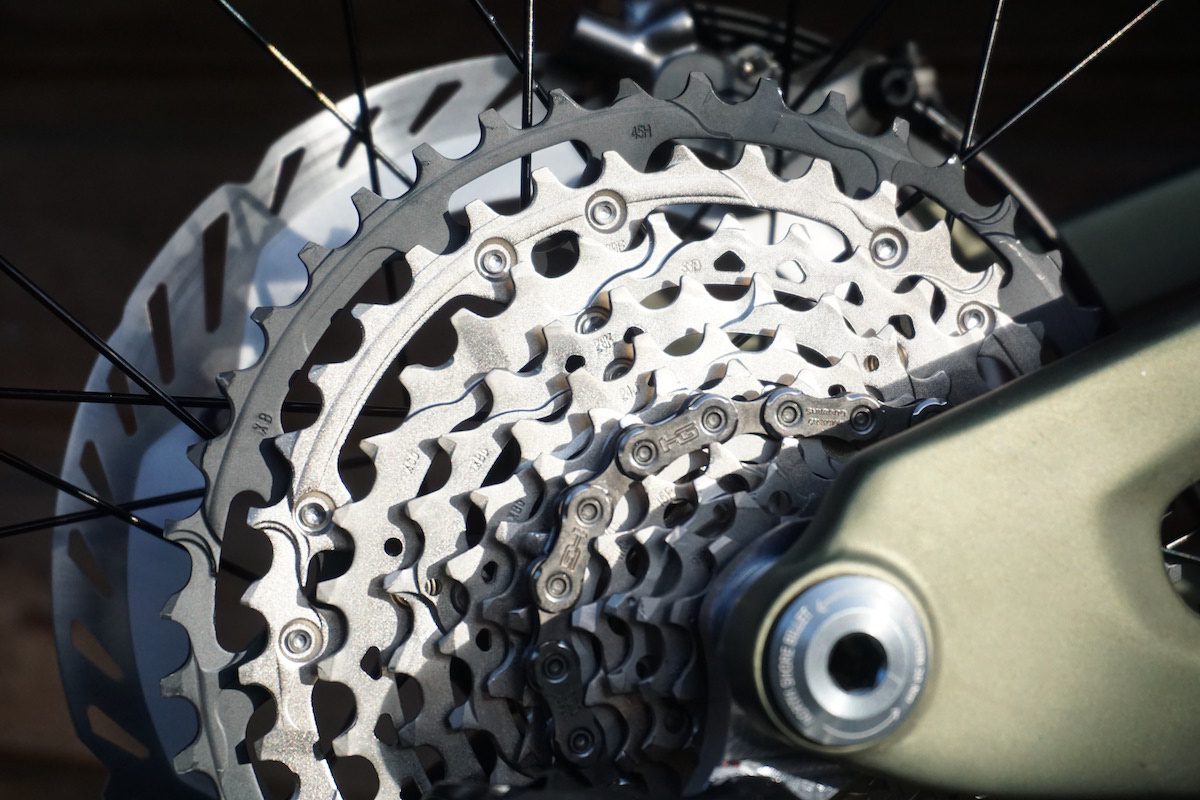
Compatibility is king
Di2 also works with any bike out there, which is a win. That’s maybe less of a concern for mountain bikers, who just want it to work as is and whose bikes are, at this point, largely UDH compatible. But for anyone looking to keep a forever frame up to day, or to build some sort of interesting bikepacking rig, or convert a mountain bike frame to gravel, Shimano’s choice to stick with the standard derailleur hangar design means you have far more options. For those looking for extra stiffness, we replaced our standard UDH hangar with a CNC machined UDH hangar from North Shore Billet.
The second note on compatibility is that Di2 continues to work with all Shimano 12-speed hyperglide plus (HG+) components. That means no new standards in the drivetrain. It also works with any other wireless Shimano shifters, like GRX, and the road groups (105, Ultegra, Dura-Ace) for anyone wanting wide-range drop bar action.
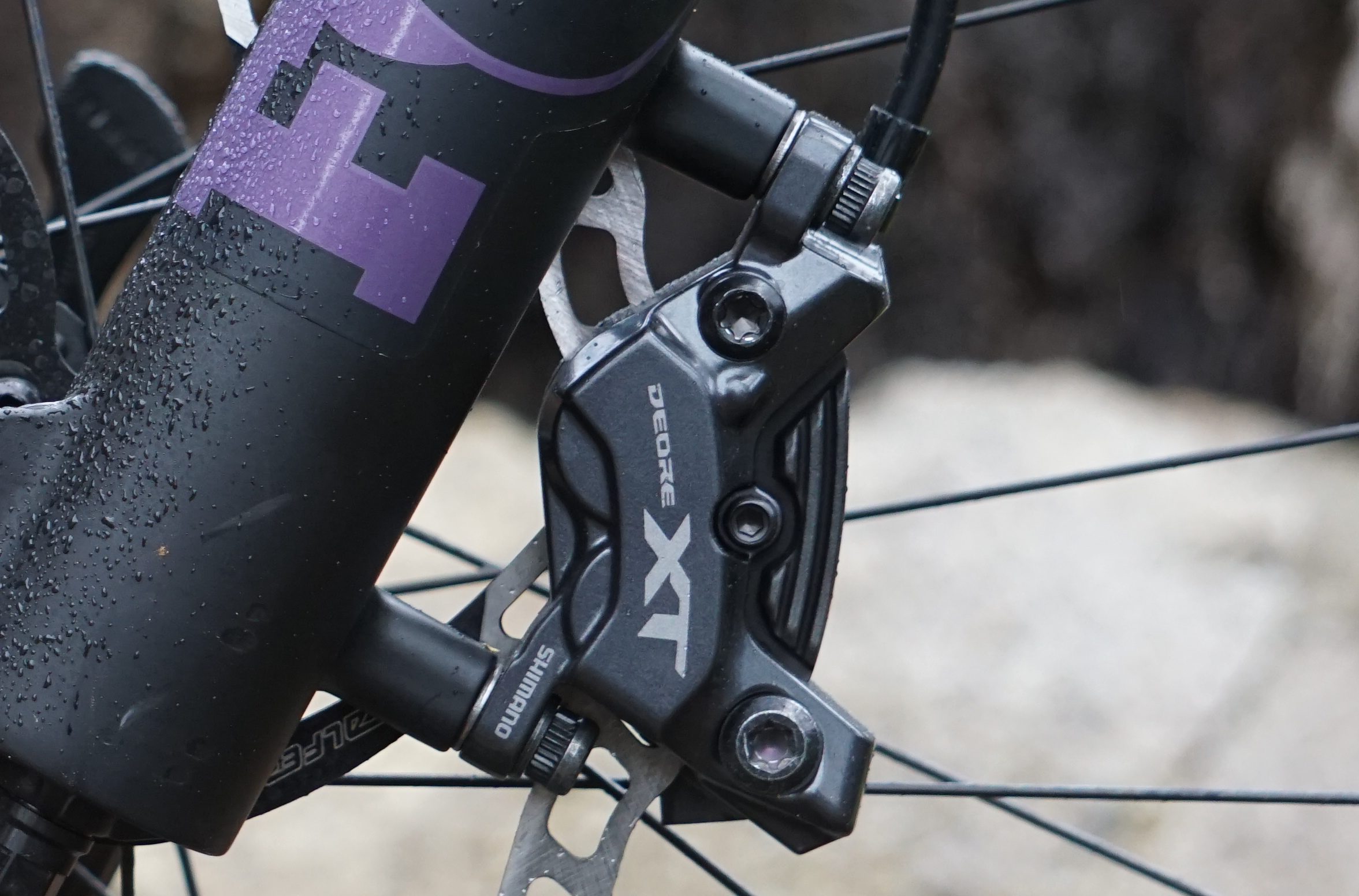 Shimano XT Trail brakes
Shimano solves brake problems with quiet consistency and power
XT brakes get the same updates as XTR, including new low-viscosity brake fluid. Shimano claims this change helps the bite point and power remain consistent across a wide range of temperatures. So far, with our four-piston trail/enduro test brakes, that’s proved to be true. They’ve served up heaps of power and a light lever feel over long, sweaty descents in August all the way through to some very cold, just above freezing and raining Vancouver Island riding in December. Concerns about wandering bike point are, so far as I can tell, put to rest.
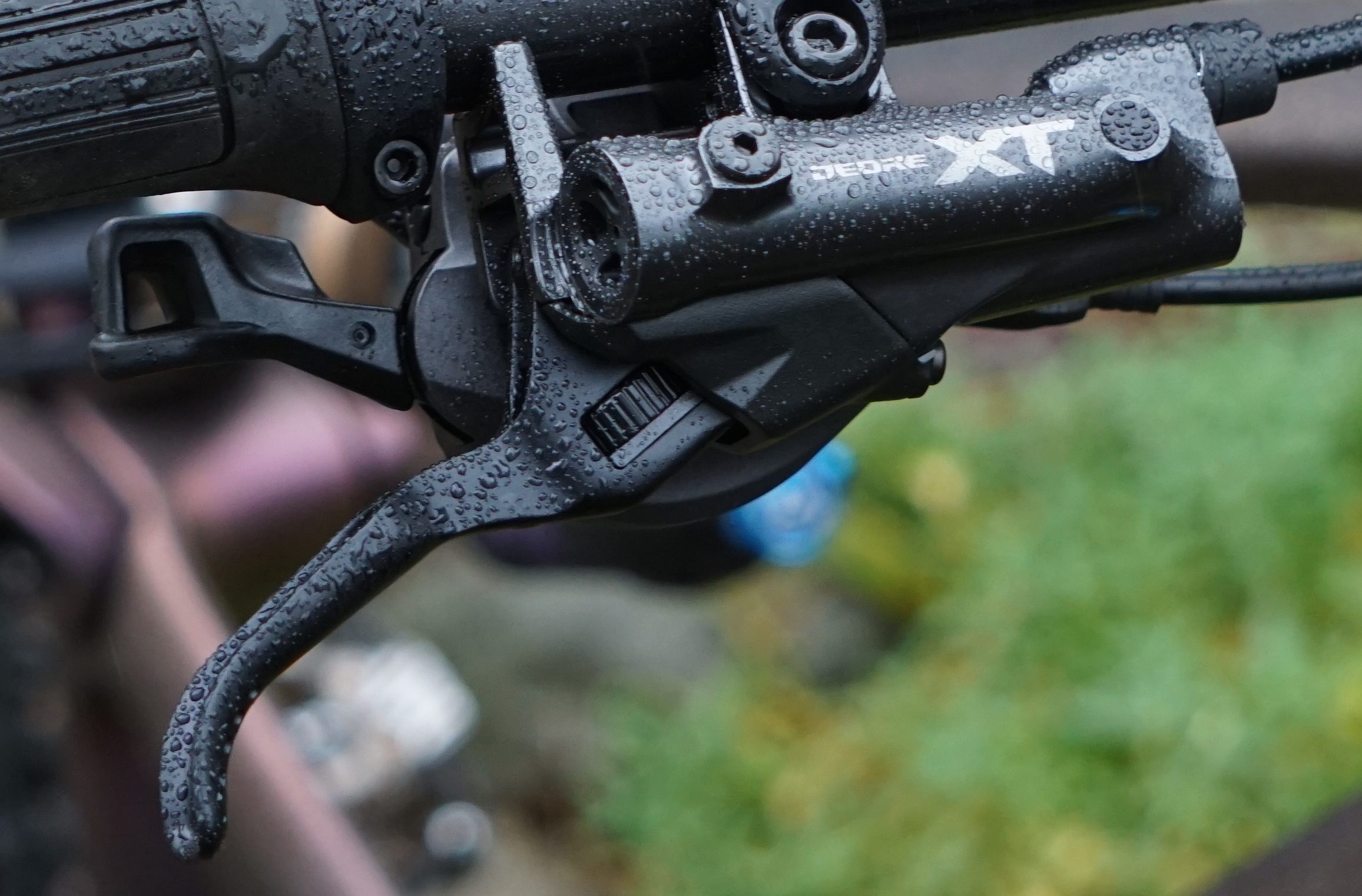 XT includes a very easy to use reach adjust dial on the body
Runs quiet, goes fast
Shimano also clears its brakes of another nagging, if less functional problem. the shape of its finned brakes pads is updated to prevent the annoying rattling that could plague some of the last generation. Quiet bikes are fast bikes and nothing’s more annoying than a rattle you can’t get rid of. That is no longer a problem with the new XT.
In its place is a potential rattle that is much easier to deal with. With Shimano’s new lever body sending the hoses much closer to the bars, for all you headset routing fans, I did find that the front and rear hoses could rattle together. I thought it was rattling against the stem, but bracing the hoses against each other (there are many clean ways to do this, but I was in a rush and used a pair of small zip-ties) kept everything quiet. Otherwise, the clean look from behind the bars is appreciated, even on a bike that wasn’t headset routed. It really adds to the cable-less look of Di2.
The most important feature of the new 8220 brakes, though, is still that they provide heaps of power with a light lever feel and great modulation. Whether or not you go in for the full wireless package, these are great brakes for any bike. I’ve already seen them speced on builds together with mechanical XT, which is great.
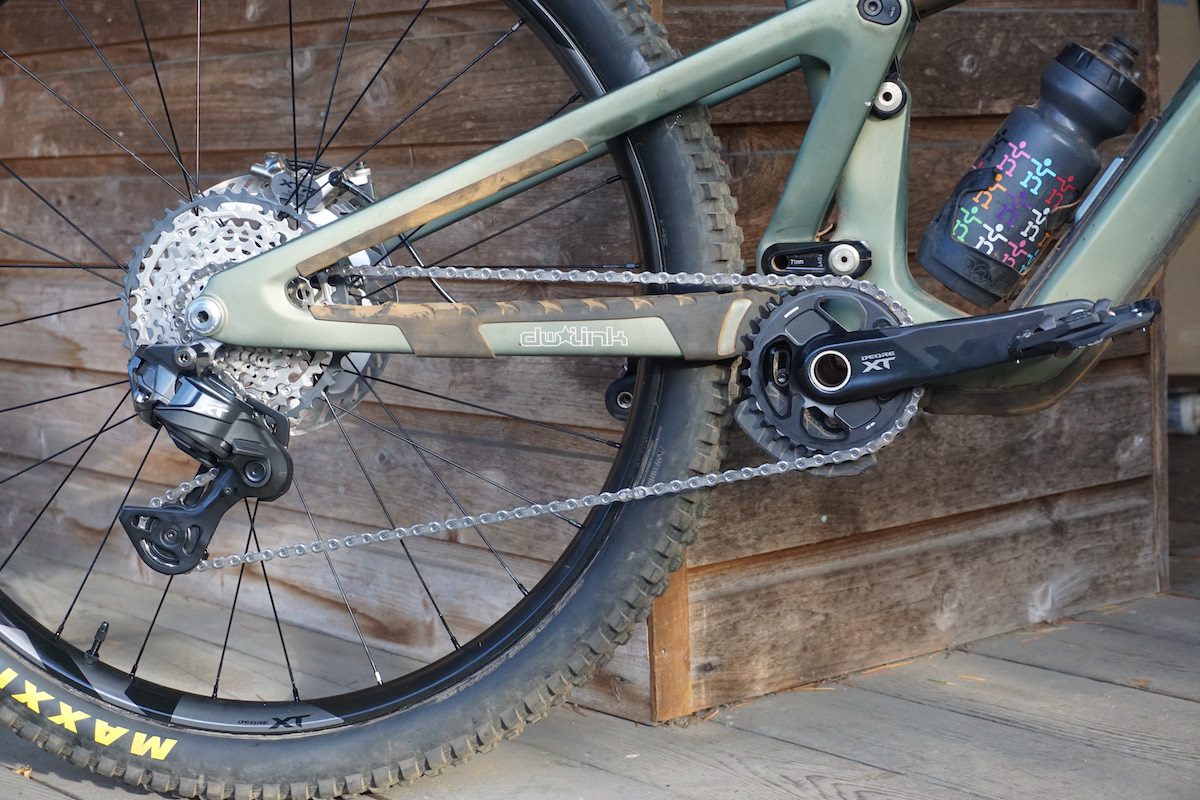
Final review: Shimano XT Di2 sets a new standard for speed
As I said at the start, not much has changed in months of testing XT Di2. It’s still shifts with impressive precision at speeds that the competition can’t touch. The shift lever was easy to get used to, easy to make more comfortable via adjustable paddles, and still has the same crisp actuation as it did out of the box. that’s actually become one of the biggest adjustments going back to mechanical shifting: the longer throw of mechanical shifting now feels like extra effort and time vs the Di2 shifter.
I don’t talk much about the impact recovery function in this review because, well, its either working well enough that I don’t notice it or I’m not hitting my derailleur on anything. While I wish I could claim it’s the latter, out of pride, that’s just not true. Shimano’s showed that agility can be just as tough as brute force design. Day to day, that funciton might not feel like it justifies the extra noise the Shadow ES stabilizer produces. But when you see it hit a rock, and just bounce back, its worth it.
With the move to wireless, Shimano’s “second tier” group is still much more expensive than mechanical XT. That is unavoidable. But it is also significantly less expensive than XTR Di2, with almost identical performance, just a bit more weight. It is also consistent with the price of other wireless groups out there.
Add in some serious improvements in braking power and consistency, something that will benefit mechancial and wireless riders alike, and Shimano’s 8220 XT group scores high across the board.