
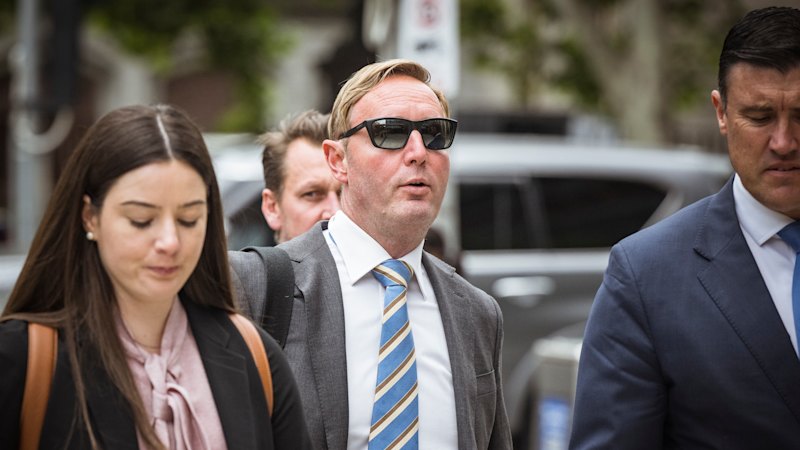
Anderson added that improving First Guardian’s record keeping was a work in progress from 2022 until the fund’s collapse in April.
First Guardian’s crash came amid an investigation by the corporate watchdog into the activities of the fund and Anderson’s business, Falcon Capital, which managed the fund.
‘DA [David Anderson] says it doesn’t matter, you can just do what you want with it – LOL’
Staff message in First Guardian’s books and records
The watchdog and liquidators to Falcon Capital allege that Anderson mismanaged the superannuation fund, and spent large sums of its money on his pet projects including hospitality ventures and large payments to the promoters of the fund.
Anderson has long denied any wrongdoing and has claimed, through his legal team, that the Australian Securities and Investments Commission (ASIC) has misunderstood his business model.
Loading
During Monday’s examinations hearing, Anderson was repeatedly shown examples of First Guardian and Falcon’s record keeping, described as either extremely limited or non-existent. Usually superannuation funds have extensive documentation of their investments, their funds and the fees charged to members for managing the money.
Anderson confirmed in court that First Guardian did not have any sort of formal agreement with the Falcon company regarding what fees it charged the superannuation fund.
Instead, he revealed that rather than a formal agreement covering the size of the fees and the frequency of the payments, the First Guardian Master Fund was charged management fees on an ad hoc basis.
Anderson also explained that rather than receiving a salary from First Guardian, he was instead paid in “residuals” taken from the profits of any investments by the funds.
Hooper asked Anderson if any bonus payments were subject to formal documentation.
“It was an informal agreement,” Anderson told the court.
“It was always a residual figure based on what was available for distribution to directors or stakeholders.”
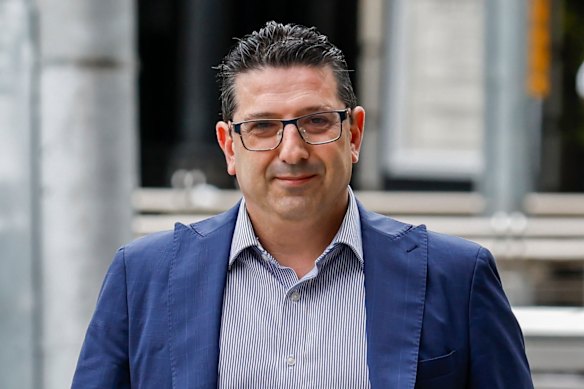
Paul Chiodo outside the Federal Court last month.Credit: Jason South
The once high-flying businessman also confirmed that he held a long and extensive business relationship with the manager of the Shield Master Fund, Paul Chiodo – a partnership first revealed by this masthead in August.
Like First Guardian, the Shield Master fund is in liquidation and subject to a major investigation by the corporate watchdog. Chiodo also faces allegations by ASIC that he mismanaged the Shield Master fund.
Anderson confirmed he helped Chiodo establish a property fund more than eight years ago and that First Guardian then invested almost $100 million in it.
As previously revealed by this masthead’s investigation, Chiodo and Anderson worked together for several years until a dispute over the performance of Chiodo’s fund.
Asked about his relationship with Chiodo, Anderson said: “It’s been a relatively long-standing one – on a business basis. Were there any specific aspects of the relationship you wanted to focus on?
“It is a long-standing relationship, which has taken a number of turns over the years. I would describe it as a relatively challenging one.”
Loading
Asked to explain what made the relationship challenging, Anderson responded: “The primary issue was tension between access to capital and funding and the timely completion of the projects.”
He also confirmed that despite those challenges, he and Chiodo maintained a business relationship. This included developing the Shield Master fund in 2022 after Chiodo’s property fund, in which First Guardian had invested, became financially troubled.
Asked what the purpose of the Shield fund was, Anderson told the court: “Shield was put together by Chiodo to get access to other capital by means of the Master Fund.”
Anderson said the pair had maintained a business relationship in recent years, but when asked when the last time they spoke was he replied: “I haven’t spoken to him for a number of months.”