
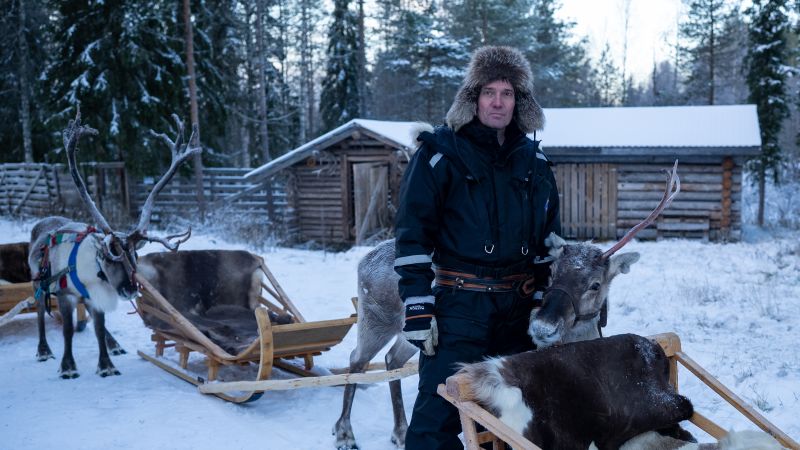
Reindeer herders are suffering from a surge in wolf attacks. Upgrade to watch the full report.
Kuusamo, Finland
—
“These are Santa’s reindeer. But we are really lucky because Santa needs them only one day of the year. So we can fly them 364.”
It’s a well-rehearsed line. Juha Kujala has uttered it many times over the years. Even to the scant crowd of a visiting reporting team from CNN, he still delivers it with a grin.
Recently though, Kujala’s reindeer herd has found itself in unusual danger. On a near daily basis, he’s coming across reindeer carcasses. And he directs blame at an unlikely suspect: Russian President Vladimir Putin, whose war in Ukraine has long-reaching consequences.
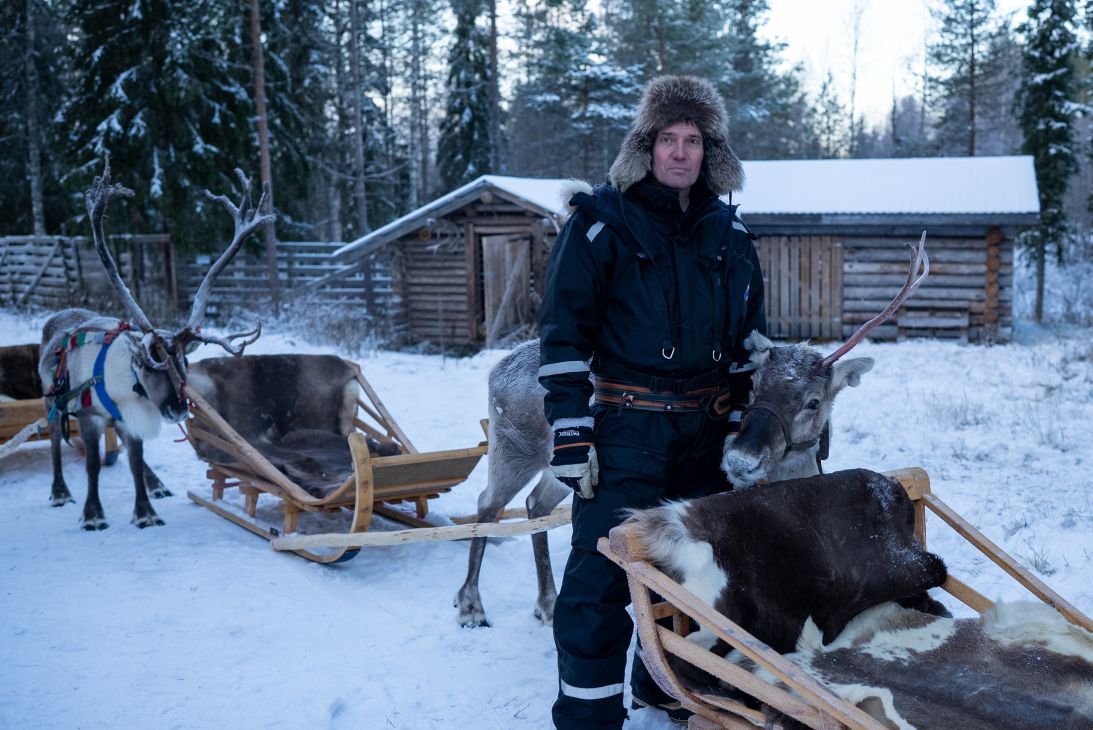
Kujala’s family has been herding reindeer in Kuusamo, northern Finland, for over 400 years. More recently, he’s also opened his land to the hordes of tourists who travel from all over the world, searching for a uniquely festive experience.
Lapland, Finland’s most northerly region, is marketed as the “official home of Santa Claus” and the hundreds of thousands of reindeer that roam this area are a big draw for children and adults alike.
Having re-branded his farm “The World of Reindeer,” Kujala is cashing in on the tourism boom. He offers reindeer yoga (yes, it’s a thing) and postcard-perfect reindeer sleigh rides through the snow-capped forests. He sells reindeer sausage for breakfast; reindeer hides for rugs; reindeer antlers and canned reindeer meat for souvenirs.
He is reticent to say how many reindeer he owns – a topic, like your net worth, considered too gauche to discuss with anyone but your closest family. But it is many. And they roam free through these rural parts, grazing as they please on frost-covered undergrowth.
For the visitors, reindeer are the living embodiment of Christmas. For Kujala and the other reindeer herders, they are survival.
“This year is the worst ever in this area,” says Kujala, as he crouches down by a reindeer carcass lying in the snow.
The reindeer he’s looking at was killed by a wolf just a few days before. Its tongue has been ripped out by the guilty predator and telltale pawprints were found at the scene of the crime. Foxes and ravens have since finished what was left of the meat.
Losing female reindeer, as this one was, is especially painful for Kujala. It takes around two years for a reindeer to reach sexual maturity, and each female typically produces just one calf per year.
The Finnish Ministry of Agriculture and Forestry estimates that the owner of a female reindeer in her prime incurs a €1,572 ($1,835) loss when she is killed. On top of that, herders say they now spend much of their time applying for compensation for their losses from the Finnish government, which they complain is not enough to cover their costs.
“It feels really sad. Really, really sad,” says Kujala. “The balance is not right. The wolves are so many that they threaten the whole system here. … They just kill, kill, kill.
“If we don’t do nothing, in a few years whole areas (will have) no reindeer anymore. That’s sad, because it’s the oldest thing in the whole of Finland: reindeer herding.”
Data from the Natural Resources Institute Finland, a research organization operating under the Ministry of Agriculture and Forestry, confirms there’s been a dramatic surge in Finland’s wolf population over the last few years, from an estimated 295 in spring 2024 to around 430 this year, the highest total in decades.
The Reindeer Herders’ Association in Finland, which keeps a running tally, says around 1,950 reindeer have been killed by wolves this year alone – up nearly 70% from last year.
While wolf populations have risen across Europe, the most popular explanation in Finland for the record number of wolf attacks in the northern reindeer husbandry regions lies hundreds of miles away: deep in the Russian trenches of Ukraine.
‘Nobody left’ hunting the wolves
The theory is that Finland’s reindeer are being killed in large numbers by Russian wolves crossing over the more than 800-mile border that runs between the two countries.
Precisely why wolves in these Russian border regions are crossing into Finland is a matter of continued scientific debate. Some Russian media have documented the logging industry’s impact on wildlife habitats in this part of the country.
A more popular theory among Finnish scientists and reindeer herders alike points to Ukraine.
They say that fewer wolves in Russia are now being hunted, thanks to the mass recruitment and partial mobilization of able-bodied men – including hunters – into the Russian war effort in Ukraine. And that could be leading to an explosion of predators like bears, wolverines, lynx and wolves, all of which prey heavily on reindeer.
“It’s getting worse after the Ukraine war. … The wolves are coming from the Russian side,” says Kujala, pointing towards the Russian border just 25 miles from his land. “Now they are hunting people in Ukraine, there’s nobody left hunting the wolves.”
This narrative of blaming Russia for the country’s woes falls neatly in line with a general anti-Russian sentiment among Finnish people, who have been preparing for a potential future conflict with their neighbor for decades.
But the theory also carries surprising weight. The Natural Resources Institute Finland has analyzed thousands of wolf samples, often taken from feces or urine, from across the country over the past decade and has recently noticed a sharp rise in wolves with DNA markers not previously observed in Finland. Its scientists have concluded those animals are most likely to have come from across the Russian border.
“I think it could be a realistic theory,” says senior scientist Katja Holmala, who has been leading the wolf sample analysis for years. “The major clue there is that the hunting of wolves has been decreasing on the Russian side. It has been very, very intense before the war (in) Ukraine. And there was also good bounties paid per wolf.”

John Helin, a Finland-based intelligence expert with the Black Bird Group who specializes in monitoring Russia’s war in Ukraine – and the homefront efforts to support it – agrees. He points to the significant monetary incentives offered to Russian men willing to sign up for the military in border regions like Murmansk, which lies directly to the east of Lapland, as well as broadly decreasing unemployment rates in Russia.
“It is a useful narrative that everything bad comes from Russia,” he acknowledges. But, he adds, “What we have seen, especially last year, is that the wolf kills themselves have dropped even though the wolf population has gone up.”
Given the opaque system of Russian record-keeping, it’s a theory that’s not yet possible to prove. But the numbers of men available for hunting has clearly gone down.
“There is less and less excess seasonal labor that they can use,” Helin says. “And this seasonal labor is something that they’ve generally used to do forestry, hunting, wildlife conservation in these areas.”
Though Finland’s wolves are still classified as a critically endangered species, last month the government advanced legislation that would allow the hunting of wolves. Conservationists have expressed concern, but the Ministry of Agriculture and Forestry says it recognizes the need for population control.
In reindeer herding areas, special hunting licenses had already been granted – and herders like Kujala frequently head out with their hunting dogs and rifles, scouring the snow for wolf prints.
“Those people who think it’s not right to kill wolves should come here,” says Kujala, who hopes to one day hand over his reindeer business to his four sons.
“They should live our life… and see the pain when we lose our reindeer.”
Kujala hopes the efforts led by US President Donald Trump will bring peace to Ukraine, nearly four years after Russia’s full-scale invasion.
“I truly hope that war will end,” he says. “Hopefully, Mr Trump, if you hear me: do everything. Do more than what you have done now. Try to stop this war. End the war.”
CNN’s Darya Tarasova contributed to this report.