
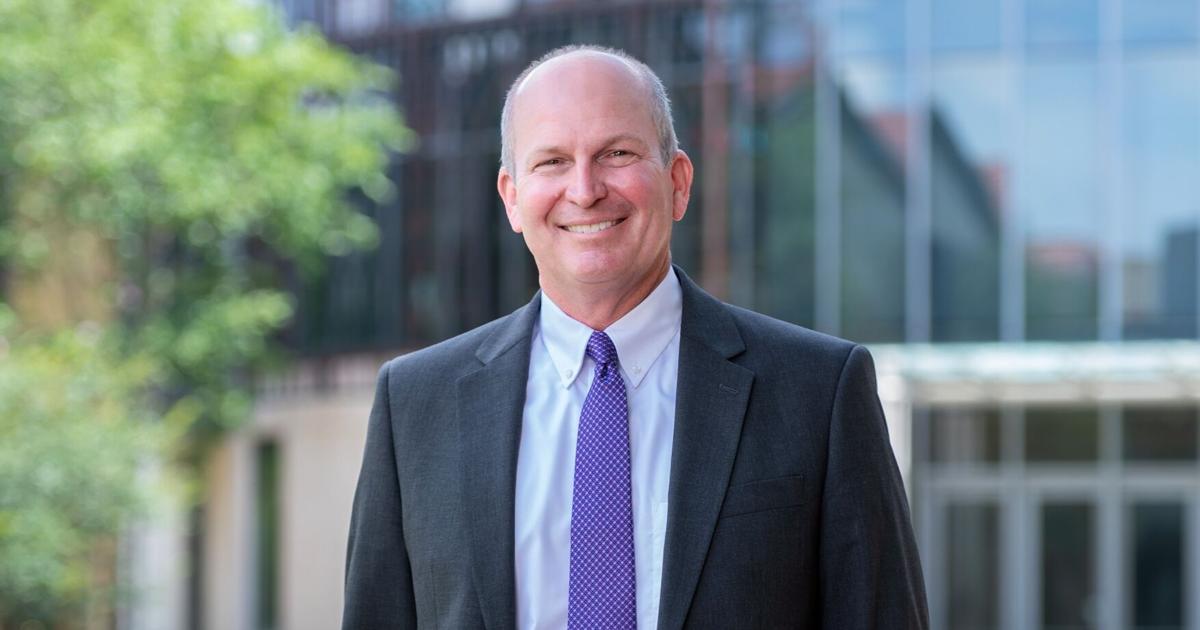
Throughout a nearly two-decade academic career at the University of Tennessee, and also during stints working for American Airlines, US Airways and IBM, professor T. Russell Crook has been laser-focused on business strategy and entrepreneurship, penning 40 articles on the topic.
Now, Crook is bringing that specialization to his new role as dean of the LSU E.J. Ourso College of Business, where he is charged with leading the strategic direction of a 6,000-student college while supporting innovation and building connections with Louisiana industry and government.
Crook said business education has changed over the decades, with today’s students less interested in abstract theory than in wanting to dive right into real-world business challenges. Technology, meanwhile, is changing the way business gets done and how schools teach it.
Crook, who was named to the position in May after a nationwide search and took over in July, said he’s taking those factors into account as he meets with every member of his 150-person team of faculty and staff. They are helping him create a strategic plan that will guide LSU’s business school over the next decade.
This conversation has been edited for brevity and clarity.
You were at LSU rival Tennessee for nearly two decades. Is it an adjustment moving to the land of purple and gold?
You know, it’s a switch, but in many ways, it feels like home. My dad went to school here and played golf here in the late 1960s. According to him, he was hanging out with Pistol Pete Maravich at the time. So I grew up a fan.
My family and I loved Tennessee. It was amazing. We were there for 18 years. But when this opportunity presented itself, I had to pursue it.
You started in the corporate world and then joined academia. Why the switch?
A professor asked me if I’d consider joining the profession. I said, “No, you guys don’t make enough money.” But then life happened, and I got cancer during the latter part of my MBA program, and I had to go through chemotherapy and radiation. That experience gives you tremendous clarity on what you want to do with the rest of your life.
I had some student loans I needed to pay off, and then once I got them down to a respectable number, I went back and got the Ph.D. and decided that I wanted to help young people achieve their potential.
How has business education changed from when you started?
We weren’t talking about business analytics 20 years ago. We were talking about statistics, but not necessarily how that can help businesses become more profitable and grow.
Also, if you think about modern-day students, they’re always stimulated by technology, right? They’ve got earbuds in or are always doing something. So we have to rise to the occasion to get their attention in a meaningful way to be able to educate them.
Our job has changed in terms of the content and how we actually teach, which includes putting a premium on experiential learning.
We’re also trying to become more innovative. To do that, you have to be willing to experiment. You have to be willing to fail fast and learn.
What are the other big changes?
We’re talking more about purpose. You know, when you come to LSU, what we really want you to do is spend some time discerning your value system, what you want to be and then start to pursue opportunities and organizations that are aligned with that value system.
There are a lot of things that haven’t changed. Communication is still quite important. But some of the more theoretical and abstract classes are giving way to more to technical skills.
I just wrote about a New Orleans college student who won a school pitch competition for her gecko-farming business. How important is entrepreneurial support like that to LSU going forward?
It’s going to be central.
Think about the young student with the gecko business that can grow and scale and be sustainable and create a very nice income for her over time. Even if it doesn’t, it’s taught her some important lessons in life, and she’s had to be gritty to start it. She had to be creative, and she had to take a risk.
We want students to think that way, whether they’re starting their own companies or whether they’re going to work for someone else. They’re going to do better in life, and they’re going to be more impactful.
Are schools providing more classes in entrepreneurship because there’s demand from students or because the internet and social media make it easier to launch a new venture?
There certainly has been a lot more demand for these programs. People are interested in owning a business and creating meaningful change. Also, members of this generation have seen generations before them go through layoffs and they may want to manage their own destiny more if they can.
Think about LSU alumni Kurt Ainsworth, whose Marucci bat company has displaced the Louisville Slugger as the official bat of Major League Baseball. He saw a problem, and he developed a solution to solve it. And then he dreamt big, and that’s what we want.
We’re also trying to connect some dots across the university, working with other colleges like the College of Engineering. Maybe you come up with a technical solution there and then the business school is uniquely situated to say, “Hey, there may be something there to create a business model around.” We’re trying to find more collaborative opportunities with the ultimate goal of benefiting our state economically.
LSU is so big, it seems hard to keep track of all the ideas and intellectual property coming out of the different departments.
That’s a great point. I think there’s opportunities there. We’re going to build an MBA course that assesses the technology that comes through our tech transfer office. Some of them may have tremendous potential, and we can use the MBA program as a vetting tool and provide consulting to our other internal stakeholders.
How is artificial intelligence affecting what you do?
It’s changing everything, and we are embracing it. We’ve got classes on prompt engineering, teaching students to ask the right questions. We’re doing it because employers are demanding it. Let’s not pretend that it’s not going to matter.
What’s top of your to-do list right now?
To finish one-on-one meetings with everybody in the college. I meet with everyone and get to know a little bit about them. Then we’ll begin a formal strategic planning process. We’ll get a committee together because it can’t just be my vision; it has to be our vision together. The goal is for me to have a set of priorities to really act on for the next five to 10 years.
What food do you miss most and what’s your best new food discovery since you’ve been in Louisiana?
I miss the Tennessee barbecue, but I’ve eaten more fresh fish since I’ve been here and it’s incredible. I’m one of the few people that I’ve heard that has lost weight after moving here, which I’m really happy about. And I love the spice here as well. Louisiana is an amazing place. I’m thrilled to be part of this great university and community.