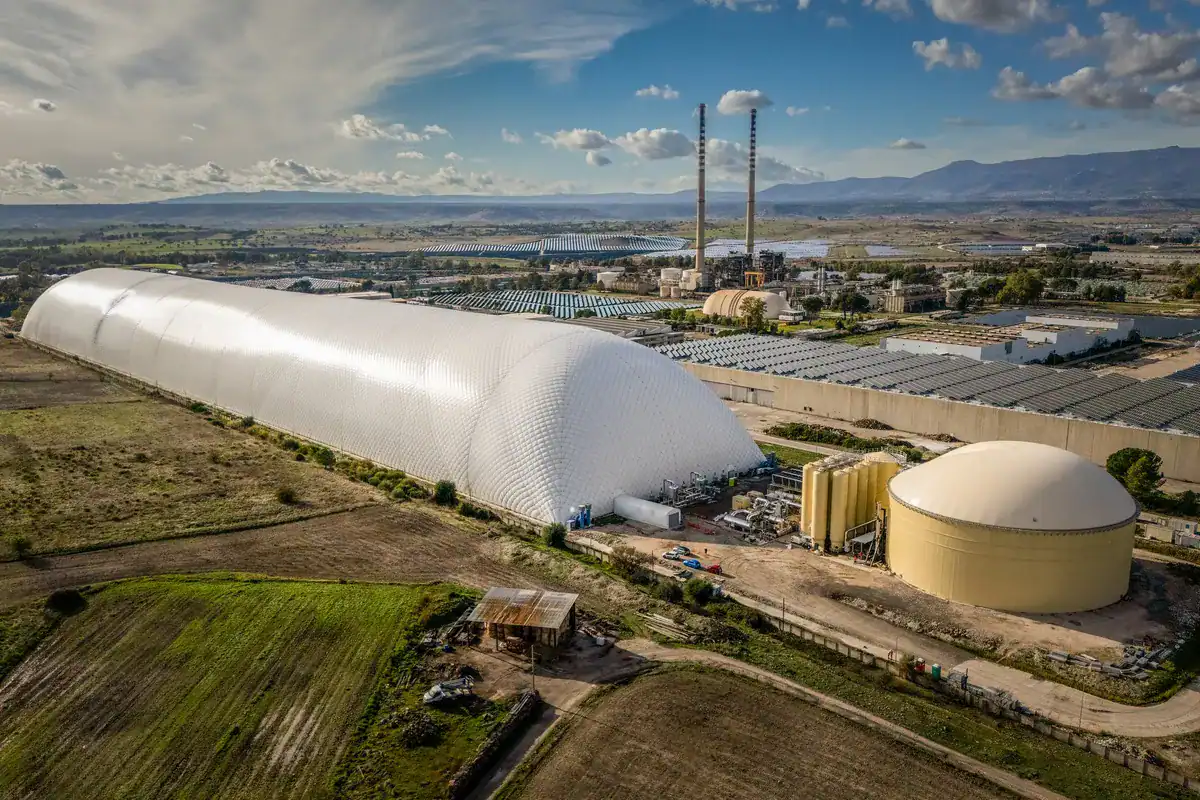
 Credit: Energy Dome.
On the Italian island of Sardinia, a strange, gleaming bubble rises from a patch of flat land. It’s held upright not by steel or concrete but by a small imbalance in pressure. Inside it sits 2,000 tonnes of carbon dioxide. But this time, the greenhouse gas is not the by-product of some polluting activity. Rather than a climate crime waiting to happen, this humble-looking dome is doing a very important job.
The structure belongs to a new kind of power plant, built by the Milan-based firm Energy Dome. Its purpose is deceptively simple: to hold on to electricity when there is too much of it, and give it back when there is not enough and the grid needs it most. In a world racing to replace coal and gas with wind and sunlight, that modest trick has become one of the hardest problems in energy science.
The solution on Sardinia, known as the CO₂ Battery, relies on familiar physics rather than exotic chemistry seen elsewhere. Carbon dioxide is compressed, cooled, stored, and allowed to expand again using excess energy generated by solar panels during sunny days. In doing so, the gas turns turbines as it goes.
If the idea sounds counterintuitive — using a greenhouse gas to help fight climate change — that’s because it is. But it may also be one of the most practical answers yet to a stubborn problem that has slowed the global shift away from fossil fuels.
The Storage Problem That Won’t Go Away
Solar panels and wind turbines generate clean power, but they can’t do so around the clock like a coal- or gas-fired power plant. The sun sets and the wind stalls. Meanwhile, people still cook dinner, cool or heat their homes, and stream videos.
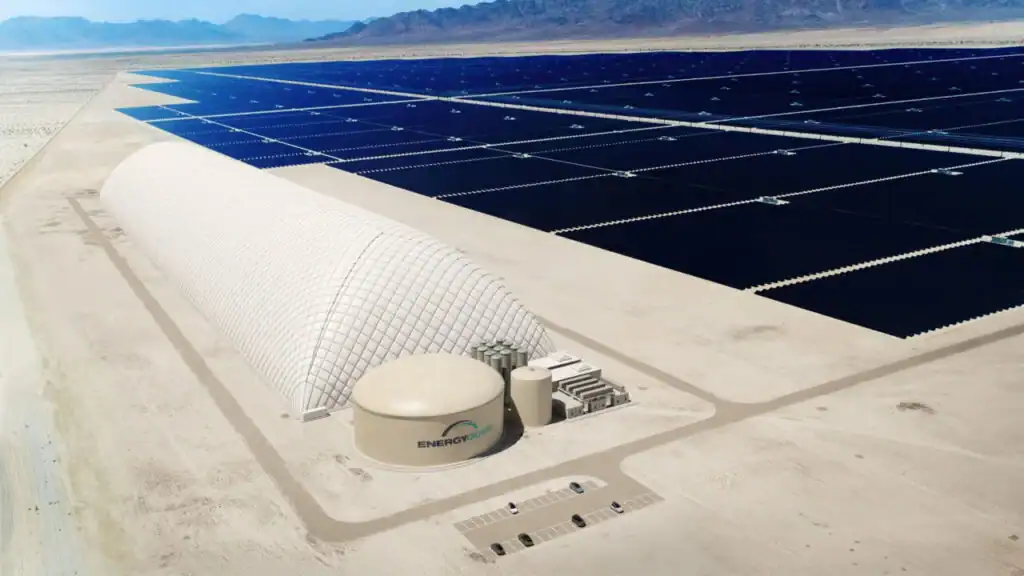 Rendering of an Energy Dome large-scale CO2 Battery project next to solar PV array. Image: Energy Dome.
Today’s most common solution is the lithium-ion battery. It works well for phones, cars, and short grid backups. But at large scale, lithium-ion systems usually provide only four to eight hours of power. That’s not enough to get through a long night, let alone several days of cloudy weather.
Engineers have tried many alternatives. They’ve compressed air, heated sand, split water into hydrogen, stacked massive weights, and pumped water uphill. Speaking of which, pumped hydro remains the gold standard for long-duration storage, but it requires specific landscapes, large reservoirs, and years of construction. You just can’t do it anywhere.
So right now this means the clean energy industry is still limited by this bottleneck. Renewable energy keeps getting cheaper and more abundant, yet grids still lean on gas and coal plants for reliability.
That’s the gap Energy Dome wants to fill.
How a CO₂ Battery Actually Works
At Energy Dome’s commercial plant in Ottana, Sardinia, excess electricity from wind or solar power runs compressors that squeeze carbon dioxide gas until it turns into a liquid. That liquid CO₂ is stored in steel pressure tanks, each roughly the size of a school bus.
When the grid needs power, the system reverses itself. The liquid CO₂ heats up, expands back into a gas, and rushes through a turbine. The spinning turbine generates electricity, which flows back to the grid. The gas then returns to the dome, ready for the next cycle.
“This is incredible,” said Emily Waltz, an editor at IEEE Spectrum who visited the Sardinia plant. “It is. But it’s physics,” quipped her tour guide Mario Torchio, Energy Dome’s global marketing director.
The entire system is closed. The carbon dioxide never leaves. It simply shifts between gas and liquid, again and again. And that’s indeed pretty elegant engineering.
Unlike lithium-ion batteries, this setup can deliver power for 10 hours — or even up to a full day. According to Google, which recently made a strategic investment in Energy Dome, the system can provide “completely clean energy into the grid for up to a full 24 hours.”
Why Big Tech Is Paying Attention
 Artist’s impression of Energy Dome’s CO2 thermal energy storage battery
Google is not known for dabbling lightly in infrastructure. Yet in July, the company announced a partnership — and an investment — with Energy Dome. The goal is to deploy CO₂ Batteries near Google data centers in Europe, the United States, and the Asia-Pacific region.
“We’ve been scanning the globe seeking different solutions,” said Ainhoa Anda, Google’s senior lead for energy strategy, speaking to IEEE Spectrum. “So standardization is really important, and this is one of the aspects that we really like” about Energy Dome. “They can really plug and play this.”
Google has pledged to run all its operations on 24/7 carbon-free energy by 2030. But if they’re really serious, their promise has to go beyond buying renewable power on paper, though carbon credits or some other mechanism that only passes climate responsibility on to someone else’s shoulders. It means matching clean electricity to every hour of demand, everywhere the company operates.
Data centers consume enormous amounts of power, and they cannot simply shut down when the wind drops. Long-duration, climate-friendly storage offers a way to keep servers running without falling back on fossil fuels.
“Google is committed to powering our operations with clean energy, and Energy Dome’s technologically proven and scalable long-duration energy storage solution can help us unlock rapid progress,” said Maud Texier, Google’s director of EMEA energy, in an earlier statement from July 2025.
A Battery Built From Familiar Parts
One reason Energy Dome’s idea is so appealing is its simple yet effective engineering. The system uses compressors, turbines, steel tanks, and carbon dioxide. This is the kind of equipment already common in industrial settings.
This battery doesn’t require lithium, cobalt, or other critical minerals that strain global supply chains. It doesn’t need mountains or deep caverns. It can be built almost anywhere with about five hectares of flat land.
Energy Dome expects its systems to last nearly three times as long as lithium-ion batteries. The company also says larger installations get cheaper per unit of energy, not more expensive. According to IEEE Spectrum, Energy Dome estimates its technology will be about 30 percent cheaper than lithium-ion storage at scale.
This economic profile has drawn interest far beyond Google. India’s largest power producer, NTPC Limited, plans to build a CO₂ Battery at its Kudgi power plant by 2026. In Wisconsin, Alliant Energy has approval to construct one that could power 18,000 homes. Chinese firms are reportedly building similar dome-based systems in Xinjiang.
“They are developing something very, very similar but quite large in scale,” said Energy Dome founder and CEO Claudio Spadacini, speaking to IEEE Spectrum. Of his Chinese competitors, he added, “They are good, they are super fast, and they have a lot of money.”
What Could Go Wrong?
The domes are hard to miss. They take up more land than lithium-ion batteries and rise high above the surrounding landscape. In some places, that visibility could trigger local opposition. Not in my back yard, remember?
Then there’s the obvious fear: what happens if the dome ruptures?
Spadacini says the structure can withstand winds up to 160 kilometers per hour. With enough warning, operators can deflate the dome and store all the CO₂ in tanks. If the worst happens, the gas would escape into the atmosphere. Yes, that would ironically contribute to global warming but that’s nothing compared to the regular emissions of a coal plant. Spadacini notes that a full release equals about 15 round-trip flights between New York and London on a Boeing 777.
People would need to stay about 70 meters away until the gas disperses. It’s not nothing — but in a world still burning fossil fuels daily, it’s a small risk.
From One Island to a Global Grid
The Sardinia plant generates 20 megawatts of power and stores 200 megawatt-hours of energy. It’s the first full-size, grid-connected CO₂ Battery in the world, completed in July. Energy Dome says replicas can be built in under two years, with the dome itself inflated in half a day.
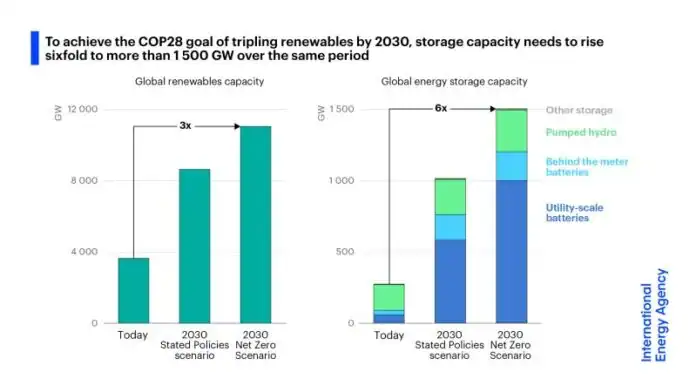
According to the International Energy Agency, the world will need more than 1,500 gigawatts of energy storage by 2050 to meet climate goals. Today, we have only a fraction of that.
Long-duration storage won’t replace every battery or every dam. But it could change how grids think about reliability. Instead of treating renewables as fragile and intermittent, systems like the CO₂ battery let them behave more like steady, dependable power plants.
For decades, carbon dioxide has symbolized the damage done by industrial society. Inside a giant bubble on Sardinia, it’s being reimagined as something else entirely: a working fluid for a cleaner future.