
Published on Dec. 22, 2025, 8:48 PM
The closing of this year’s ozone hole over the Antarctic continues the positive trend of smaller gaps in Earth’s ozone layer in recent years, perhaps leading to an eventual, full recovery of it in the coming decades
The Earth’s ozone layer is on an optimistic trend towards an eventual recovery in the years to come, if it maintains the path it’s currently on.
According to the Copernicus Atmosphere Monitoring Service (CAMS), the 2025 Antarctic ozone hole officially closed on Dec. 1, marking the earliest closure since 2019.
RELATED: Smaller ozone hole in 2024 pushes Earth closer to seeing it vanish
In addition to that, the 2025 ozone hole was also the smallest in five years, the second consecutive, 12-month period that featured “relatively” tiny holes compared to the large ozone craters documented from 2020-23. Also, this year featured higher ozone concentrations, indicating more optimism for a recovery, CAMS said in the news release.
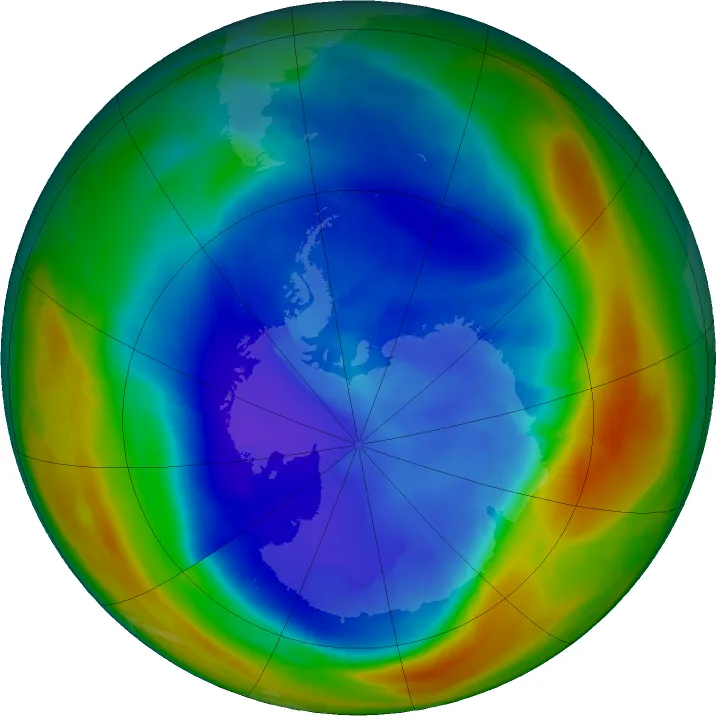
False-colour view of total ozone over the Antarctic pole on Sept. 1, 2025. The purple and blue colors are where there is the least ozone, and the yellows and reds are where there is more ozone. (NASA Ozone Watch)
“The earlier closure and relatively small size of this year’s ozone hole is a reassuring sign, and reflects the steady, year-on-year progress we are now observing in the recovery of the ozone layer, thanks to the ODS (ozone-depleting substances) ban. This progress should be celebrated as a timely reminder of what can be achieved when the international community works together to address global environmental challenges,” said Laurence Rouil, CAMS director, in the news release.
Ozone hole’s 2025 size progression
Each year, the ozone hole season, which occurs during the austral spring, is formulated by temperatures and winds in the stratosphere over the Southern Hemisphere, as well as the inclusion of human-emitted ODS, according to CAMS.