
Canada’s federal government plans to pump tens of billions of dollars into modernizing its military via a new agency led by a former Goldman Sachs investment banker. That’s perked up a few ears on Bay Street. With annual defence spending set to more than double by 2035, investors say they’re turning bullish on a sector that has historically flown under the radar.
Prime Minister Mark Carney has committed Canada to its biggest military spending hike since the Second World War. His aim is to raise defence-related spending to the equivalent of five per cent of Canada’s gross domestic product by 2035, meeting NATO’s newly increased target for members. (Canada is set to meet the old two per cent target for the first time next year.)
Overall, the Carney government says it has earmarked $81.8 billion in new spending over five years to strengthen the Canadian Armed Forces. Canada’s annual defence budget is expected to reach $150 billion by 2035. Spending this year is estimated at $62.7 billion.
Ottawa unveiled its new Defence Investment Agency in October, tasked with centralizing and accelerating military procurement. It will focus on projects worth $100 million or more. The first slate of projects includes new submarines, Arctic surveillance radar, and aircraft.
Carney has tapped Doug Guzman to be its CEO. Guzman was previously deputy chair at Royal Bank of Canada, following stints as an investment banker at RBC’s capital markets division, and Goldman Sachs.
“He’s going to be responsible for really stimulating the sector,” said Craig Aucoin, a portfolio manager at ValueTrend Wealth Management. “The government has said, ‘We’re going to put up an agency here like we haven’t done before. We’re not just going to throw dollars at it.’”
“It’s a very large and material opportunity,” added Ian Chong, a portfolio manager at Toronto-based First Avenue Investment Council.
If the federal government follows through, it will mark a major spending shift for Canada. According to a recent NATO report, the country is expected to spend 2.01 per cent of GDP on defence in 2025, a tie with Albania and Italy.
“We’ve done a terrible job on the defence side in this country,” said Paul Harris, a portfolio manager at Harris Douglas Asset Management in Toronto. “The idea that Europe and Canada are going to meet their NATO requirements over the next couple of years is really important.”
America’s defence industry is dominated by large, well-known players like Lockheed Martin (LMT), RTX (RTX) (formerly Raytheon Technologies), Northrop Grumman (NOC), and General Dynamics (GD). That’s not the case in Canada, making it trickier to narrow down which companies will benefit from rising defence spending.
Story Continues
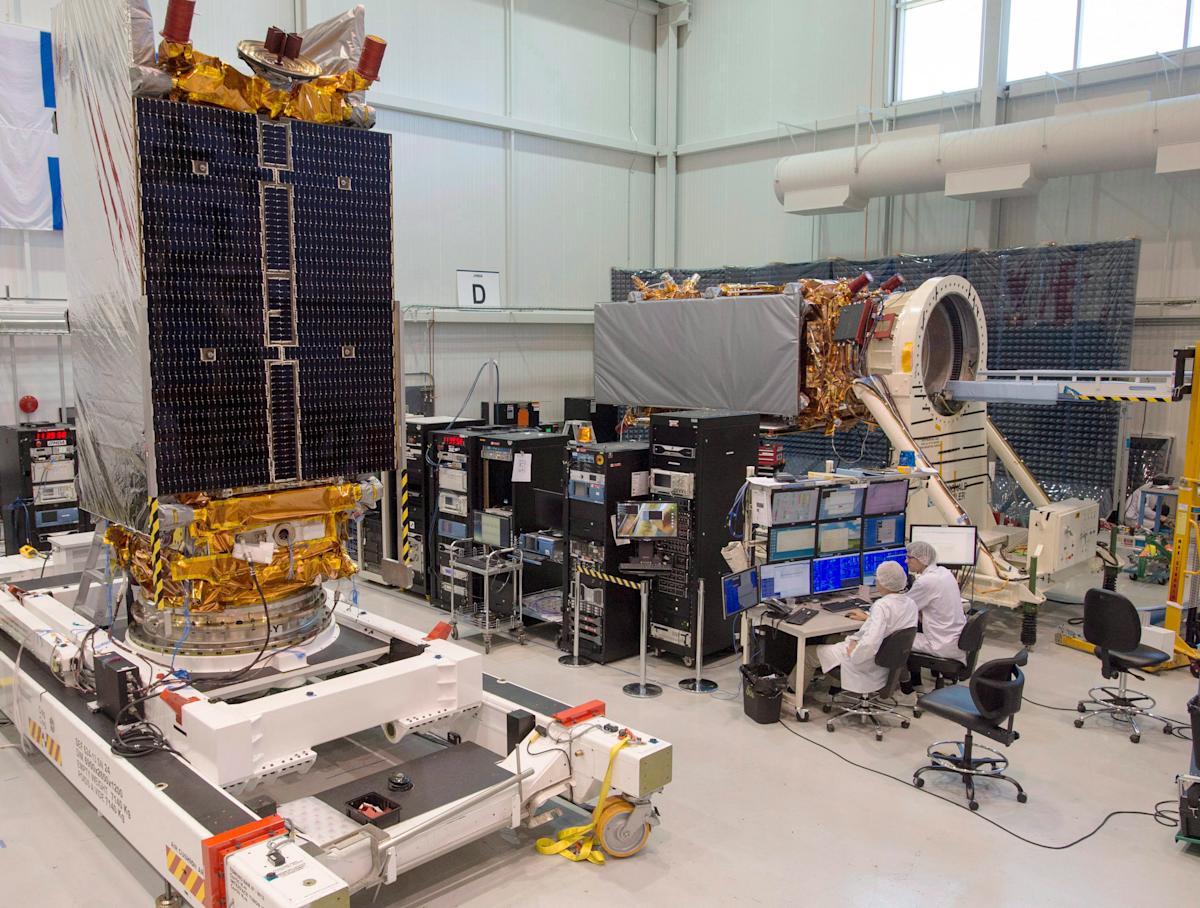
However, all three money managers say they’re bullish on MDA Space (MDA.TO), a Canadian satellite maker out of Brampton, Ont. The company manufactures a host of satellite systems, as well as robotic applications for shuttles and space stations, including the famous Canadarm. Aucoin and Chong own shares for clients.
“There are a lot of initiatives that have been put forth with the Carney government that favour domestic procurement, and domestic companies getting a leg up on the global stage,” Chong said.
“MDA is primed for this. The company has been operating for 55 years. It is the leading Canadian space technology company. The global space economy is a rapidly expanding market. It’s benefiting from secular growth, and national defence modernization.”
MDA recently announced a $45 million government contract with the Canadian Space Agency, as well as a smaller agreement with the government to improve satellite communications in the Arctic with Ottawa-based Telesat (TSAT.TO) (TSAT).
Last month, the company said its project backlog stood at $4.4 billion. On a recent conference call with stock analysts, chief executive officer Mike Greenley said there are also “more than a handful” of opportunities for orders worth over a billion dollars.
The space company has been a rollercoaster for investors. Shares tumbled in September after MDA announced it lost a $1.8 billion contract with EchoStar (SATS). The American telecommunications firm sold its spectrum licences to Elon Musk’s SpaceX, eliminating the need for a deal with MDA. Greenley calls this a “very unexpected event.”
Aucoin says he purchased MDA shares after the decline, only to be hit with another sharp Musk-related drop in late-October. The stock is down nearly 50 per cent from its 52-week high reached in August.
Citing an unnamed source, Reuters reported that SpaceX will pursue an initial public offering next year. It remains to be seen if such a move would ignite investor interest in the broader space sector, or sap attention from smaller players like MDA.
According to a report released last year by the World Economic Forum and McKinsey & Company, the so-called “space economy” could be worth US$1.8 trillion by 2035, up from US$630 billion in 2023.
“We don’t have a huge tech sector in this country,” said Harris. “We have smart people. We have great entrepreneurs. But the trend is to leave Canada and go to the United States, where it’s a lot easier to find capital.”
The Business Development Bank of Canada (BDC) wants this to change. Last week, the Crown Corporation announced a $4 billion plan to finance and invest in small and medium-sized enterprises in industries related to national defence. These span manufacturing, critical minerals, robotics, quantum computing, aerospace, artificial intelligence, cybersecurity, and dual-use technologies.
BDC president and CEO Isabelle Hudon says the bank recently reviewed its criteria, and decided to become more open to supporting Canada’s defence sector.
“It’s been a long time since we got very active in the sector,” she told Yahoo Finance Canada in an interview.
“It’s pretty new that this sector is a strategic one for our economy,” Hudon added. “I really think that we will build champions.”
Jeff Lagerquist is a senior reporter at Yahoo Finance Canada. Follow him on X @jefflagerquist.
Download the Yahoo Finance app, available for Apple and Android.