
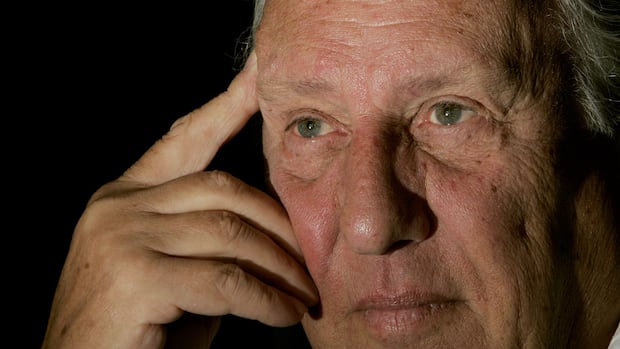
Tony Kent had no idea his late friend and legendary best-selling author Frederick Forsyth wrote The Shepherd on a dare.
In a 2004 interview with former As It Happens host Carol Off, Forsyth revealed he had written the now-beloved Christmas ghost story after being challenged by his late wife.
“That’s the first time I heard of [that story],” Kent told As It Happens host Nil Köksal. “But it doesn’t surprise me.”
The Shepherd has since become not only an essential part of Forsyth’s body of work, but a cherished holiday favourite of CBC Radio listeners — read almost every Christmas Eve since 1979 by the late As It Happens host Alan Maitland.
Best-known for his gripping political thrillers like his debut novel, The Day of the Jackal and 1972’s The Odessa File, Forsyth’s books have sold millions of copies worldwide. After his death this summer at age 86, Transworld Publishers released his final novel, Revenge of Odessa, a sequel co-written with Kent.
Kent spoke with Köksal about what Forsyth taught him and the legacy he leaves behind. Here is part of that conversation:
Political thrillers, those were his bread and butter, that’s what he was beloved for. What did you think ultimately of his Christmas ghost story, [The Shepherd]?
The Christmas ghost story, it’s quite credible, isn’t it? When you read it, it’s nothing like a Frederick Forsyth book, and yet it’s everything like one. It’s got exactly the same sort of roots in reality and roots in complete knowledge and experience. But he lived that life, albeit for a relatively short time, but he lived that life. He’d done exactly what he was writing about, but he was then able in a very non-Frederick way to make that mystical and make it supernatural.
And one of the things I always think it compares to — and I think it’s ironic that you always play it on a Christmas Eve — I think one of the things that it compares to most is actually a Frank Capra movie more so than a ghost story. It’s much more like something like It’s A Wonderful Life or alternatively, It’s a Matter of Life and Death with David Niven.
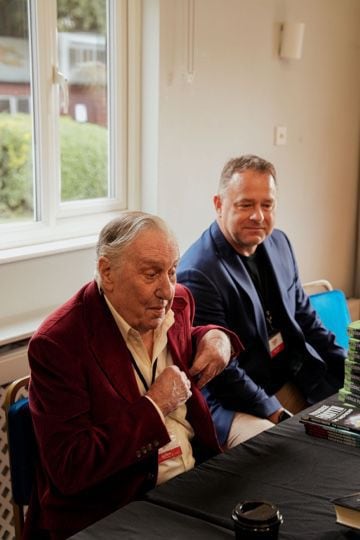 Tony Kent, right, and Frederick Forsyth, left, sitting together. Kent co-wrote the novel, ‘Revenge of Odessa’ — the sequel to ‘The Odessa File’ — with Forsyth. (Submitted by Tony Kent)
I think for many people, The Day of the Jackal, it might be the work they know him best for apart from The Shepherd. What impact did that work and those other books have on you as an aspiring writer?
As an aspiring writer, they were the opposite of inspiration. And I mean that positively, but it doesn’t sound like it. Writing thrillers, the books I write are very similar to Freddy’s. We write in a different way, but we both wrote political thrillers, hence he asked me to get involved with Revenge of Odessa.
But because that was what I wanted to write, I did what everyone should do if they want to learn to become a writer. And rather than taking a course, I read all of the books written by the best and the best was Frederick and I read The Day of the Jackal first. And the problem with it is it’s perfect.
It was his first book that he ever wrote. He never bettered it. He never wrote anything even as good as it. As great as his books are, The Day of Jackal is literally the perfect thriller. The reason it’s the perfect thriller or the test for it being the perfect thriller is that it’s a thriller that we know the ending of. We know how it’s going to end. We know the Jackal is going to fail. We know Charles de Gaulle doesn’t die, and yet he still manages to keep you on the edge of your seat for every single paragraph of that book.
And for an aspiring writer in the same genre, such as myself, the problem with reading that book is you kind of read it and think, Well, what’s the point? I’m never going to write something even close to this.
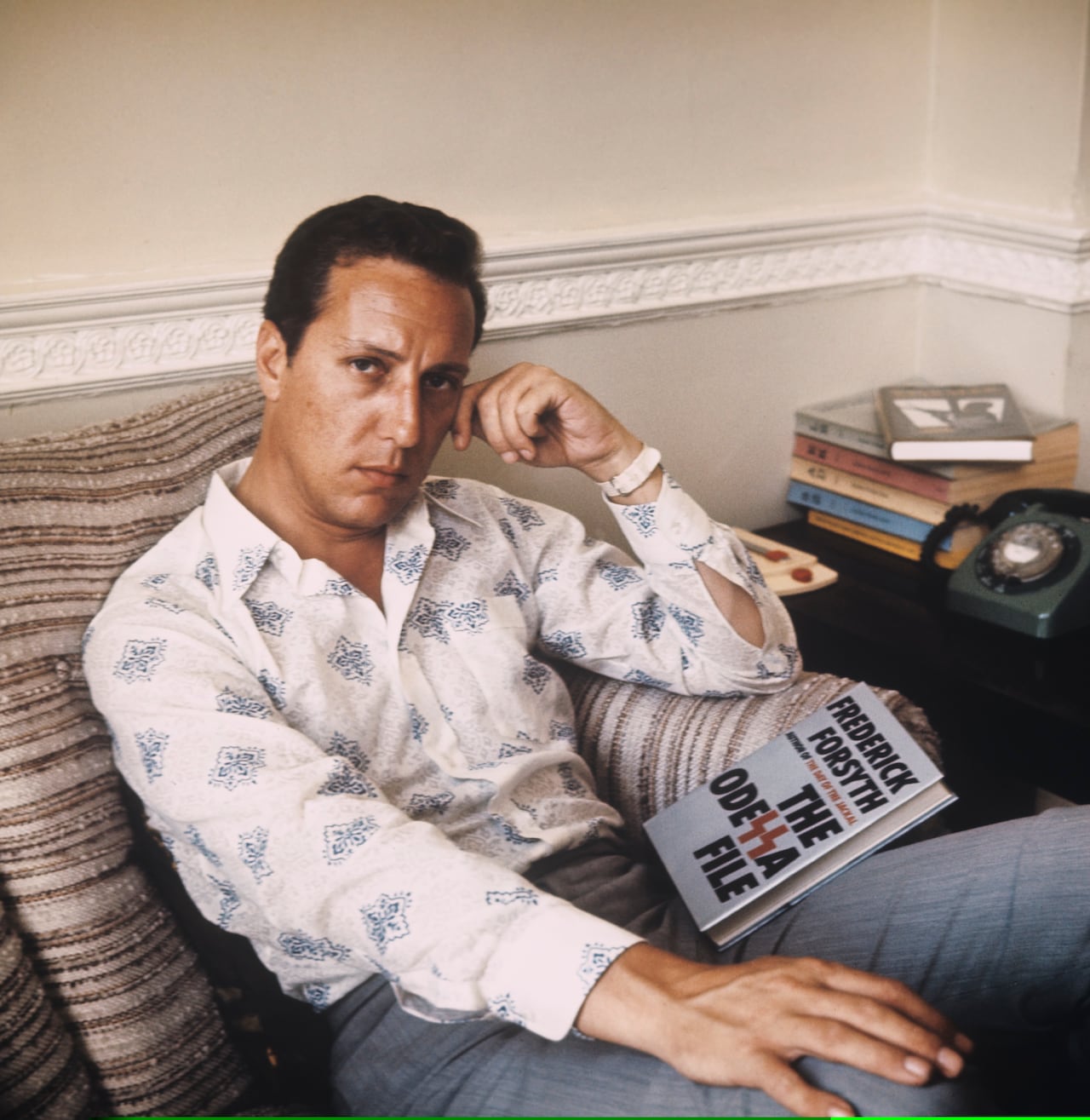 Frederick Forsyth pictured with a copy of his novel, The Odessa File, circa 1972. (Photo by Keystone Colour/Getty Images) (Getty Images)
The Odessa File was first published in 1972. It’s about a journalist trying to track down a former Nazi commander. It’s set in the years after the end of the Second World War. What did he tell you about why he wanted to revisit that, write a sequel to that, more than 50 years on?
He wanted to write a sequel because again, where I say his books were steeped in the real world — he was always very much a student of what was going on, even in his later years and he was very concerned, very concerned about the rise of the far-right in Central Europe and Eastern Europe. I should say, and I think he would want me to say that he doesn’t include Britain. He never included Britain in that.
And his main concern was Germany. And the reason he had the main concern of Germany was really the speed. It now has become a situation where the AFD, the Alternative for Deutschland, are actually publicly saying, ‘Well, the SS weren’t that bad and we think we’ve said sorry enough, etcetera, etcetera.’ And that was what was concerning him. The speed with which you’ve gone from one extreme to the other and the rise of the far-right, it made him wonder, ‘Well, what if Odessa was still around? What would they be up to?’
The Odessa File because it was set so close to the war — it’s only set 15, 16 years after the war or 17 or 18 years after the war — the Nazis then were still concerned with getting away, hiding themselves and being able to live a good affluent life after their atrocities. And what we discussed really was, well, they wouldn’t be satisfied with that. Once they’ve achieved that, they’re going to go back to form and what they’re really about is power. I guess it was a concern for the reality of the world, but also it sort of whet his appetite again, got his imagination firing and it kind of came from there.
I mean, was there any moment, was there any hesitation to saying yes to taking this on?
The quickest yes of my life was agreeing to write this book and that was quicker than the yes I gave at the altar. And [my wife] will be very upset to hear that, but, it’s true.
What ultimately do you think he taught you? As a person, as a friend, what did he teach you?
The one thing where he would not be humble, the one thing that he was very, very, very proud of was that The Day of the Jackal was written in six weeks, and he didn’t change a word of it. And it’s one of the first things he ever told me. And I kind of expected a lot of that because it’s one of the first things you ever told me. But actually from that point onwards, from that one boast — and God, it’s an understandable boast — from that one boast onwards, I don’t think there was another one. I think apart from that, every interaction with Freddy was, was nice and very, very humble.
And I often get told these days — I’m a criminal barrister by trade, I’m a writer and I used to be a boxer — and I get told by a lot of people, ‘Wow, you’ve lived this incredibly interesting life.’ There’s so many things. And then I look at the life Freddy led — RAF pilot, effectively spy in Eastern Europe, the best-selling author on the planet. And you look at these things and think, no, that’s an interesting life, and yet the humility — he was just incredibly normal and unaffected by it.