
Good morning and happy holidays.
The turbulence caused by the January inauguration of President Donald Trump and his immediate launch of a trade war and sovereignty threat to Canada has dominated our news coverage in British Columbia.
The blast radius of those events will continue into 2026 as Premier David Eby’s government struggles to grow this province’s economy through amped-up resource projects. The hope is the new projects will help diversify the province’s trade relationships away from the U.S., but the NDP also needs the economic boost as a way to get out of significant financial troubles.
Columnists have repeatedly noted that when Eby took the helm from former premier John Horgan in 2022, he was left a surplus of almost $6-billion.
Now B.C. is forecasting a deficit of $11.2-billion, the largest in the province’s history, including the COVID-19 years.
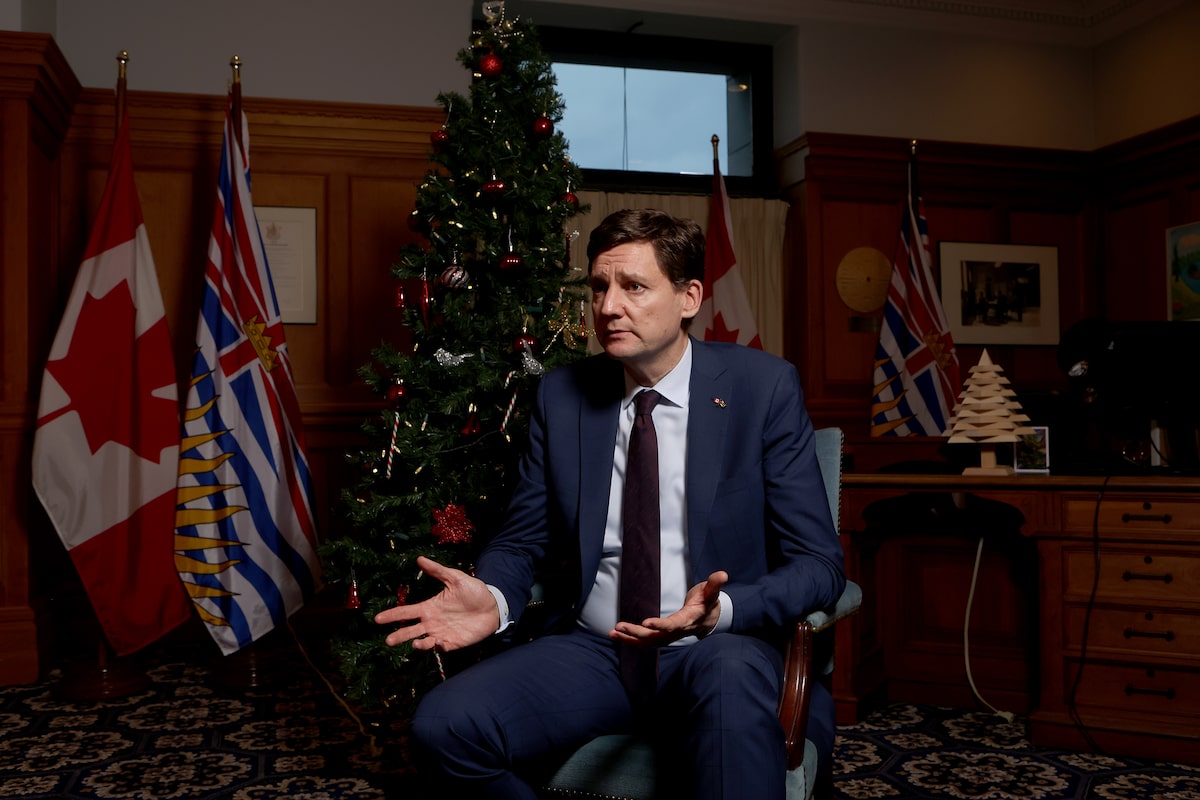
Eby told The Canadian Press in a year-end interview the swing in financial fortunes is part of the reality of a resource-based economy.
“We see these booms and these busts from time to time,” he said. “The decision is: Do we keep working to support British Columbians, or do we cut back?”
He said his government has chosen not to make drastic cuts because “people are really struggling.”
But whereas B.C. once boasted of being ahead of other provinces on many metrics, RBC’s Canadian analysis issued earlier this month shows the province with the lowest economic growth for 2025.
“Slowing demographic growth driven by new federal immigration targets, tariff headwinds in lumber and aluminum, and softer residential investment will be partially offset by natural resource export gains and labour market improvements,” the analysis says of the year ahead.
It notes public infrastructure spending will help – six of the 13 projects referred to the federal government’s Major Projects Office are in B.C.
But the RBC analysis repeats what others, including Eby, have said about the economic uncertainty posed by the B.C. Supreme Court’s decision in the Cowichan land claims case, which questioned fee-simple title.
As the year closed out, Eby lashed out at the courts for the Cowichan decision, as well as a B.C. Court of Appeal decision that set a binding obligation on government to swiftly abide by its own legislation implementing the United Nations Declaration on the Rights of Indigenous Peoples. That legislation was intended to be implemented over several years, Eby said.
“To face such dramatic, overreaching and unhelpful court decisions as we have seen over the last couple of months, is deeply troubling,” the Premier told a luncheon with the B.C. Business Council.
Ordinarily, a premier leading a party with the thinnest of majorities in the legislature – just one seat – would be under suffocating pressure.
But whereas the court, Donald Trump and the economic data have the province in a squeezing grip, the NDP has been getting a bit of breathing space from the chaos that is the Official Opposition.
In the process of ousting leader John Rustad, the party splintered into at least three factions. One of those, OneBC formed by two MLAs who were elected as Conservatives, itself split earlier this month when Tara Armstrong said she had lost confidence in leader Dallas Brodie.
Last week, Brodie was apparently turfed by the party. On Monday, she said she was back, which the party confirmed.
Now, Trevor Halford, interim leader of the Conservatives, says the free-wheeling party Rustad envisioned might require a rethink.
When asked if free speech and free votes has worked for the Conservatives, Halford told Justine Hunter in a year-end interview: “I’m not sure it has. I think that, you know, at the end of the day, every caucus, whether you’re government or opposition, you need a form of structure, and you need stability and you need unification.”
Sadly, none of the political or economic drama of the last half of 2025 is going away in the coming year.
So as you settle into the holidays, have a read of Mike Hager’s delightful check-in on a tradition among many in the Filipino community.
While many of us bridle at seeing Christmas decorations or hearing Christmas songs before Halloween, the people Mike talked to are all in, starting in September and continuing through the “ber” months – September, October, November, December.
Hilda Baybay’s tree goes up on Sept. 1. In October, she gives the counterfeit conifer a spooky makeover befitting the Halloween vibe of her East Vancouver neighbourhood. Then, at dawn on Nov. 1, Christmas returns.
May you all find reasons to celebrate the year that was and the year that’s to come. Thanks for reading.
This is the weekly British Columbia newsletter written by B.C. Editor Wendy Cox. If you’re reading this on the web, or it was forwarded to you from someone else, you can sign up for it and all Globe newsletters here.