
While most countries allow for reasonable limits to be placed on individual rights, Canada’s notwithstanding clause allows governments, rather than courts, to decide which liberties can be suspended altogether.
This series will explore how the clause has been used across Canada’s provinces, the social and historical factors behind its inclusion, civil society responses, differing perspectives, and proposals to limit its use.
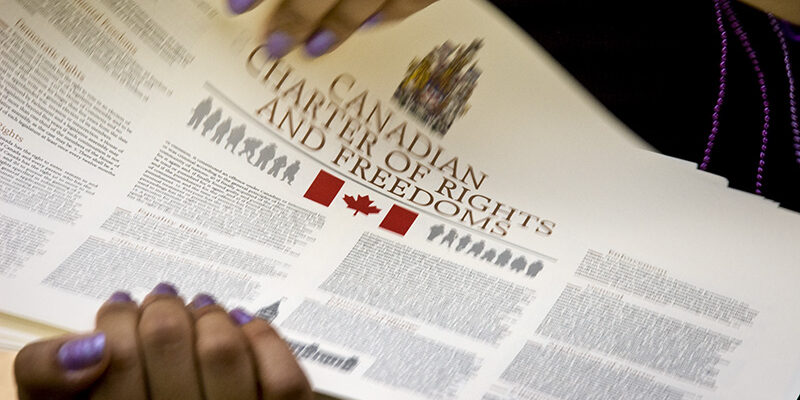
The notwithstanding clause is section 33 of the Canadian Charter of Rights and Freedoms. It permits federal or provincial governments to temporarily enact legislation that overrides certain Charter protections, specifically those set out in section 2 and sections 7 to 15, for a renewable period of up to five years. When invoked, the clause shields the legislation from being struck down by the courts on Charter grounds, notwithstanding where it greatly infringes on fundamental freedoms.
The federal government has recently intervened in a case before the Supreme Court of Canada regarding Bill 21, Quebec’s policy prohibiting individuals who wear religious symbols from working in the public sector, to ask whether the Court could define limits on how federal and provincial governments use the notwithstanding clause.
The federal government has asked whether the courts can still determine if a law violates a Charter right even when it has been enacted legally under the notwithstanding clause. They are also asking whether repeated invocation of the clause to maintain a law could be considered tantamount to abolishing the protected right altogether.
This move comes on the heels of not only one of the most controversial uses of the notwithstanding clause in Quebec, but also an increase in its use by governments all over Canada.
Since 2018, the use of the notwithstanding clause has grown substantially. Ontario has successfully invoked the clause once and threatened it on several other occasions; Saskatchewan has used it to protect legislation concerning gender identity from court challenges; Quebec has invoked it to override certain religious and language rights; Alberta has applied it multiple times to legislation affecting transgender youth and workers’ rights.
Recently, the federal Conservatives under Pierre Poilievre have said that, if they were to be the governing party, they would invoke the clause to override Supreme Court decisions concerning criminal sentencing. This would be the first time the federal government has ever invoked the clause.
Moreover, it is increasingly being used pre-emptively by provincial governments. While nothing in the Constitution explicitly prohibits this, early proponents envisaged the clause being used “in those rare cases where there was a strong case to be made that the courts had made a big mistake,” said Richard Mailey, Director of the Centre for Constitutional Studies at the University of Alberta, implying that such legislation was never meant to be insulated from judicial scrutiny altogether.
These developments have placed the notwithstanding clause back at the centre of Canada’s political discourse, sparking debate over its inclusion in the Charter, the role of courts in a democracy, and its impact on regional tensions and separatist sentiment.
Background
The notwithstanding clause applies to some of the Charter’s most significant guarantees, including the rights to life, liberty, and security of the person, equality rights, and due process protections.
There was strong support for including the notwithstanding clause at the time of its creation, not necessarily to undermine freedoms, but to return the most hotly debated political and moral questions of the day to the people, rather than leaving them in the hands of unelected members of the judiciary.
Peter Lougheed, the Premier of Alberta in 1980 at the time of the negotiations for repatriating the Canadian Constitution, was a staunch advocate for the notwithstanding clause, drawing on a similar override provision in John Diefenbaker’s Canadian Bill of Rights, which sought to balance the protection of individual liberties with the authority of elected officials.
“We did not want to be in a position where public policy was being dictated or determined by non-elected people,” Lougheed said in defence of the clause.
Prime Minister Pierre Trudeau needed the support of the majority of the provinces to advance his push for a constitutional bill of rights. To reconcile these differences while reaching his objective, the Prime Minister accepted the inclusion of the notwithstanding clause in the Charter, despite being an opponent of it.
“It is better to have a Charter with the clause than to not have a Charter at all,” Trudeau said.
“The consensus is that the Charter would likely not have been possible without some version of the notwithstanding clause,” said Craig Scott, a professor at Osgoode Hall Law School and former Member of Parliament in an interview with rabble.ca.
The notwithstanding clause in the present
Recent justifications for invoking the notwithstanding clause by Canada’s premiers echo arguments Peter Lougheed made more than four decades ago.
Premier Doug Ford, in defending his use of the clause to override a court ruling prohibiting him from reducing the size of Toronto’s city council, stated, “I was elected. The judge was appointed.”
In September 2025, Ford doubled down on this sentiment while commenting on the federal government’s factum to the Supreme Court of Canada.
“Legislatures are supreme, not judges ruling on stuff that shouldn’t even be in front of the courts. There’s not one person I’ve talked to that has said, we want to give the judges, politically appointed judges, more authority,” Ford said.
Proponents of the notwithstanding clause feel it is a useful tool to democratize the policy-making process.
“One way of viewing the notwithstanding clause is that it actually gives the final say to the electorate, and is therefore, in a certain sense, a power that is held by the people themselves. When the government invokes it, it is inviting the judgment of the electorate at the next election,” said Mailey.
Critics of this perspective argue that many supporters of the clause fail to fully understand the principles undergirding a liberal democracy like Canada.
“Western democracy is not populist. It’s not majority rule at all costs. It’s the majority rule for those things that have to be decided by the majority,” said Julius Grey, a lawyer, former progressor, and former president of the Canadian Human Rights Foundation. “You can only have one budget. You can only have one highway code, one criminal code. But democracy really means majority government with safeguards for dissenters. A real democracy today maintains the Charter precisely for the type of thing the notwithstanding clause allows them to get rid of. Freedom of expression, freedom of association, freedom of religion, and so on.”
Without constitutional safeguards, there is a risk of a tyranny of the majority, in which a simple majority could impose its will on minority groups, potentially silencing or harming them simply because they are out of favour or represent a small faction of the population.
Moreover, many premiers across Canada today see the notwithstanding clause as a tool to protect the distinct identities of provinces within the broader national framework.
“Just as judges on the same court can disagree with each other about what is and isn’t a reasonable limit, provinces can adopt quite different but equally reasonable approaches to rights protection. A limit on a right that Ontario regards as over the line might seem perfectly acceptable to Alberta, and this difference might be fuelled by deeper cultural differences between the two,” said Mailey.
In a public letter to the federal government regarding its submissions to the Supreme Court, the premiers of Ontario, Quebec, Alberta, Saskatchewan, and Nova Scotia defended provincial use of the notwithstanding clause.
“These arguments threaten national unity by seeking to undermine the sovereignty of provincial legislatures, a fact we will raise for the consideration of the full Council of the Federation given the fundamental implications for Canadian federalism,” the provinces state in their defense.
Quebec, which will be explored in depth in a subsequent installment, is at the forefront of efforts to preserve provincial autonomy through the use of the notwithstanding clause, particularly with respect to language rights and cultural practices. Even critics of the clause acknowledge that its continued existence in the Charter is seen as essential to forestalling separatism, said Scott.
The Canadian Constitution is difficult to amend, requiring the assent of the provinces, making the notwithstanding clause’s continued existence in the Charter of Rights and Freedoms a certainty for the time being., Both supporters and critics alike recognize that its use today diverges from the framers’ original intent.
What was meant to serve as a last-resort safety valve is now, according to Grey, being treated by some provinces, like Quebec, as a routine tool.
The Premier of Saskatchewan at the time of the repatriation of the Canadian Constitution in 1980, Allan Blakeney, had envisioned the clause as a means to preserve human rights in cases where court decisions went catastrophically wrong. In contrast, recent uses have raised concerns about potential threats to individual rights that, as Mailey notes, are hard or even impossible to justify.
However, for Grey, the gap between the notwithstanding clause’s original intent and its current use represents a fundamental problem with its very existence.
“There is a principle of political theory that if you give someone power they will eventually use it. There is nothing more dangerous than untrammelled power,” he said.
For those aligned with Grey, the misuse of the clause to violate rights is not an accident but an inherent feature. His reasoning goes as follows: if a tool exists that can be used harmfully, eventually a bad actor will come along and take advantage of it.
The notwithstanding clause remains a controversial feature of the Constitution. Debates underway in the Supreme Court will define how the clause, and in turn Canadian democracy, functions in the years to come. Its future use will continue to test the balance between legislative authority, minority rights, and the principles of liberal democracy. This series aims to ensure Canadians are informed and engaged in these debates by examining each province’s history with, and use of, the clause.
Next, in rabble’s series on the notwithstanding clause, we will examine its history in Alberta, from its attempted use against same-sex marriage and forced sterilization compensation, to its current invocations by Premier Danielle Smith concerning the right of workers to strike and the rights of transgender youth. We will explore the role civil society has played in challenging these pieces of legislation and consider why the clause has been a key element in Alberta’s approach to its place within Canada’s broader federalist framework.
Support rabble today!
We’re so glad you stopped by! Thanks for consuming rabble content this year.
rabble.ca is 100% reader and donor funded, so as an avid reader of our content, we hope you will consider gifting rabble with a donation during our summer fundraiser today.
 Nick Seebruch, editor
Whether it be a one-time donation or a small monthly contribution, your support is critical to keep rabble writers producing the work you’ve come to rely on as a part of a healthy media diet.
Become a rabble rouser — donate to rabble.ca today.
Nick Seebruch, editor