
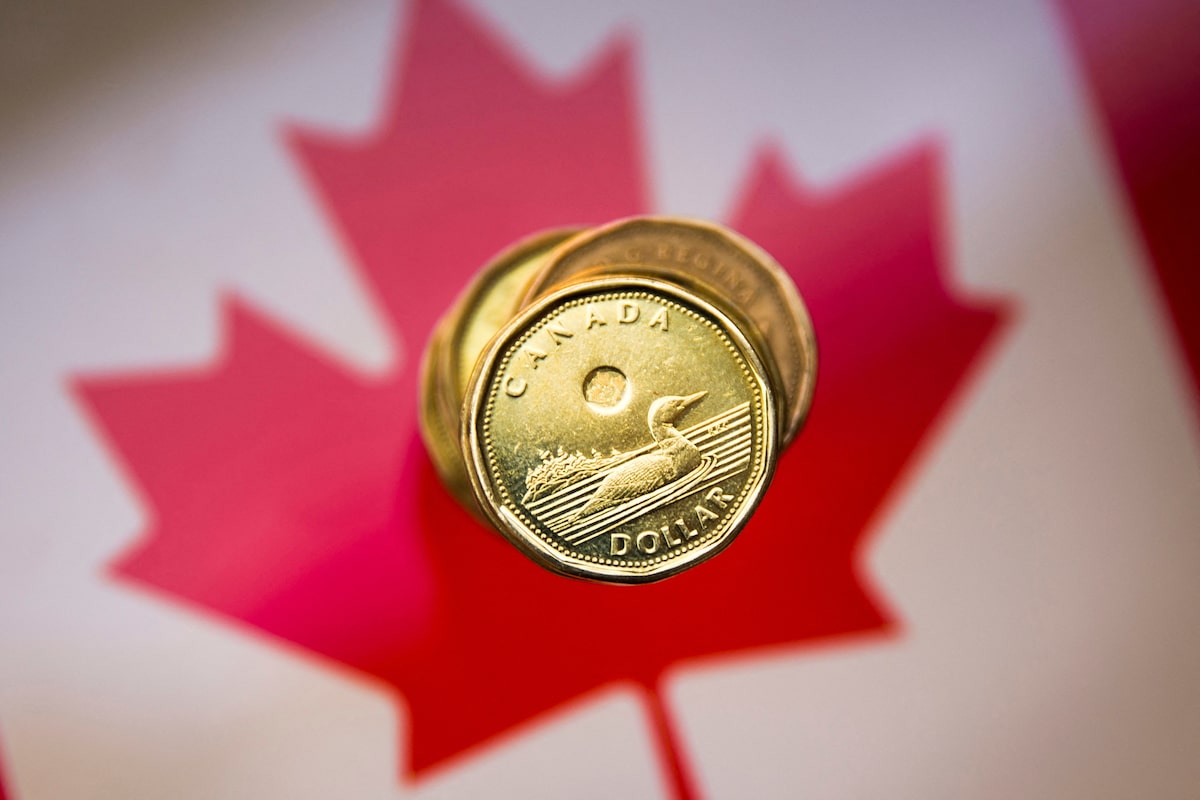
The Canadian dollar rose to a near five-month high against its U.S. counterpart on Tuesday as a recent improvement in risk appetite offset softer-than-expected domestic GDP data.
The loonie was trading 0.4% higher at 1.3690 per U.S. dollar, or 73.05 U.S. cents, after touching its strongest intraday level since July 28 at 1.3689.
Canada’s economy shrank by 0.3% in October, the largest drop in almost three years and a steeper decline than the 0.2% decrease that economists had forecast. A preliminary estimate showed 0.1% growth in November.
“I don’t think the Canadian data lately has been much to celebrate but you’ve had risk sentiment broadly return with a bang since the last Fed (Federal Reserve) meeting,” said Erik Bregar, director, FX & precious metals risk management at Silver Gold Bull.
“Since the Fed meeting you’ve seen (interest) rate spreads contract – that’s helping the Canadian dollar. You’ve seen the stock market generally have a buoyant feel to it … and I think that’s helping the Canadian dollar because it’s a risk-sensitive currency.”
The S&P 500 rose for a fourth straight day and U.S. Treasury yields climbed after data showed that the U.S. economy grew at its fastest pace in two years in the third quarter.
The price of oil was trading 0.6% higher at $58.35 a barrel, supported by supply disruption fears after Ukrainian attacks on Russian vessels and piers. Oil is one of Canada’s major exports.
Ahead of the Bank of Canada’s interest rate decision on December 10, the governing council agreed it was hard to predict whether its next move would be a hike or cut, according to minutes of the meeting.
Canadian bond yields moved lower across a flatter curve, with the 10-year down 4.5 basis points at 3.428%.
The 10-year yield was trading 4.7 basis points further below its U.S. equivalent at a gap of 74.5 basis points. On Friday, the gap touched its narrowest in more than two years at 68 basis points.