
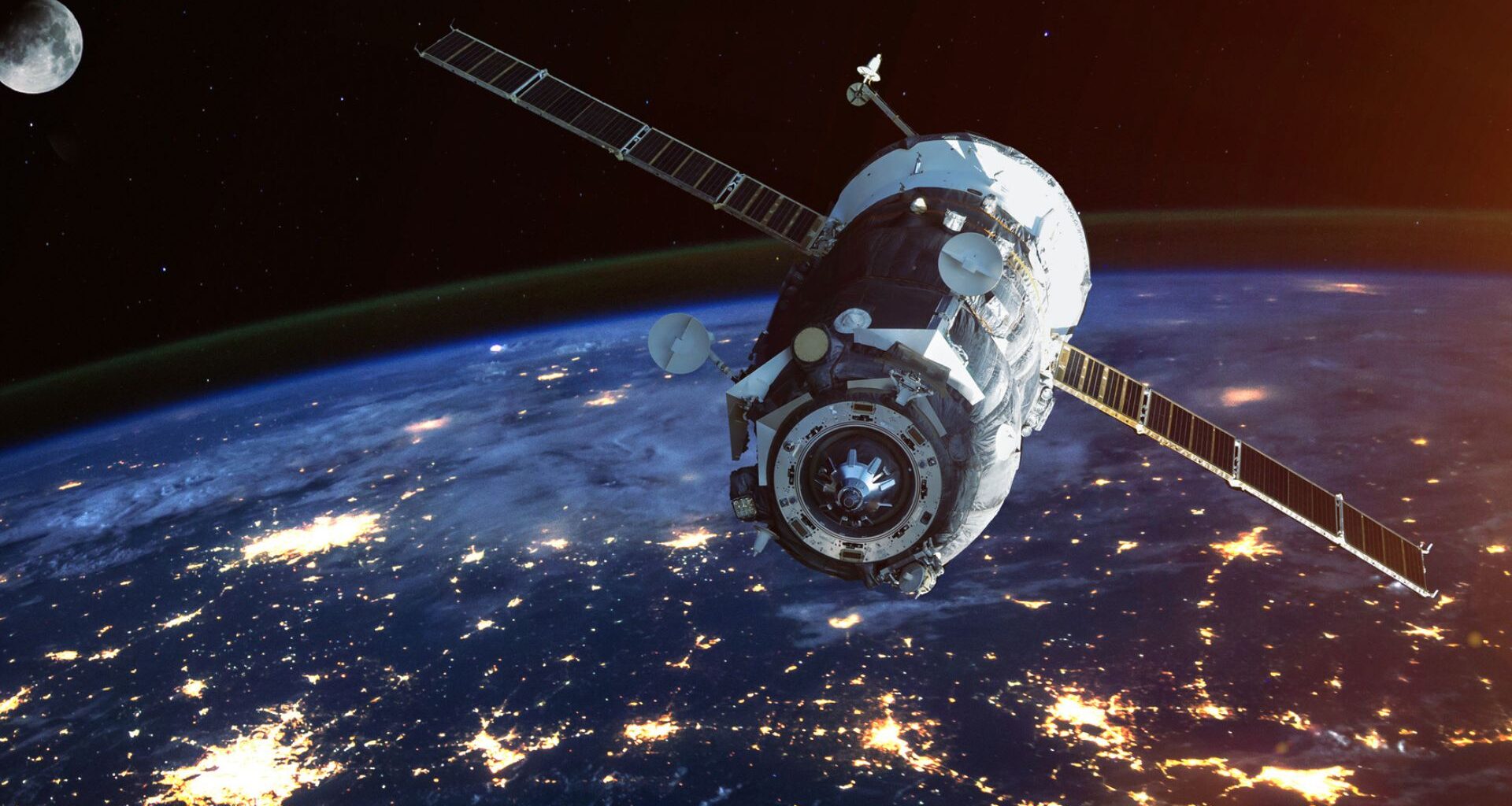
As the world races toward sixth-generation mobile networks, the real battleground may not be on Earth at all, it may be in orbit.
With 6G commercialization expected around 2030, researchers are already rethinking how artificial intelligence will operate at a global scale.
The International Telecommunication Union (ITU) has identified future 6G use cases such as “integrated artificial intelligence (AI) and communication” and “ubiquitous connectivity,” signaling a shift toward networks that do more than just transmit data.
One major hurdle remains: delivering seamless AI services across vast, remote, and underserved regions.
Terrestrial networks alone may not be enough to meet these demands, especially as AI workloads grow heavier and more latency-sensitive.
A new study proposes an answer that stretches far beyond the ground. Researchers from the University of Hong Kong and Xidian University have introduced a framework that merges edge AI with space–ground integrated networks (SGINs), turning satellites into both communication hubs and computing servers.
Their approach, called space–ground fluid AI, aims to overcome the challenges posed by fast-moving satellites and limited space–ground link capacity—two issues that have long restricted the use of AI in orbital systems.
AI flows like water
Inspired by the way water flows seamlessly across boundaries, the space–ground fluid AI framework allows AI models and data to move continuously between satellites and ground stations.
The researchers describe this as extending traditional two-dimensional edge AI architectures into space.
The framework rests on three core techniques: fluid learning, fluid inference, and fluid model downloading. Each is designed to keep AI services running smoothly despite the constraints of satellite mobility and intermittent connectivity.
Fluid learning tackles long training times by introducing an infrastructure-free federated learning scheme.
Instead of relying on costly inter-satellite links or dense ground stations, the system uses satellite motion itself to mix and spread model parameters across regions.
By doing so, satellite movement shifts from being a limitation to becoming an advantage, enabling faster convergence and higher test accuracy.
Fluid inference, meanwhile, focuses on optimizing real-time AI decision-making. Neural networks are split into cascading sub-models distributed across satellites and ground nodes.
This allows inference tasks to adapt dynamically to available computing resources and link quality, using early exiting strategies to balance latency and accuracy.
Satellites as AI servers
The third pillar, fluid model downloading, addresses how AI models are delivered efficiently to end users on the ground. Instead of storing entire models on satellites, only selected parameter blocks are cached.
These blocks can migrate through inter-satellite links, improving cache hit rates and reducing download delays.
Multicasting reusable model parameters further boosts efficiency, allowing multiple devices to receive the same AI components simultaneously while conserving spectrum resources.
Deploying AI in space, however, comes with its own set of challenges. Satellites operate under harsh radiation conditions and rely on limited, intermittent power supplies.
To address this, the researchers highlight the importance of radiation-hardened hardware, fault-tolerant computing, and energy-aware task scheduling.
Looking ahead, the team outlines future research directions such as energy-efficient fluid AI, low-latency fluid AI, and secure fluid AI, each targeting critical tradeoffs between performance, reliability, and security.
By exploiting predictable satellite trajectories and repeated orbital motion, space–ground fluid AI could play a central role in delivering truly global edge intelligence in the 6G era, as detailed in the journal Engineering.