
Yesterday
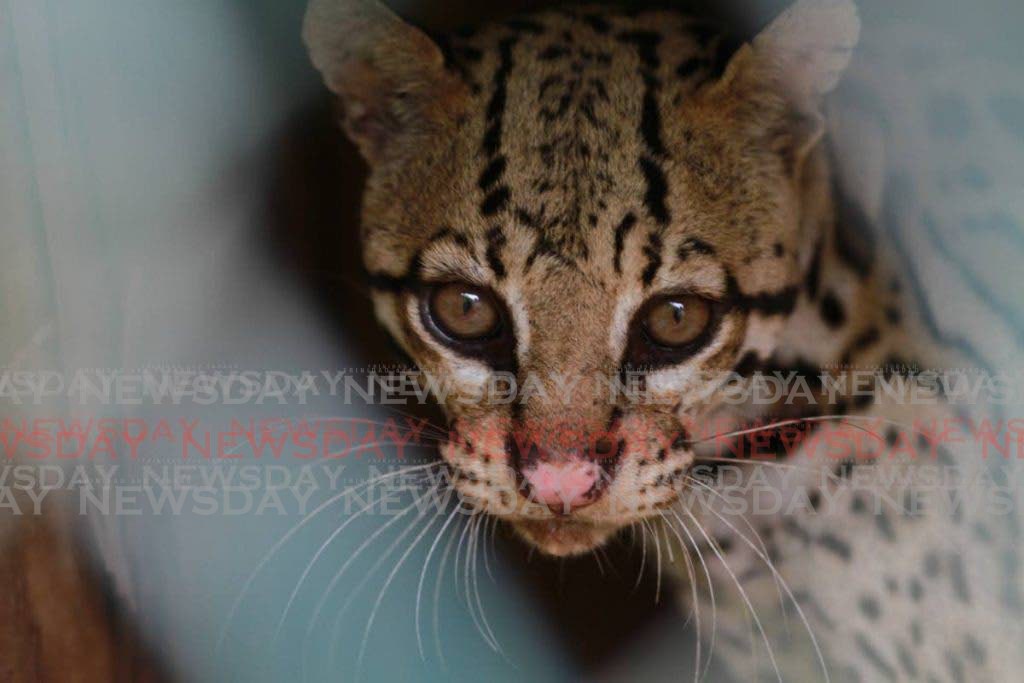 An ocelot at the El Socorro Centre for Wildlife Conservation in Freeport. –
MAJESTIC is the ocelot.
And even more majestic is the ocelot of this country; nowhere else did this species evolve in the absence of large mammalian carnivores like jaguars and pumas.
It is believed that Trinidad, once physically part of South America before sea-level rises thousands of years ago, hosts the only population of this extraordinary wild cat within an isolated continental tropical island setting.
So, reports that emerged last week suggesting an ocelot had been gratuitously shot and killed by hunters in Grande Riviere are disturbing in the extreme.
Images of the dead animal, with its distinctive black, brown and cream fur markings, were widely circulated on social media. The images were posted by Hadco Experiences after the creature was found by activist Len Peters.
A necropsy done on December 17 by veterinarians and researchers of the University of the West Indies’ Zoology Museum discovered eight shotgun slugs.
One environmentalist, quoted in a newspaper report, suggested hunters have been engaged in a cull of the animal in an effort to replenish the agouti population. If so, that shows complete ignorance of the special status of ocelots and proves the need for better regulation of the hunting season by the state.
Ocelots are not listed as endangered in some directories, but there is growing anecdotal evidence that their population may be on the decline and that they face greater threats from human activities. This month’s developments would go some way to proving the latter to be true.
Amid all this, it must be asked: What has happened to the ocelot management plan that the Ministry of Planning and Development spent $160,000 on years ago? Is anybody enforcing it? Or is it sitting somewhere, gathering dust on a shelf?
But the deeper issue is awareness.
As noted by Newsday columnist Paolo Kernahan, whose Bush Diary television series once played a role in highlighting our natural habitat, “This incident and others like it are an accurate reflection of how a lack of education in the population presents itself devastatingly and holds us in place.”
Ignorance breeds callousness; callousness breeds ignorance.
The result is not just the depletion of our biodiversity, which is bad enough and which could trigger many unforeseen ripple effects. The result is also the degradation of a valuable asset that could, and should, be at the forefront of economic renewal.
The government’s October budget spoke of stimulating tourism as a high-growth sector, with plans for a “Turtle Tourism Capital” initiative and a move to “integrate culture, conservation and community.”
That kind of planning is laudable. It should be extended to enforcement of protections and regulations to ensure hunters, or those prone to animalistic actions, do not shoot the nation in the foot.