
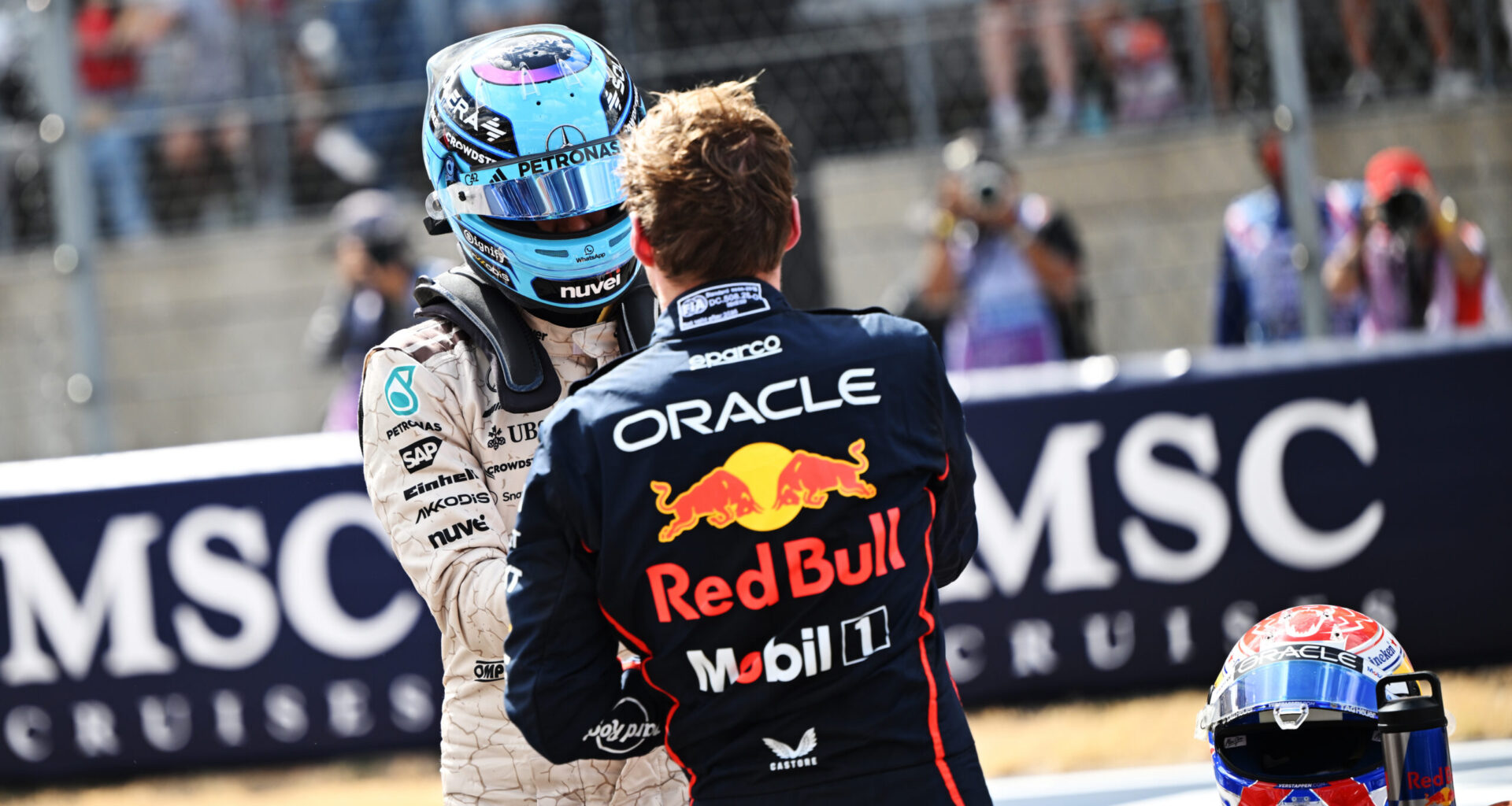
Within a few weeks of the 2025 season’s conclusion, a significant controversy has emerged ahead of 2026. As has often been in recent decades, Mercedes and Red Bull are the talk of the town.
Both teams have been under scrutiny for developing a solution to increase their engine compression ratio above the 16:0 limit.
This ratio is measured when the cars are stationary in the garage at normal temperatures. Mercedes and Red Bull, however, have been successful in increasing their compression ratios (generating more horsepower) when the engines are on track at higher temperatures.
Critically, this trick does not prevent the power units from passing the required static tests. It is understood that, despite queries from other manufacturers, the FIA have no problem with this approach.
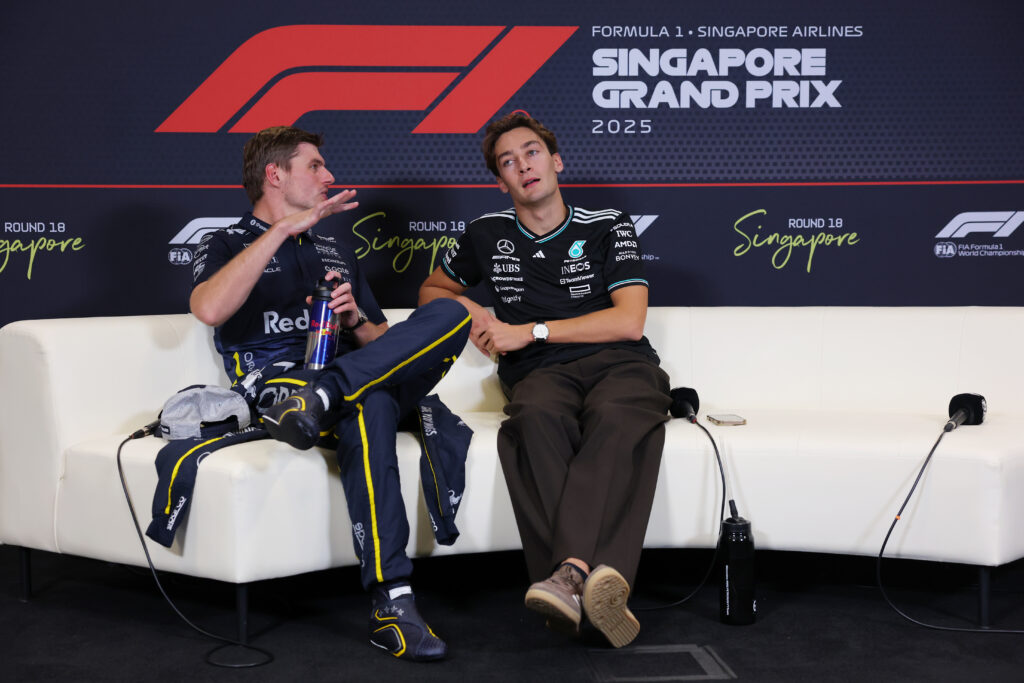 George Russell and Max Verstappen in Singapore. (Photo by Clive Rose/Getty Images) // Getty Images / Red Bull Content Pool
Mercedes and Red Bull given the green light
Pushing to the limits, both on and on track, is an ever-present aspect of Formula 1. With that said, teams are especially willing to take risks during the beginning of a regulatory cycle.
Engineers are constantly working to capitalise on grey areas and develop innovations that others have overlooked. In short, this is what Mercedes and Red Bull look to have achieved with the compression ratios of their engines.
To summarise this creative approach, these manufacturers have found a way to increase compression ratio beyond the 16:0 limit. This is significant because a higher compression ratio can generate more horsepower.
During stationary tests, Mercedes and Red Bull – like other manufacturers – will be within the 16:0 limit. However, thanks to the thermal expansion of specific components, a higher ratio can be achieved whilst on track.
This is comparable to the ‘flexi-wing’ saga from earlier this season, where the wings complied with the regulations under static checks but could move on track due to aerodynamic load.
Over the past few days, this issue has surfaced as a major talking point. The other three engine manufacturers (Ferrari, Honda and Audi) even wrote to the FIA for clarification on this topic.
However, according to it.motorsport, the FIA have confirmed the legality of this controversial solution. Of course, this is predicated on passing the established tests and checks carried out at room temperature in the garage.
In some respects, this verdict is not a massive surprise. Mercedes have been in active dialogue with the federation to ensure their trick is within the rules.
Whilst other teams might persist on this topic, the FIA were never likely to U-turn on an idea that Mercedes worked to clarify before pursuing with their development.
 Toto Wolff, George Russell, 2025 Saudi Arabian Grand Prix – Richard Pardon
Still more to come
Mercedes have been the focus of this analysis because, based on the available information, they pioneered this solution. Red Bull, meanwhile, are understood to be a few steps behind in working on this idea.
The consensus is that Red Bull learned of this trick from one of the dozens of technicians they signed from Mercedes.
In any case, the next equation is how rivals respond. To some extent, there are limitations in how far this issue can be further probed or escalated.
On paper, it is possible that some teams could lodge an official protest to the stewards at round one in Australia.
Still, even in this scenario, it is difficult to envisage that six teams (four Mercedes-powered, two Red Bull-powered) will be penalised on the eve of the 2026 season. It must be stressed that Mercedes have been transparent in their dialogue with the FIA to ensure compliance with the regulations.
Although the specificities can be debated, this kind of creative interpretation of the rules is to be expected. Most of the grid, if not the entirety, will bring certain components throughout 2026 that at least push the limits of the regulations.
It is also unknown how much of an advantage Mercedes and Red Bull will gain from this approach. Moreover, though spending is far from unlimited, power unit development will be prevalent throughout 2026.
This means other manufacturers can replicate this idea over time, should they deem it worth expending resources on. Despite this verdict, there is still everything to play for on the engine front.
It would be presumptive to assume that none of the other manufacturers will have tricks up their sleeves.
Of course, the likes of Ferrari and Honda might be frustrated at the outcome of this saga. However, this is just the first battle in what will be an extremely intense few years – both on and off track.
READ MORE: Pierre Gasly – 2026 Mercedes engine “in a great place”
Main photo: Simon Galloway/LAT Images (Red Bull Content Pool)