
Photo: A24/Everett Collection
Warning: Spoilers ahead for the plot and ending of Marty Supreme.
All throughout Marty Supreme, things happen that are hard to believe. Here’s an incomplete list of Marty Mauser’s (Timothée Chalamet) high jinks: sleeping with movie star Kay Stone (Gwyneth Paltrow), falling through the floor of his motel room in a bathtub and not being injured at all, blowing up a gas station and seemingly killing a bunch of people. Marty gets away with basically everything — theft, manslaughter, international incident — with a flippant “I love you” and a hasty retreat. But nothing in Josh Safdie’s new film is as far-fetched as its final minutes, which ask us to believe that Marty would, at the sight of his newborn child, turn into a blubbering mess of emotional overflow. This guy? The movie never gestures at Marty having enough emotional interiority to be moved by suddenly becoming a father. The film’s conclusion is as much of a cop-out as Marty’s own exits.
Much of Marty Supreme plays out like a critique of American exceptionalism, powered by Chalamet’s most bombastic performance yet. Chalamet plays Marty as Icarus, burning brighter and faster as he chases his dream of being the best Ping-Pong player in the world; practically no one else is convinced of his fated success except for him. As Marty schemes to make his way to the British Championship, he’s an avatar of everything wrong with the American belief that we’re somehow inherently better than anyone else and therefore can do whatever we want — he steals money from his relatives, spends money he doesn’t have because he believes he deserves a luxury-hotel stay, throws temper tantrums during matches he’s losing, and insults the table-tennis federation’s representatives. He’s a typical Safdie protagonist in that he makes reckless, selfish choices that negatively affect other people and has no regrets about them whatsoever. He has no filter, and no limits, and he bounces back from every obstacle like the Ping-Pong ball he paints orange and tries to sell to fund his journey.
This all feels completely detached from how filmmaker Josh Safdie has been describing Marty Supreme, and how it’s been marketed, as a movie dedicated to dreamers. Safdie seems to see himself in Marty; in an interview with GQ, he describes the difficulty of making Uncut Gems in a way that evokes the character: “And when someone doesn’t take your dream seriously, it makes you believe in it a lot harder because every moment that you aren’t being believed in, every moment that that dream isn’t being realized, there’s an urgency. The dream is deflating and the dream could die. So every moment becomes a do-or-die with that dream and you have to get as many people to believe in it as possible.” That’s exactly what Marty does as he hustles, double-crosses, and debases himself to make it to Japan to take on table-tennis champion Endo (Koto Kawaguchi) in a rematch. He runs from the cops, gets shot at by people he owes money to, and is publicly spanked by Kay’s millionaire husband, ink entrepreneur Milton Rockwell (Kevin O’Leary). Every scene is another challenge for Marty to bust through like the Kool-Aid Man, and Safdie intends for us to marvel at the intensity of his dream and the purity of his ambition.
The issue with Marty Supreme isn’t that it’s about a protagonist who is probably a bad person. It’s that the film never slows down long enough to suggest that Marty has the ability to reflect on anything. Without that, how can we believe that Marty would ever look upon someone other than himself and feel anything at all?
Even Rachel (Odessa A’zion), Marty’s neighbor who has been in love with him her whole life, rarely registers as a blip in his priorities. Marty has a tendency to casually tell people he loves them after they do something for him, but when Rachel says it back to Marty, she means it; she’s been besotted with him forever. She sticks by him even after he gets her pregnant and denies being the father, and even after he suggests she give the baby up for adoption. Rachel is presented simultaneously as Marty’s tether to his “real” life and the person whose admiration buoys him most, but that relationship is so lopsided — so weighted toward Rachel’s endless defense of Marty and her willingness to do whatever for him, including hitting someone with her car and setting up a bizarre ransom plot — that Marty’s affection always feels explicitly dependent on her belief in him rather than any genuine interest he has in her. That’s all part of what makes the film’s finale feel so inauthentic to the character we’ve spent two hours with and so frustratingly redemptive.
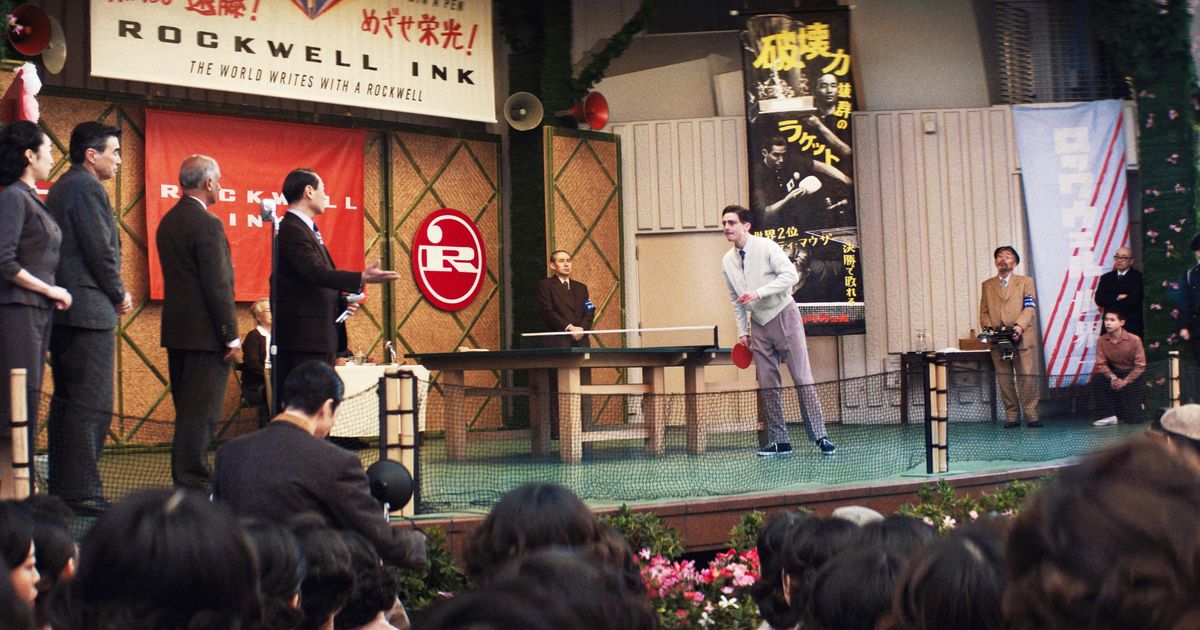
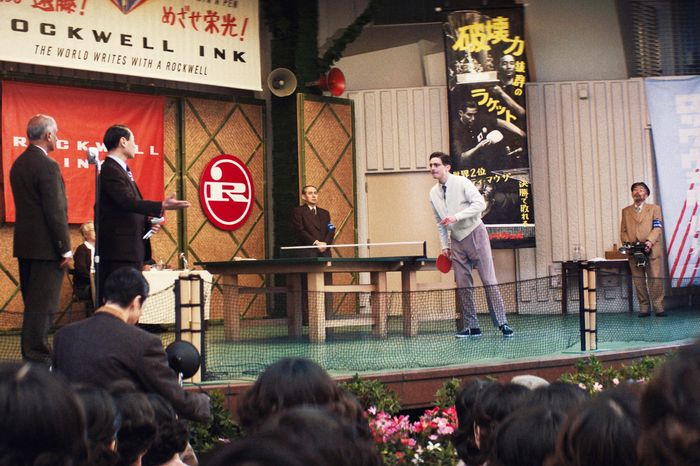
The scene plays out like this. Marty gets to Japan on Rockwell’s dime by agreeing to play an exhibition match against Endo, but when he learns that the table-tennis federation is sticking to its decision to ban him and won’t let him play in the next championship, he realizes that the friendly game against Endo is the only way to regain his pride. So through some bluster and bravado, he goads Endo into playing a real match against him and wins, of course, to the shock of the Japanese crowd and the delight of the spectating American soldiers. After flying back to the U.S., Marty then goes straight to the hospital, where Rachel has had their baby. He announces himself as “the father,” suddenly embracing a role he had previously rejected; goes to Rachel’s bedside, kissing her and telling her he’ll never leave her again; and then he goes to see their baby. In what’s meant to be an emotionally climactic finale, Safdie frames Marty’s meeting of the child with a close-up on Chalamet’s face, which immediately bursts into tears once he makes eye contact with his child. The camera looks up at Chalamet’s face as if from the newborn’s perspective, and Safdie holds the shot for so long as if to convince us of Marty’s own rebirth. Here is Marty taking responsibility, the film seems to be saying, and from this moment on he is going to change. When I saw the film with an audience, I heard multiple people describe this as a happy ending. But the arrival of a baby Marty didn’t want isn’t enough to realign the priorities of a narcissist, nor does it redeem all the solipsistic things he did before abruptly deciding he wants to be a father after all — who’s to say Marty doesn’t see this child as just an extension of himself and cares about it only as further self-obsession?
Curiously, Josh isn’t the only Safdie brother who has portrayed the arrival of a child as inherent validation of a person who hasn’t done any work to make themself better. Benny Safdie resolved his Showtime series, The Curse, the same way. In The Curse, Emma Stone plays Whitney, an HGTV host who has made her name via allegedly eco-sustainable “passive” houses that are actually ugly gentrified blights on lower-income neighborhoods. She’s petty, pushy, and driven to be famous; she treats her dopey husband, Asher (played by series co-creator Nathan Fielder), like a sycophantic pet, not unlike how Marty treats Rachel. After nearly an entire season of them both being terrible, selfish people, Whitney gives birth to her and Asher’s first child in the series finale. The moment that she sees her son, she’s beatific, proud, awed, overwhelmed — and, The Curse suggests, ready to abandon her old ways and devote her life to her child. The Curse lingers on her smile as if to recognize her as an improved person, and it’s a mirror of the way Marty Supreme depicts Marty as he holds his own newborn. Both endings suggest that a baby will force these people to change their ways for the better. That kind of fantasy of redemption left my eyes, unlike Marty’s or Whitney’s, drier than dry.