
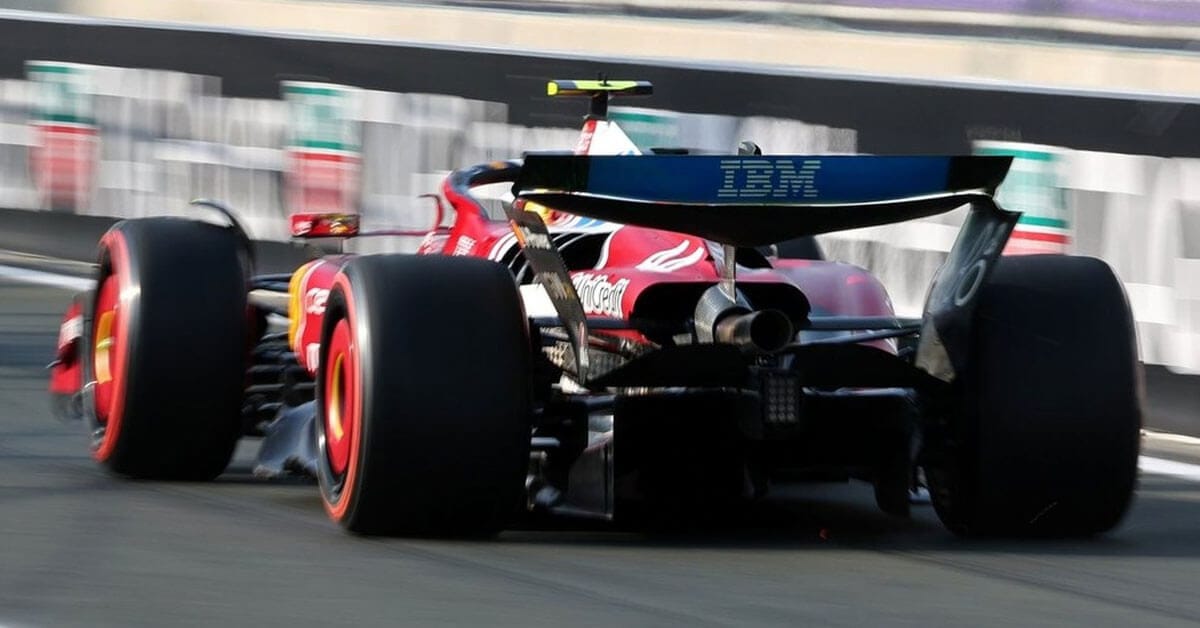
The Ferrari 2026 engine is now under close observation: is there a technical issue that could force the Maranello team to redesign the power unit for next season? The Ferrari 2026 engine project appeared ready to enter its decisive phase, but an unresolved regulatory interpretation now threatens to slow development and place the Scuderia at a technical disadvantage at the most delicate moment of the new era. This technical issue could jeopardize everything.Work on the Ferrari 2026 power unit had been planned well in advance and based on clearly defined parameters. However, in recent weeks, an unexpected scenario has begun to complicate Maranello’s plans. At the center of the issue is a technical aspect that appears clear on paper, but is far more complex in its practical application—an aspect the FIA is still analyzing and that could affect the performance of the new power units, at least during the first part of the season.
The matter concerns the geometric compression ratio, a parameter regulated in a very precise manner by the technical directives, but which contains a gray area linked to verification methods. This very uncertainty has opened the door to different solutions among manufacturers, with Ferrari closely monitoring developments at Mercedes and Red Bull, concerned about being forced into a chasing position.
Power unit 2026: the overall technical picture
To fully understand the problem, it is necessary to look at the technical details. The geometric compression ratio represents the relationship between the maximum and minimum volume inside the cylinder. These values are determined by the position of the piston between bottom dead center and top dead center. The 2026 regulations, through Article C5.4.3, establish that this ratio must be fixed at 16:1.
In practical terms, the air-fuel mixture is compressed into a space sixteen times smaller than its initial volume, a condition that brings the mixture very close to the limit of auto-ignition. This is a fundamental parameter in determining engine efficiency, combustion stability, and overall performance.
The critical point arises from the verification method adopted by the FIA, which checks compliance with the compression ratio with the engine switched off. This approach, however, does not take into account the changes that occur when the power unit is running and reaches high operating temperatures. This is where Mercedes and Red Bull come into play. Both are accused of exploiting the thermal expansion of metallic components to gain a performance advantage.
In this scenario, several elements could contribute to improving engine efficiency, with a theoretical gain of around two percent. In a tightly regulated environment like Formula 1, such an advantage could prove extremely significant.
Ferrari’s moves and the worst-case scenario
Ferrari has already opened discussions with the FIA, requesting official clarification on the legitimacy of these solutions. In recent hours, dialogue has intensified between engine manufacturers and the Power Unit Advisory Committee, which has been tasked with determining whether it is necessary to intervene with a more restrictive technical directive.

The Scuderia’s objective is to avoid having to redesign part of the engine, as this would be a complex and time-consuming operation, requiring months of simulations, new design work, testing, and production. According to FUnoAnalisiTecnica, it would not simply mean modifying a single component, but rather rebalancing the entire mechanical system.
If the Federation were not to intervene, Ferrari would risk being forced into a recovery phase until mid-season, compromising a significant portion of the championship. This is a scenario that Maranello is eager to avoid, hoping that the regulations will be clarified before the stopwatch begins to dictate verdicts that would be difficult to overturn.